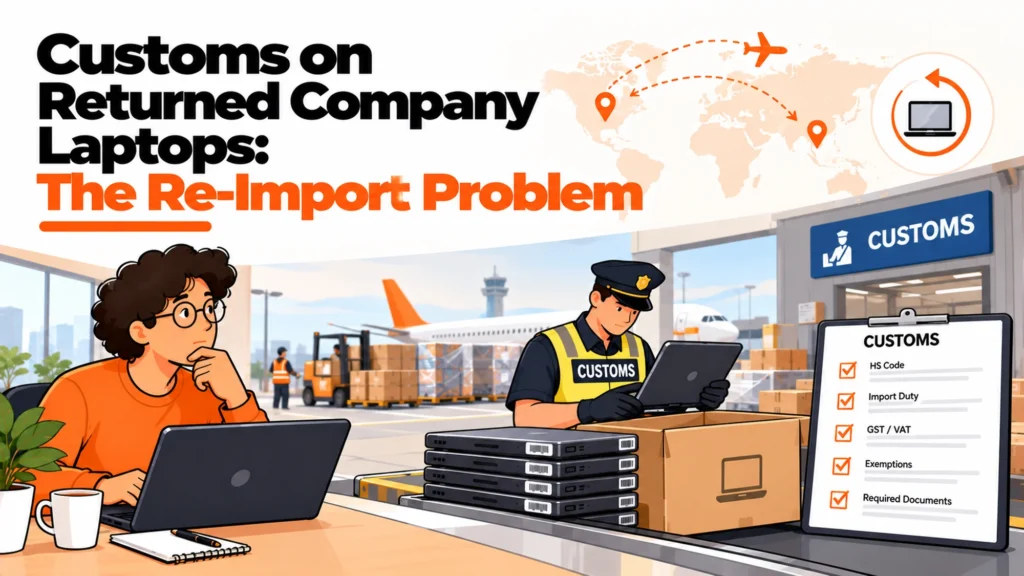
Customs on returned company laptops catches teams out because a return is not a reverse export. The machine is an import into the receiving country, and the fact that you sent it out originally is something you must evidence. For most ageing laptops, keeping the device in country is cheaper than proving any of this.
TL;DR
- A return is an import, whatever your internal paperwork calls it.
- Relief for returning goods usually exists and usually has conditions.
- Declare a defensible used value, never the purchase price or a token figure.
- The former employee cannot and should not prepare the declaration.
- Wiping does not help with customs, but it limits the damage if a shipment is opened.
- For a two-year-old machine the return often costs more than the laptop.
When not to ship it at all
This section is first because it resolves most cases.
Reissue locally. You hire in that market again. Wipe and hand it to the next person. No border, no declaration, no duty question.
Sell locally. The machine is past your spec but has value. A local sale recovers something and avoids the whole subject.
Dispose locally. End of life. Moving used electronics across borders can engage international controls under the Basel Convention, so disposal near the device is simpler and usually cheaper.
Actually ship it. Reserve this for high residual value, specialist hardware, or a device needed for a security or legal examination. That last case is the only one where cost should not decide.
Why customs on returned company laptops works differently
Sending a new laptop out is familiar. There is an invoice, a clear value and a supplier who does this daily.
The return inverts the parts that make that easy. The goods are used, so the value is a judgement you have to defend. The sender is a private individual rather than a business with an account. And the shipment is an import into wherever it lands, which means the receiving country’s rules govern, not yours.
Most jurisdictions have some concept of relief for goods that are coming back rather than arriving for the first time. In the United Kingdom that sits within the wider framework His Majesty’s Government publishes for businesses handling equipment, and in India the relevant authority is the Central Board of Indirect Taxes and Customs. We are not going to tell you whether you qualify, because that turns on timing, evidence, ownership and the specific route. It is a question for a broker in the receiving country.
What is worth internalising is the shape of the problem. Relief generally exists, generally has conditions, and generally requires you to prove the goods left in the first place. Teams that assume it applies automatically are the ones who get the bill.
What to have ready before anything moves
- Evidence of original export. The outbound paperwork, if you still have it. Many companies do not, which is itself a reason to decide locally.
- Serial number. Ties the returning device to the one you sent. Without it the link is an assertion.
- A documented used value. Write down the method, whether that is depreciation schedule or market comparison. The number matters less than being able to explain it.
- A clear statement of purpose. That the goods are returning to their origin rather than being sold.
- A named party for the declaration. Broker, vendor or your own team. Decide before booking, not after a hold.
- A wipe record. Not a customs requirement, but if a parcel is opened and examined you want the machine to be carrying nothing sensitive. The usual reference is NIST Special Publication 800-88.
Five questions before you book
What is the machine actually worth today? Compare honestly against the all-in return cost including broker time. This ends most discussions.
Do you have the original export evidence? If not, any relief claim is harder and you should expect to pay.
Who is declaring, and are they instructed? An unbooked broker is the commonest cause of a parcel sitting still.
Will you hire in that market again? If yes, reissuing locally is almost always the better answer.
Is anyone waiting for this specific device? If not, speed is irrelevant and the cheapest route wins.
Who handles this, and where each one struggles
Named honestly, including the one we have an interest in.
A customs broker directly. Best for the declaration itself and for relief claims, which is genuinely specialist work. They struggle on everything physical: no collection, no packaging, no wiping.
International couriers. Best for transport and simple declarations. They struggle on relief for returned goods, which often falls outside a standard service and gets handled as an ordinary import.
Equipment lifecycle platforms such as Firstbase, Workwize, GroWrk and allwhere. Best because the collection and the paperwork sit with one party. They struggle on clarity about which markets they handle directly, and that is exactly where customs competence varies most.
Your own logistics team. Best if you already ship goods commercially and have broker relationships. They struggle when the shipment starts at a residential address, which is a different operation from a warehouse.
RemoAsset. Disclosure: RemoAsset is owned by the same people who publish this site. It handles collection, wiping, storage and reassignment across 80 or more countries, and the relevant point here is that local reissue removes the customs question entirely rather than solving it. Where it struggles: it is not a customs broker, so a genuine relief claim on a high-value return is still specialist work you should buy separately. Check what the retrieval service covers in your markets before assuming a return has to cross a border at all.
The decision table
| Situation | Scale | Setup | Primary pain | Recommended starting point |
|---|---|---|---|---|
| Hiring again in that market | Any | Any | None once you decide | Wipe and reissue locally |
| Ageing machine, no rehire planned | Any | No local entity | Return costs exceed value | Local sale or disposal |
| High residual value | Any | Logistics function | Duty and relief evidence | Broker in the receiving country |
| No original export paperwork | Any | Any | Relief hard to evidence | Price the return assuming no relief |
| Security or legal examination | Any | Compliance owner | The device itself is needed | Ship with full custody record |
| Several returns from one market | 150 plus | Small IT team | Repeating the same work | Consolidate, or stop shipping entirely |
What a held shipment costs
A parcel stopped at a border is not a delay in the normal sense. Storage charges accrue daily, somebody has to find documents nobody saved, and the person who booked it has moved on to other work.
The second cost is the decision that follows. Teams facing a hold and an unexpected bill frequently abandon the shipment, which means paying the collection, the transport and the storage and receiving nothing. That is the worst available outcome and it is reached by small steps rather than one bad choice.
The third is the precedent. One painful return teaches an organisation that cross-border returns are impossible, and machines then quietly stay with former employees because nobody wants to repeat the experience. The real lesson was narrower: that particular return should never have been shipped.
So the question is not how to get a laptop through customs. It is whether this specific machine is worth more than the cost and risk of moving it, and that answer is usually no.
When cross-border returns stop making sense
There is a point where shipping machines home is a habit rather than a decision, and it is worth noticing.
Three signals suggest you have reached it. Returns routinely cost more than the devices are worth. Nobody can find original export paperwork for anything. And the machines that do arrive sit unissued because they no longer match your current spec.
The alternative is not giving up on recovery. It is recovering locally: collect in the country, wipe in the country, then reissue or sell there. The device stops being an asset you have to repatriate and becomes stock in a market where you keep hiring.
That only works if you have a way to hold and reissue machines where your people actually are, which is the real question behind the customs one. Seeing how storage and reassignment work across markets answers it faster than another conversation with a broker.
Related reading
- Import duty on laptops
- Shipping laptops internationally
- Shipping a laptop to India
- Laptop buyback, and what drives the quote
- Where to sell retired laptops
Frequently Asked Questions
Why is a returning laptop treated differently?
Because customs looks at goods crossing a border, not at your intentions. A laptop coming back is an import into the receiving country regardless of who originally owned it. The fact that you sent it out two years ago is something you have to demonstrate, not something the system already knows.
Will we pay duty twice?
Potentially, and avoiding it usually depends on relief schemes for goods being returned, which have conditions about timing and evidence. Whether you qualify is a question for a broker in the receiving country. Assuming relief applies automatically is the mistake that generates unexpected bills.
What value should be declared?
A defensible used value, not the original purchase price and not a token amount. Declaring near zero to reduce duty invites scrutiny and can delay the shipment far longer than the duty was worth. Document how you arrived at the figure before anybody asks.
Who should prepare the paperwork?
A broker, your vendor or your own logistics function. Never the former employee. They have no access to purchase records, no authority to declare on the company’s behalf, and no reason to spend an afternoon on it. Plans that rely on them stall.
Is it ever cheaper to abandon the laptop?
Abandoning is the wrong word, but keeping it in country frequently is cheaper. Wipe it, then reissue or sell locally. For a machine two or more years old the all-in cost of a cross-border return often exceeds what the device is worth, so shipping it is a loss you chose.
Does a wiped laptop clear customs more easily?
Wiping is about data rather than customs, so it does not change the classification. It matters for a different reason: if a shipment is held and inspected, a machine with no company data on it is a much smaller problem than one still carrying customer records.
What should we prepare before shipping?
Proof of original export where you have it, the serial number, a documented used value, a clear statement that the goods are returning, and a named party handling the declaration. Missing any one of those is the usual reason a return sits in a warehouse for weeks.