Tools Roundup · 2026

10 Best Laptop Procurement Platforms in 2026

End-to-end platforms to buy, ship, manage, and retrieve laptops for distributed and remote-first teams.

Transparency note: some links in this guide are partner links and may earn PeopleOpsHQ a commission at no extra cost to you. We only feature tools we have researched against a consistent set of criteria. See our editorial policy.

Why Trust Us

You can trust our software reviews

01 - Research

Independent research

Every platform is evaluated against a consistent rubric covering coverage, feature depth, pricing transparency, and integrations - no pay-to-play rankings.

02 - Practitioners

Real practitioner input

Reviews draw on first-hand experience from IT and People Ops leaders running distributed teams in 2026 - not vendor marketing claims.

03 - Disclosure

Transparent methodology

We disclose every commercial relationship and link to our editorial policy so you can see how recommendations are made.

Overview

About Laptop Procurement Platforms

Laptop procurement for distributed teams isn't just buying hardware - it's OEM sourcing, cross-border shipping, customs, MDM enrollment, and eventual retrieval.

We evaluated the top 10 platforms on global coverage, device catalog depth, MDM integrations, retrieval workflows, and pricing transparency.

Side by Side

Laptop Procurement Platforms comparison chart

Starting prices reflect entry-tier plans published by each vendor as of 2026. Most platforms scale by device or user and offer volume discounts - always confirm a live quote for your team size.

Tool Best for Free trial / tier Starting price Platforms
RemoAsset global teams that want to buy, rent, or lease laptops and have them delivered, MDM-enrolled, and retrieved end-to-end Demo only Quote-based Web app · global delivery & retrieval
Deel IT (Hofy) global laptop deployment tied to payroll and EOR Demo only Quote-based Web app + global logistics in 130+ countries
Workwize IT-led teams wanting transparent global equipment ops Demo only Quote-based Web app + regional warehouses worldwide
allwhere US-headquartered companies hiring globally Demo only Quote-based Web app + global warehouse network
Fleet European teams wanting laptop-as-a-service Demo only From €37.50/workstation/month Web app + EU/US logistics network
GroWrk global IT logistics in emerging markets Demo only Quote-based Web app + emerging-market logistics
Firstbase full remote-workstation equipment programs Demo only Quote-based Web app + global logistics network
Rippling IT HR-IT-payroll consolidation on one platform Demo only Quote-based (module add-on) Web app + integrated logistics partners
Electric SMB IT outsourcing with hardware procurement Demo only Quote-based, per-seat subscription Web app + US-focused logistics
Multiplier global EOR-led teams wanting IT equipment lifecycle bundled with hiring Demo + 30-day Quote-based Web · 150+ countries

In Depth

The 10 best laptop procurement platforms tools, reviewed

Full write-ups for every shortlisted platform - what it does well, where it struggles, and who should buy it.
RemoAsset homepage screenshot
01

RemoAsset

Best for global teams that want to buy, rent, or lease laptops and have them delivered, MDM-enrolled, and retrieved end-to-end
★★★★½ 4.8

Why I Picked RemoAsset

Global laptop procurement and retrieval, handled end-to-end - buy, rent, lease, deliver, and recover laptops across countries from one platform.

RemoAsset positions itself as end-to-end global laptop lifecycle management: buy, rent, or lease devices, have them delivered and MDM-enrolled for new hires, manage and maintain them in life, then retrieve, store, or wipe them at offboarding - across countries, without coordinating multiple vendors and couriers. For distributed and remote-first teams it consolidates procurement, deployment, management, and recovery into a single platform.

Who Is RemoAsset Best For?

Laptop procurement for hybrid and remote teams - laptop tracking + light procurement in one platform

Sweet spot: Distributed companies 20-500 employees

Try it if you: You want one platform to buy, deliver, manage, and recover laptops globally

  • Distributed startups 20-200 ppl: Companies that need asset visibility but aren't at enterprise ITAM scale yet.
  • Companies consolidating tools: Teams that want one platform for asset tracking + procurement requests instead of separate tools.
  • US/EU-focused distributed teams: Teams where global logistics is handled separately and procurement focus is workflow, not country coverage.

RemoAsset Key Features

  • Buy, rent, or lease laptops for your global workforce
  • Cross-border delivery to employees in multiple countries
  • Automatic MDM enrollment on delivery for new hires
  • Real-time, automated asset tracking across all devices
  • End-of-life retrieval, secure storage, and data wiping

Pros and Cons

Pros

  • Covers the entire lifecycle - procurement, delivery, management, retrieval
  • Flexible buy / rent / lease options per device
  • Global delivery and recovery without managing vendors or logistics yourself

Cons

  • Pricing is quote-based (demo required)
  • Newer platform with a smaller footprint than legacy global resellers
Starting price Quote-based Free demo
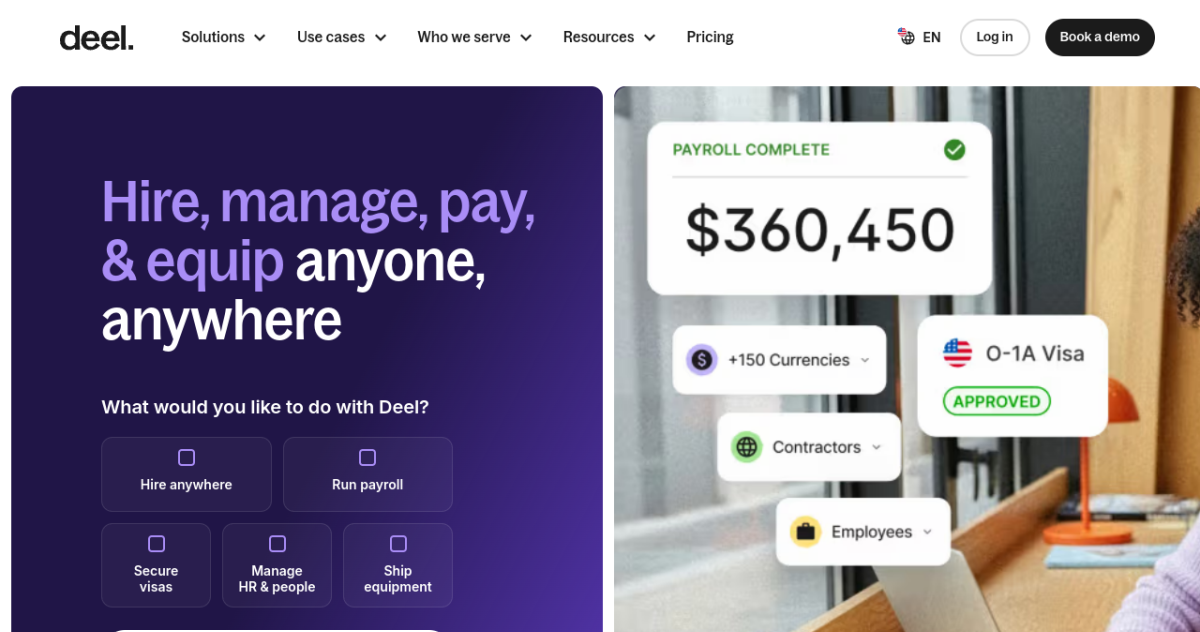
Deel IT (Hofy) homepage screenshot
02

Deel IT (Hofy)

Best for global laptop deployment tied to payroll and EOR
★★★★½ 4.7

Why I Picked Deel IT (Hofy)

Procure, deploy, and retrieve laptops in 130+ countries - wired into Deel HR, payroll, and EOR.

Deel IT is what Hofy became after Deel acquired it in July 2024. The result is the most complete global equipment platform on the market, with deep coverage in 130+ countries and a native trigger from Deel HR and Deel EOR - the moment you create a new hire, a laptop dispatch can fire automatically.

Who Is Deel IT (Hofy) Best For?

Companies already on Deel HR/EOR

Sweet spot: 200 - 5,000 globally distributed employees

Try it if you: You're standardizing HR + IT on Deel

  • Deel HR/EOR customers: Already running payroll, contracts, and EOR through Deel, and want laptops to share the same employee data and trigger workflow.
  • Globally distributed scaleups: Hiring across 20+ countries where in-country sourcing and customs handling avoid the cross-border courier tax.
  • Series C+ companies: Past 200 employees, with finance and IT looking to consolidate vendor count and have one invoice per region.
  • Compliance-driven buyers: Need wipe certificates, audit trail, and importer-of-record paperwork for SOC 2 / ISO 27001 / GDPR.

Deel IT (Hofy) Key Features

  • Buy, rent, or lease laptops across 130+ countries
  • Automated provisioning triggered from Deel HR/EOR onboarding
  • Native MDM (Jamf, Kandji, Intune) enrollment and zero-touch setup
  • In-country warehousing with retrieval, wipe, and resale at offboarding
  • Lifecycle dashboard with warranty, repairs, and asset history

Pros and Cons

Pros

  • Strongest global footprint of any procurement platform
  • Deep integration with Deel HR, payroll, and EOR
  • Buy, rent, or lease flexibility on the same catalog

Cons

  • Pricing is quote-only and skews enterprise
  • Most valuable if you're already on Deel
Starting price Quote-based Free demo
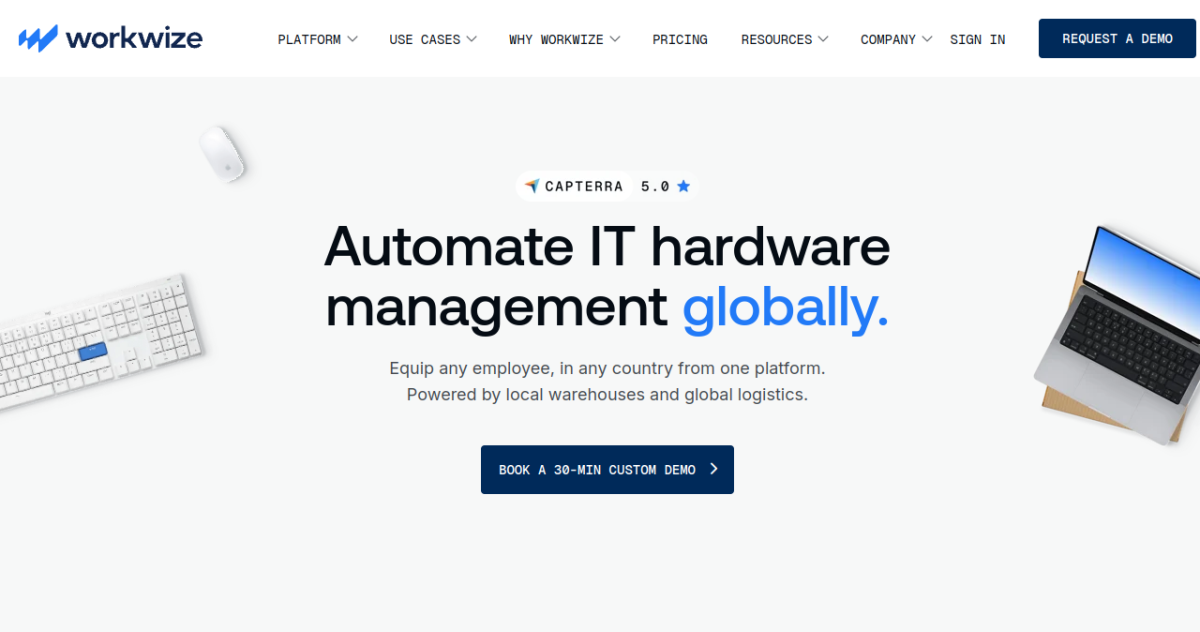
Workwize homepage screenshot
03

Workwize

Best for IT-led teams wanting transparent global equipment ops
★★★★½ 4.6

Why I Picked Workwize

Procure, deploy, store, and retrieve laptops globally - without the customs headaches.

Workwize is an Amsterdam-based equipment lifecycle platform that helps distributed companies buy, ship, configure, store, and retrieve laptops anywhere their employees happen to work. Founded in 2018, it sits in the same category as Hofy and allwhere but tends to win on transparent IT-led workflows and a clean admin console.

Who Is Workwize Best For?

Mid-market IT teams hiring globally

Sweet spot: 100 - 2,000 distributed employees

Try it if you: Hire across EU, US, APAC & LATAM

  • Mid-market IT teams: 100 - 2,000 employees, with one or two IT generalists who don't have time to manage OEM portals in 12 different countries.
  • Globally distributed companies: Hiring in EU, US, APAC, and LATAM where shipping a laptop from one warehouse to another country is a customs adventure.
  • Series B - D startups scaling fast: Headcount doubling year over year, no internal IT specialist for procurement, and a CFO who wants per-device unit economics.
  • Sustainability-minded buyers: Companies that want to extend laptop lifecycles via refurbishment and redeployment instead of buying new every offboarding.

Workwize Key Features

  • Global laptop catalog with local-stock warehousing in 100+ countries
  • Built-in MDM setup (Jamf, Kandji, Intune, Mosyle) at the point of shipment
  • Storage and re-deployment of returned devices in regional hubs
  • HRIS triggers from BambooHR, HiBob, Rippling, and Workday
  • Lifecycle reporting with TCO, warranty, and depreciation views

Pros and Cons

Pros

  • Truly global warehouse footprint, not just shipping
  • Strong IT/MDM focus rather than HR-only workflow
  • Self-serve employee portal for ordering and returns

Cons

  • Pricing is quote-only and scales with device count
  • Smaller catalog of peripherals than some competitors
Starting price Quote-based Free demo
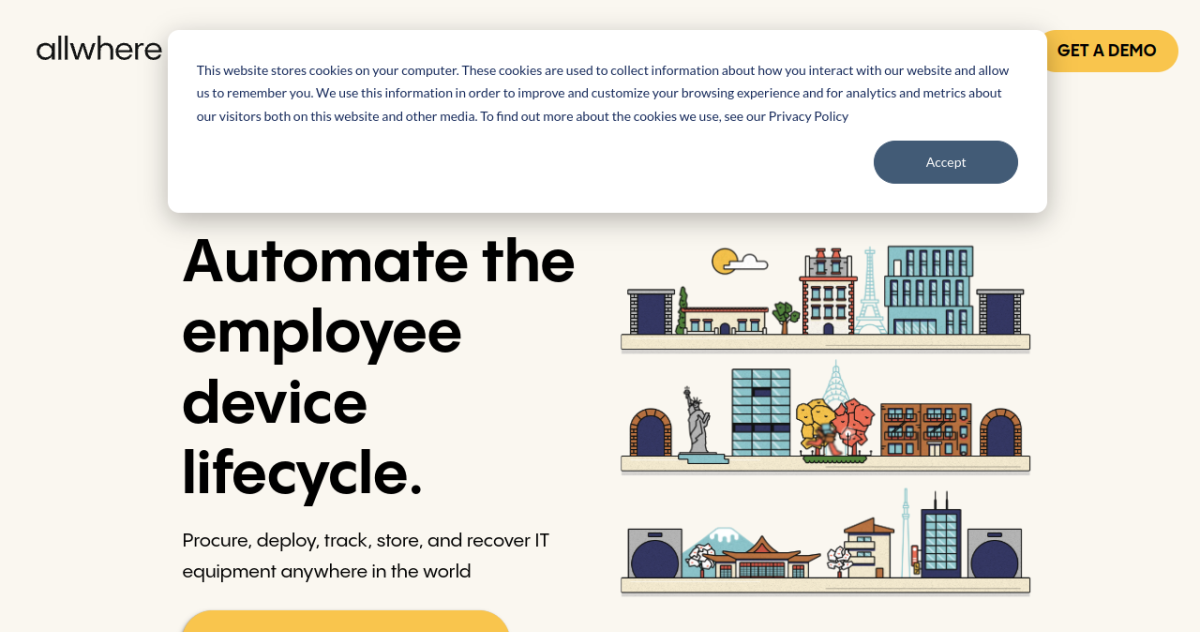
allwhere homepage screenshot
04

allwhere

Best for US-headquartered companies hiring globally
★★★★½ 4.6

Why I Picked allwhere

Procure, deploy, and retrieve global IT equipment with a US-led platform and built-in ITAM.

allwhere is a New York-headquartered equipment lifecycle platform that emerged in 2021 to give US-led companies a single console for global procurement, MDM enrollment, warehousing, and retrieval. It raised $9.5M seed in 2022 and has since built one of the cleaner UIs in the category, with a Series B-D customer base typical for US-headquartered fintech and SaaS scaleups.

Who Is allwhere Best For?

US-headquartered companies hiring globally

Sweet spot: 100 - 1,500 distributed employees

Try it if you: You're a US-led Series B - D scaling internationally

  • US-led Series B - D scaleups: Headquartered in the US, hiring internationally, with first 30 international hires in EU/Canada rather than emerging markets.
  • Mid-market IT teams: 100 - 1,500 employees with one or two IT generalists who want procurement and ITAM in one tool, not two.
  • Compliance-conscious buyers: Need wipe certificates and clean asset-register audit trail for SOC 2 / ISO 27001 evidence.
  • Companies replacing OEM portals: Already buy laptops through Dell, Lenovo, Apple Business Manager - want to consolidate without losing OEM warranty access.

allwhere Key Features

  • Global procurement and white-glove deployment in 100+ countries
  • Integrated ITAM (post-BlueTally) for asset tracking and audits
  • Warehousing, storage, and redeployment of returned devices
  • MDM enrollment (Jamf, Kandji, Intune) before shipment
  • Retrieval workflows with prepaid labels and wipe certificates

Pros and Cons

Pros

  • Combined procurement + ITAM after BlueTally acquisition
  • Strong US base with mature international shipping
  • Good fit for Series B-D companies scaling globally

Cons

  • Pricing is quote-only, not posted publicly
  • EU and APAC coverage is improving but uneven by country
Starting price Quote-based Free demo
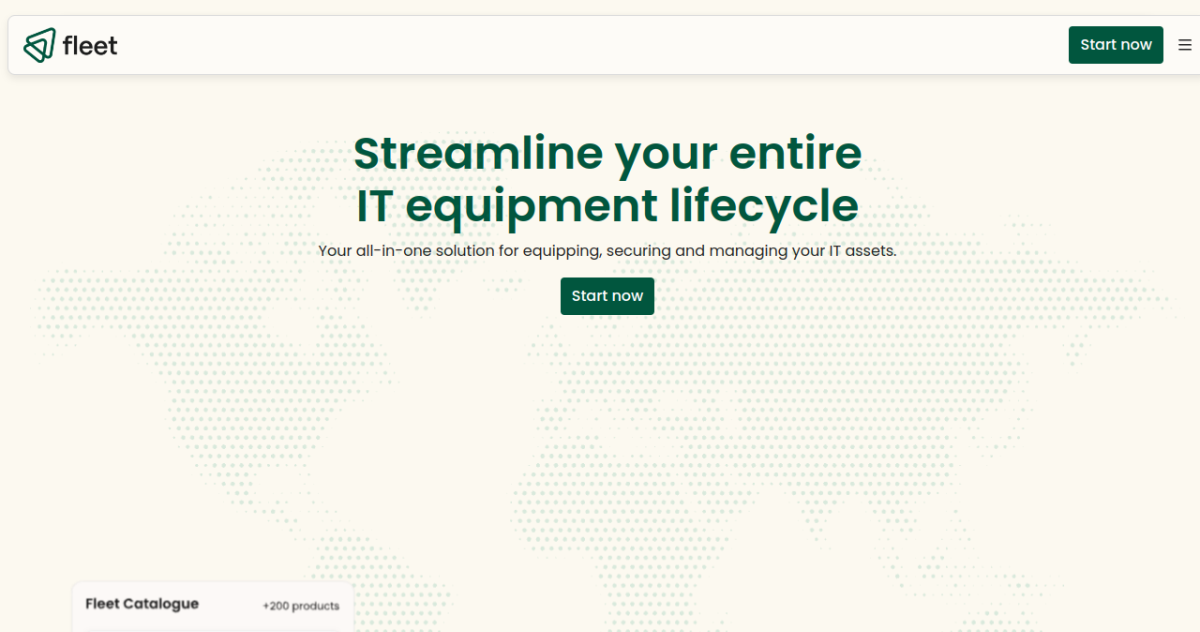
Fleet homepage screenshot
05

Fleet

Best for European teams wanting laptop-as-a-service
★★★★½ 4.6

Why I Picked Fleet

Subscription-priced laptop-as-a-service for European teams that want predictable opex.

Fleet is a Paris-based laptop subscription platform founded in 2019 that pioneered transparent pricing in a category dominated by quote-only contracts. Roughly €37.50 per workstation per month gets you the hardware, MDM enrollment, repairs, replacements, and an automated 3-year refresh - no down payment, no quote, no credit check dance.

Who Is Fleet Best For?

European startups wanting capex-free laptop fleets

Sweet spot: 20 - 500 employees in EU

Try it if you: You want opex predictability and refurbished options

  • European startups: 20 - 500 employees in EU, want laptop programs without capex, quote-only contracts, or credit checks.
  • Opex-preferred CFOs: Finance teams that want predictable per-employee per-month device cost on the income statement rather than capex with depreciation.
  • ESG-conscious buyers: Refurbished catalog and sustainability reporting are increasingly required for B Corp certification and corporate tenders.
  • SMBs without dedicated IT: Companies under 200 employees that want laptops, MDM, security, and password management as one subscription - no separate vendors.

Fleet Key Features

  • Laptop-as-a-service subscription with refurbished and new options
  • MDM and security tooling bundled with every device
  • Replacement and on-site support included in the monthly fee
  • Self-serve employee equipment portal
  • Sustainability reporting and refurbished-first catalog

Pros and Cons

Pros

  • Truly subscription-priced rather than quote-only
  • Refurbished options for sustainability-minded buyers
  • Strong EU coverage and French market depth

Cons

  • Subscription model can cost more than outright purchase long-term
  • Coverage outside EU/US is still expanding
Starting price From €37.50/workstation/month Indicative; config-dependent
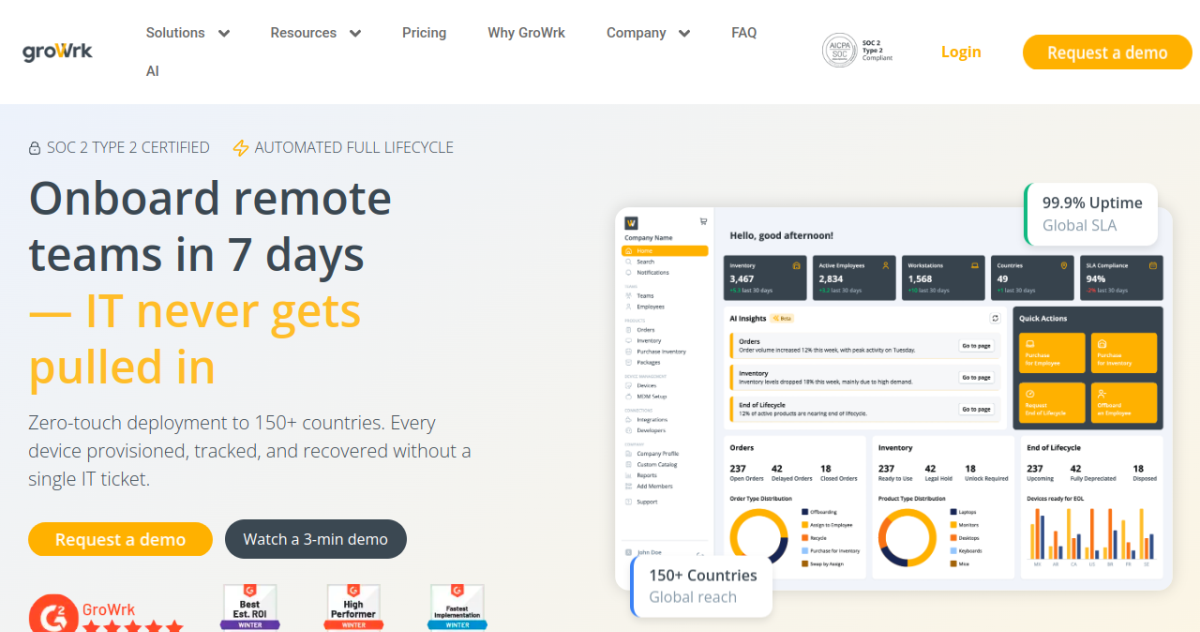
GroWrk homepage screenshot
06

GroWrk

Best for global IT logistics in emerging markets
★★★★½ 4.5

Why I Picked GroWrk

Global IT equipment deployment with the deepest LATAM and APAC coverage in the category.

GroWrk is a San Francisco and Mexico City-headquartered equipment platform founded in 2019 that specializes in the markets US-led platforms struggle with: LATAM, APAC, India, the Philippines, Nigeria, and other emerging markets where cross-border courier shipping and customs delays make every other option miserable.

Who Is GroWrk Best For?

Global teams hiring heavily in emerging markets

Sweet spot: 100 - 2,000 employees with LATAM/APAC concentration

Try it if you: You hire in Brazil, India, Indonesia, the Philippines, Nigeria

  • Globally distributed engineering teams: Companies with half the engineers in Brazil, India, the Philippines, or other emerging markets where customs handling is painful.
  • Latin America-focused scaleups: Headquartered in Latin America or with concentrated hiring there, where regional knowledge and warehousing beat US/EU alternatives.
  • APAC-heavy companies: Hiring in India, the Philippines, Indonesia, Vietnam - markets where Deel IT and allwhere have coverage gaps.
  • Cost-sensitive global hirers: Teams where the customs tax and cross-border shipping cost of a US-hub model materially affects per-device economics.

GroWrk Key Features

  • In-country procurement in 150+ countries to avoid customs
  • MDM enrollment and zero-touch provisioning
  • Storage, retrieval, and re-deployment from regional hubs
  • HRIS and onboarding integrations
  • Real-time tracking and lifecycle dashboard

Pros and Cons

Pros

  • Best-in-class coverage in LATAM and APAC
  • Local sourcing reduces customs delays and duties
  • Strong fit for globally distributed engineering teams

Cons

  • Pricing is quote-only
  • UX is functional but less polished than top competitors
Starting price Quote-based Free demo
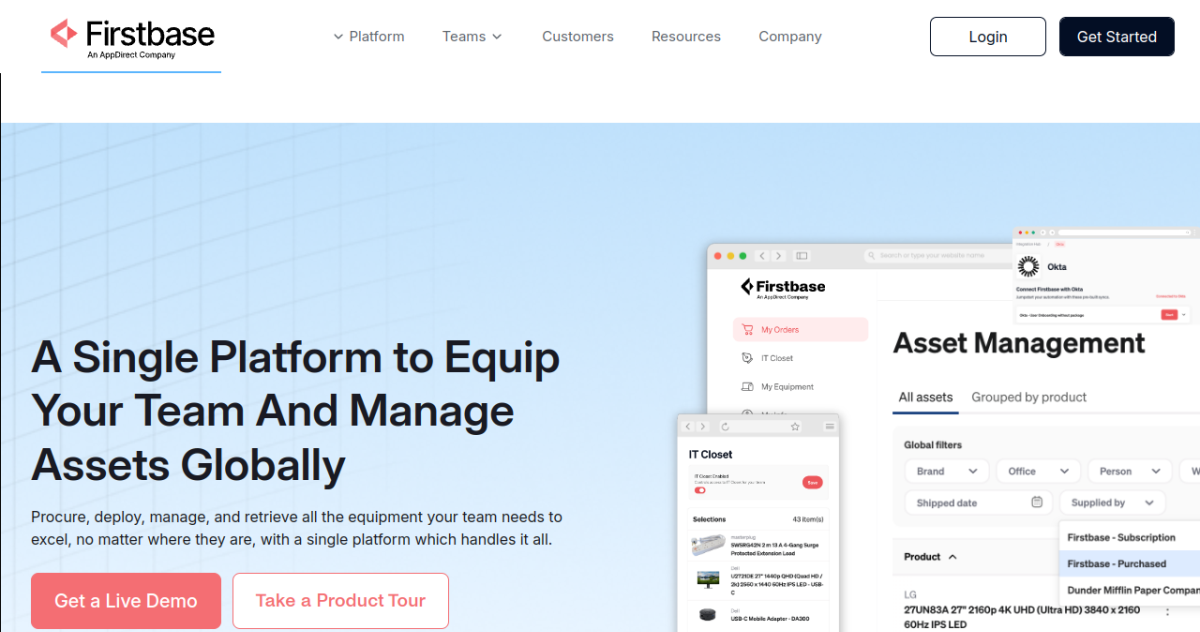
Firstbase homepage screenshot
07

Firstbase

Best for full remote-workstation equipment programs
★★★★½ 4.5

Why I Picked Firstbase

Ship full remote workstations - laptops, monitors, chairs, peripherals - to employees worldwide.

Firstbase is a New York-headquartered platform founded in 2019 that pioneered the 'remote workstation as a service' category. Where Workwize, Deel IT, and allwhere focus on laptops, Firstbase ships entire home-office setups - laptop, monitor, ergonomic chair, desk, keyboard, mouse, lamp - directly to employees with white-glove delivery in major markets.

Who Is Firstbase Best For?

Remote-first companies funding full home offices

Sweet spot: 50 - 1,500 distributed employees with home-office budget

Try it if you: Your equipment program covers full home offices, not just laptops

  • Remote-first scaleups: Series B-D companies with explicit remote-first culture and a real per-employee home-office budget ($2K-$5K).
  • Employee-experience-driven companies: Talent-focused organizations where new-hire experience and ergonomic quality are competitive differentiators.
  • Sustainability-conscious buyers: B Corps and ESG-reporting companies needing circular-economy and refurbishment data.
  • Companies with home-office stipends: Already spend $1,500-$3,000 per employee on home-office gear and want a curated, retrievable program instead of expense reimbursements.

Firstbase Key Features

  • Full home-office catalog: laptops, monitors, chairs, peripherals
  • Global shipping with white-glove delivery in major markets
  • Retrieval and refurbishment workflow on offboarding
  • Employee self-serve equipment requests with approval flows
  • HRIS integrations for automated provisioning

Pros and Cons

Pros

  • Broadest non-laptop equipment catalog in the space
  • Strong remote-first brand and employee experience
  • Good retrieval and reuse program

Cons

  • Pricing is quote-only and can be premium
  • Less IT/MDM-deep than pure equipment platforms
Starting price Quote-based Free demo
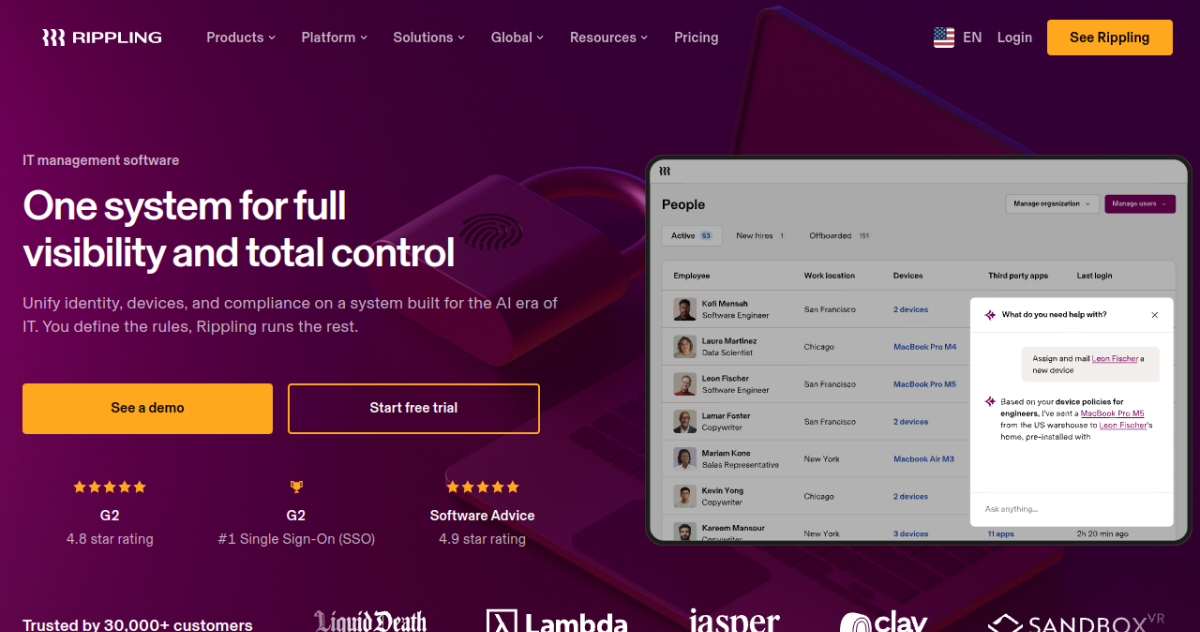
Rippling IT homepage screenshot
08

Rippling IT

Best for HR-IT-payroll consolidation on one platform
★★★★½ 4.5

Why I Picked Rippling IT

Order a laptop the moment you create the employee record - HR, IT, and finance on one platform.

Rippling IT extends Rippling's HRIS into device procurement, native MDM, identity, and SaaS app management - letting you order a laptop the moment you create the employee record in HR. Rippling was founded in 2016 by Zenefits' Parker Conrad; the IT module launched in 2021 and has expanded steadily to include native MDM for macOS, Windows, and iOS.

Who Is Rippling IT Best For?

Companies fully standardized on Rippling

Sweet spot: 50 - 1,000 employees with Rippling HRIS

Try it if you: You're already on Rippling for HR, payroll, and identity

  • Rippling-standardized companies: Already use Rippling for HR, payroll, identity, and apps - Rippling IT is the natural extension.
  • Mid-market SaaS scaleups: 50-1,000 employees, US-led, growing internationally with Western-market concentration.
  • Compliance-driven buyers: Need unified audit trail across HR and IT for SOC 2 / ISO 27001 - single platform reduces evidence collection effort.
  • Companies replacing Jamf or Intune: Already on Rippling and considering whether to maintain a separate MDM contract - Rippling IT can replace it.

Rippling IT Key Features

  • Order laptops from inside the Rippling employee workflow
  • Native MDM for macOS, Windows, and iOS
  • Inventory management and warehousing for returned devices
  • Identity, SSO, and app provisioning in one console
  • Global shipping coordinated with Rippling's logistics partners

Pros and Cons

Pros

  • Tight integration across HR, payroll, IT, and finance
  • Single source of truth for employee + device data
  • Strong native MDM included

Cons

  • Most valuable only if you're on Rippling end-to-end
  • Device pricing is quote-based on top of Rippling subscription
Starting price Quote-based (module add-on) Free demo
Electric homepage screenshot
09

Electric

Best for SMB IT outsourcing with hardware procurement
★★★★☆ 4.4

Why I Picked Electric

Managed IT helpdesk plus laptop procurement and MDM, bundled for SMBs without dedicated IT.

Electric (electric.ai) is a New York-headquartered managed IT services company founded in 2016 that operates as outsourced IT for sub-500-employee companies. The core product is a chat-based IT helpdesk staffed by Electric's own engineers, with hardware procurement, MDM, app management, and SOC 2 readiness bundled as additional services.

Who Is Electric Best For?

Sub-500 employee SMBs without a dedicated IT lead

Sweet spot: 20 - 500 employees, US-led

Try it if you: You'd hire an IT manager but you're not quite there yet

  • US SMBs without dedicated IT: 20-500 employees, no full-time IT manager, current IT handled by office manager or HR - Electric replaces the role.
  • Series A-B startups: Growing past 50 employees where DIY IT starts breaking but you're not ready to hire a CIO.
  • Compliance-driven SMBs: Need SOC 2 readiness for enterprise customer requirements but don't have the internal team to do it.
  • Companies between sizes: Too big for DIY IT, too small for an internal team - managed IT is the right scale for 50-300 employee range.

Electric Key Features

  • Managed IT helpdesk paired with device procurement
  • MDM, identity, and app management in one console
  • Inventory and warranty tracking across the device fleet
  • Onboarding/offboarding workflows tied to HRIS
  • US-focused logistics and warehousing

Pros and Cons

Pros

  • Combines managed IT and procurement under one vendor
  • Strong fit for SMBs without a dedicated IT team
  • Predictable subscription pricing per seat

Cons

  • Primarily US-focused; weaker for global deployments
  • Hardware sourcing is secondary, not the core product
Starting price Quote-based, per-seat subscription Free demo
Multiplier homepage screenshot
10

Multiplier

Best for global EOR-led teams wanting IT equipment lifecycle bundled with hiring
★★★★☆ 4.2

Why I Picked Multiplier

Global EOR with IT equipment lifecycle bundled - hire, pay, and equip international staff from one platform.

Multiplier is one of the fast-growing global EOR platforms, headquartered in Singapore and competing directly with Deel and Remote.com. The IT equipment lifecycle offering is part of the broader EOR/HR stack - when you hire someone via Multiplier EOR, you can also provision their laptop through the same workflow.

Who Is Multiplier Best For?

Companies hiring through EOR that want bundled HR + IT equipment from one vendor

Sweet spot: Global teams 20-500 ppl using EOR for international hiring

Try it if you: Already evaluating Deel/Remote for EOR and want IT equipment in the same deal

  • EOR-driven international hirers: Companies whose primary international hiring mechanism is EOR.
  • Companies consolidating HR vendors: Teams wanting fewer vendors across hiring, payroll, and IT equipment.
  • APAC-hiring distributed teams: Multiplier's Singapore roots produce strong APAC coverage and operational depth.

Multiplier Key Features

  • Global EOR + IT equipment in one platform
  • Coverage in 150+ countries
  • HRIS-triggered equipment procurement
  • Lease, buy, or refurbished device options
  • Bundled HR + payroll + benefits

Pros and Cons

Pros

  • Real EOR platform competing with Deel/Remote
  • IT equipment integrated with hiring workflow
  • Single vendor for global hiring + equipping

Cons

  • Smaller than Deel; less brand recognition
  • IT equipment less deep than dedicated procurement platforms
Starting price Quote-based Free demo + EOR pricing per employee

Our Methodology

How we picked these tools

We evaluate every laptop procurement platforms platform against the same five criteria, weighted toward what matters most to distributed teams.

1

Core laptop procurement platforms depth

The non-negotiables of laptop procurement platforms - judged on how reliably and granularly each tool delivers them.

2

Coverage & integrations

Breadth of OS, platform, or environment coverage and the depth of integrations with the rest of your stack.

3

Security & compliance

How much audit-readiness work the tool removes for frameworks like SOC 2 and ISO 27001, and how it handles BYOD privacy.

4

Deployment & ease of use

Time to value, quality of admin and end-user experience, and whether a lean team can run it without a dedicated specialist.

5

Pricing & value

Transparent, predictable pricing measured against the capability delivered - including free tiers and scaling with team size.

Questions & Answers

Laptop Procurement Platforms FAQ

A laptop procurement platform is a SaaS service that sits between your company and the global ecosystem of OEMs, refurbishers, warehouses, and couriers, letting IT and People Ops teams order configured laptops, ship them to employees anywhere, enroll them in MDM, track them through their lifecycle, and retrieve them at offboarding from a single console. The category overlaps with IT asset management (ITAM) and HRIS, but is specifically optimized for the buy-ship-manage-retrieve loop for distributed teams.

Most modern platforms offer all three. Buying makes sense when you have stable, long-tenured employees and want the lowest total cost of ownership over a 3-4 year horizon. Renting or laptop-as-a-service smooths cash flow into predictable opex and is helpful for fast-growing or seasonal teams, and bundles repairs and replacements. Leasing sits in the middle and is often used for tax or balance-sheet reasons. The right answer usually depends on geography, employee tenure, and whether you prize capex efficiency or opex predictability.

The strongest platforms maintain in-country warehousing in dozens or hundreds of countries so that devices ship domestically to the employee, avoiding customs delays, import duties, and VAT surprises. Lower-tier platforms cross-border-ship from a single hub, which is cheaper to operate but exposes you to customs holds, duties, and longer lead times. If you're hiring in LATAM, APAC, or other emerging markets, in-country sourcing is typically worth the premium.

Yes. Most modern platforms enroll devices into your MDM (Jamf, Kandji, Intune, Mosyle, or similar) before the laptop ships, so the employee receives a zero-touch, pre-configured device. This pre-staging is one of the biggest practical differences between a real procurement platform and a plain reseller, and it dramatically reduces day-one IT support load.

Good platforms automate the retrieval flow: the employee receives a prepaid shipping label and packaging, returns the device to a regional warehouse, and the platform performs data wipe, condition assessment, and re-deployment, resale, or recycling. Wipe certificates and condition reports are surfaced in the dashboard for audit and compliance. Retrieval is often where the real cost savings of a procurement platform show up versus shipping ad hoc from each employee.

TCO for a globally deployed laptop includes hardware cost, shipping and customs, MDM and security tooling, repairs and replacements over a 3-4 year life, warehousing and storage between deployments, retrieval and wipe at offboarding, and resale or recycling residual value. Per-device monthly subscriptions can look expensive against an outright purchase but often come out comparable once you factor in repairs, replacements, and retrieval. Always ask vendors for a fully-loaded per-device-per-year number rather than just the device price.