Kandji
Best for Apple-first distributed teams wanting modern, opinionated zero-touch automation
Visit Website ↗MDM and UEM platforms that automate device enrollment, configuration, and policy deployment for distributed teams - so new laptops ship directly to employees ready to use.
Transparency note: some links in this guide are partner links and may earn PeopleOpsHQ a commission at no extra cost to you. We only feature tools we have researched against a consistent set of criteria. See our editorial policy.
Why Trust Us
Every platform is evaluated against a consistent rubric covering coverage, feature depth, pricing transparency, and integrations - no pay-to-play rankings.
Reviews draw on first-hand experience from IT and People Ops leaders running distributed teams in 2026 - not vendor marketing claims.
We disclose every commercial relationship and link to our editorial policy so you can see how recommendations are made.
Overview
Zero-touch provisioning ships laptops directly to employees, ready to use on first boot - no IT touching the device. Essential for distributed teams shipping internationally.
These 10 MDM and UEM platforms handle ZTP for Mac, Windows, and Android, with varying depth and pricing.
The Shortlist
Each pick is matched to the team or environment it serves best. Jump into the full reviews below for features, pricing, and trade-offs.
Side by Side
Starting prices reflect entry-tier plans published by each vendor as of 2026. Most platforms scale by device or user and offer volume discounts - always confirm a live quote for your team size.
| Tool | Best for | Free trial / tier | Starting price | Platforms |
|---|---|---|---|---|
|
|
Apple-first distributed teams wanting modern, opinionated zero-touch automation | Demo only | From $5/device/month | macOS · iOS · iPadOS · tvOS |
|
|
established Apple-first enterprises with mature MDM operations | Demo only | From $4/device/month | macOS · iOS · iPadOS · tvOS |
|
|
Microsoft 365 organizations needing cross-platform endpoint management | 30-day free trial | $8/user/mo (incl. in M365 E3+) | Windows · macOS · iOS · iPadOS · Android |
|
|
SMB and education Apple deployments seeking value pricing | Free tier available | Free tier + $1.50-3/device/month | macOS · iOS · iPadOS · tvOS |
|
|
large enterprises needing cross-platform UEM with deep policy control | Demo only | Quote-based | Windows · macOS · iOS · iPadOS · Android · Linux |
|
|
Best cross-platform UEM for SMB and mid-market budget-conscious teams | 14-day free trial | From $1.08/device/month | Windows · macOS · iOS · iPadOS · Android · tvOS · Linux |
|
|
Best cross-platform UEM growing strongly in Asia, Europe, and Middle East | 14-day free trial | From $2/device/month | Windows · macOS · iOS · iPadOS · Android · Linux |
|
|
IT teams wanting UEM combined with patch management and ITAM in one platform | 30-day free trial | From $795/year (50 endpoints) | Windows · macOS · iOS · iPadOS · Android · Linux |
|
|
Best Apple MDM for MSPs and IT consultancies managing multiple client environments | Demo only | From $5/device/month | macOS · iOS · iPadOS · tvOS |
|
|
Best open-source MDM for engineering-led IT teams wanting transparency and customization | Free OSS | Free OSS + $7/device/mo cloud | macOS · Windows · Linux · iOS · ChromeOS |
Top Picks
Our highest-rated picks across the category - strong starting points if you want to skip the full read.
Best for Apple-first distributed teams wanting modern, opinionated zero-touch automation
Visit Website ↗Best for established Apple-first enterprises with mature MDM operations
Visit Website ↗Best for SMB and education Apple deployments seeking value pricing
Visit Website ↗In Depth
Full write-ups for every shortlisted platform - what it does well, where it struggles, and who should buy it.

Modern Apple MDM with the cleanest zero-touch provisioning experience for distributed Apple-first teams.
Kandji is the modern-Apple-MDM story - a 2018-founded competitor that took on Jamf Pro by building cleaner UX, opinionated zero-touch automation, and compliance frameworks built into the platform. It has become the default Apple MDM choice for distributed companies optimizing for end-user experience.
Apple-first distributed teams that want zero-touch to feel effortless
Pros
Cons
The industry-standard Apple MDM with the deepest ecosystem, largest community, and most mature feature set.
Jamf Pro has been the Apple MDM market leader for two decades, with deployments at most large Apple-centric enterprises and the majority of US universities and K-12 schools. Its zero-touch provisioning capability is built on the deepest Apple Business Manager integration in the market, refined through years of iteration with Apple's own deployment program.
Established Apple-first enterprises with mature MDM operations
Pros
Cons
Microsoft's cross-platform endpoint manager, the Windows zero-touch leader and a viable cross-platform option for Microsoft 365 shops.
Microsoft Intune (now part of Microsoft Intune Suite) is Microsoft's flagship cloud endpoint management platform, bundled with Microsoft 365 E3/E5 licenses and increasingly the default cross-platform MDM at organizations already deep in the Microsoft ecosystem.
Microsoft 365 organizations needing Windows + cross-platform endpoint management
Pros
Cons
Apple MDM with strong SMB and education positioning, a free tier, and good zero-touch provisioning at value pricing.
Mosyle has built its position in Apple MDM through aggressive SMB and education pricing, including a Mosyle Business Free tier that drove significant adoption among small Apple-first organizations. The platform handles core Apple MDM operations including zero-touch via Apple Business Manager, configuration profile management, and self-service app deployment.
SMB Apple deployments with budget-conscious IT teams
Pros
Cons
Enterprise UEM with the deepest cross-platform zero-touch provisioning of any platform, formerly VMware Workspace ONE.
Omnissa Workspace ONE (rebranded from VMware Workspace ONE after the 2024 KKR acquisition spun the unit out of Broadcom-acquired VMware) is the deepest cross-platform unified endpoint management platform available. Originally built from the AirWatch acquisition, the platform supports Windows, macOS, iOS, iPadOS, Android, and Linux in a single management console with feature parity across platforms.
Large enterprises with mixed Windows/Mac/iOS/Android fleets
Pros
Cons

Cross-platform UEM at SMB-friendly pricing with solid zero-touch provisioning across all major platforms.
Hexnode is a cross-platform UEM that has carved out a strong position in the SMB and mid-market by offering enterprise-class feature breadth at meaningfully lower pricing than Workspace ONE, Intune, or other enterprise UEMs.
SMBs and mid-market with cross-platform fleets on a budget
Pros
Cons

Cross-platform UEM with strong Asia, Europe, and Middle East presence and workflow automation that differentiates from competitors.
Scalefusion is a cross-platform UEM that has scaled significantly in Asia, Europe, and Middle East markets, competing with Hexnode and other mid-market UEMs through workflow automation features and strong kiosk mode capabilities.
SMBs and mid-market in Asia/Europe with cross-platform fleets
Pros
Cons
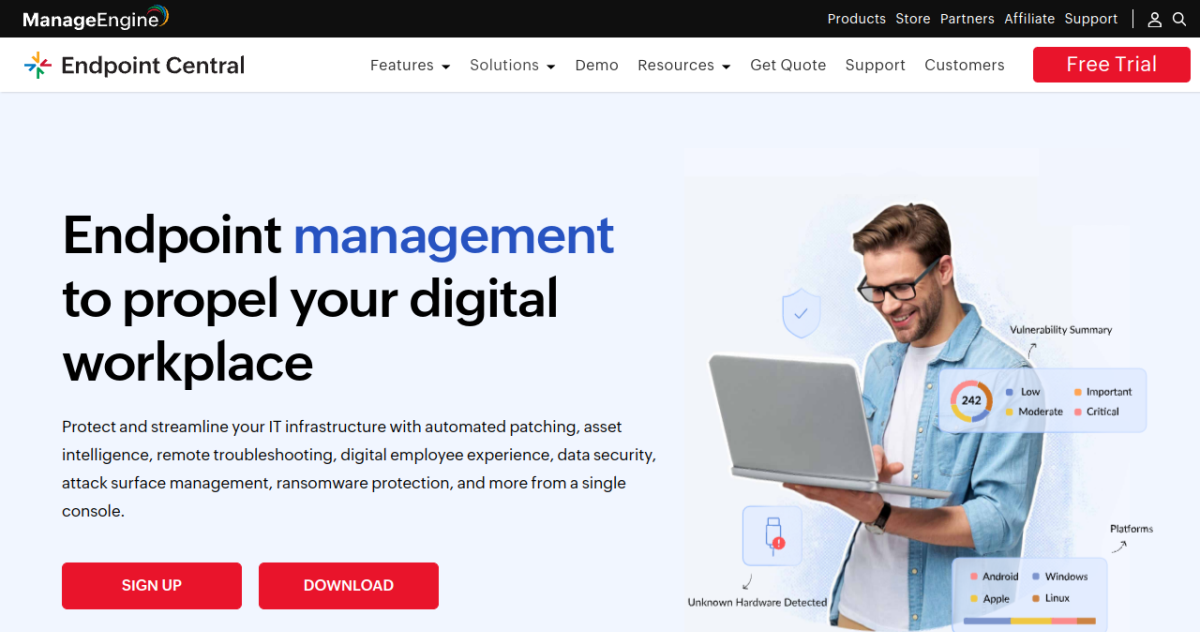
UEM combined with patch management, software deployment, and IT asset management in a single Zoho platform.
ManageEngine Endpoint Central (formerly Desktop Central) is part of the Zoho-owned ManageEngine portfolio, combining unified endpoint management with patch management, software deployment, and asset management in a single platform. This consolidation differentiates it from pure-play MDMs.
IT teams consolidating UEM + patch management + ITAM in one platform
Pros
Cons

Apple MDM purpose-built for MSPs and IT consultancies, with multi-tenant management and RMM-style remote control.
Addigy is the Apple MDM purpose-built for managed service providers - the IT consultancies, MSPs, and outsourced IT teams that manage Apple devices across multiple client organizations. Its multi-tenant architecture, PSA/RMM integrations, and white-labelable end-user experience differentiate it from in-house-IT-focused platforms like Kandji.
MSPs and IT consultancies managing multiple Apple-focused client environments
Pros
Cons
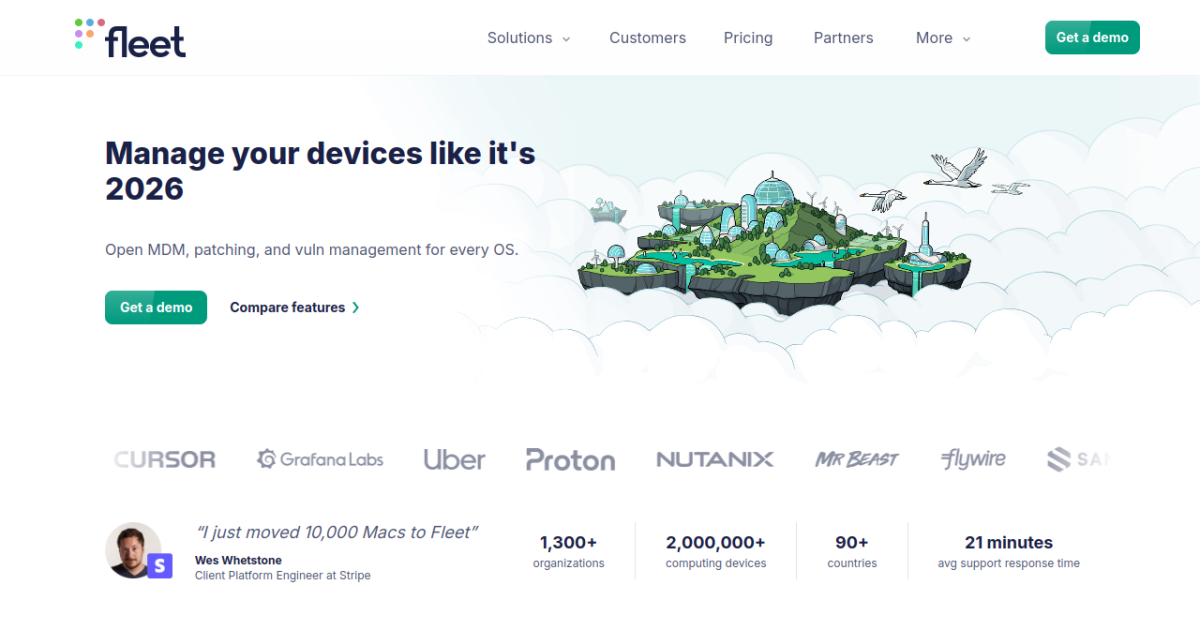
Open-source UEM built on osquery, for engineering-led IT teams that value transparency and customization.
Fleet is a 2020-founded open-source unified endpoint management platform built on osquery (the standard cross-platform endpoint querying tool). It has become increasingly popular with engineering-led IT teams at tech companies - organizations that value transparency, want to avoid vendor lock-in, and prefer GitOps-style infrastructure-as-code workflows.
Engineering-led IT teams valuing transparency and customization
Pros
Cons
Our Methodology
We evaluate every zero-touch provisioning platform against the same five criteria, weighted toward what matters most to distributed teams.
The non-negotiables of zero-touch provisioning - judged on how reliably and granularly each tool delivers them.
Breadth of OS, platform, or environment coverage and the depth of integrations with the rest of your stack.
How much audit-readiness work the tool removes for frameworks like SOC 2 and ISO 27001, and how it handles BYOD privacy.
Time to value, quality of admin and end-user experience, and whether a lean team can run it without a dedicated specialist.
Transparent, predictable pricing measured against the capability delivered - including free tiers and scaling with team size.
Questions & Answers
Zero-touch provisioning (ZTP) is the process of getting a new device fully configured and ready for an employee to use without IT physically touching it. When done well, a laptop ships from the manufacturer or refurbisher directly to the employee, who unboxes it, signs in once, and finds it fully configured - enrolled in MDM, encrypted, with apps installed and policies applied.
Both are zero-touch enrollment services from the OS vendor. Apple Business Manager handles Apple devices (Mac, iPad, iPhone). Windows Autopilot handles Windows PCs via Microsoft. They serve the same purpose for their respective platforms; an MDM/UEM platform like Intune or Workspace ONE integrates with both.
Not really - ZTP requires both an enrollment service (ABM, Autopilot, Android Zero-Touch) AND an MDM/UEM to receive the enrolled device and apply configuration. The OS-vendor service handles enrollment; the MDM/UEM handles configuration.
Refurbished or transferred laptops can be added to your Apple Business Manager (via DEP/Apple Configurator) or Windows Autopilot (via hardware hash registration). Some platforms like Workwize and Deel IT handle this enrollment automation when delivering refurbished devices.
End-to-end: 15-30 minutes from box-opening to fully ready, depending on your app catalog and policy complexity. With strong ZTP automation (e.g., Kandji Liftoff), most of this is hands-off after initial sign-in.
Increasingly less so. Cross-platform UEMs (Intune, Workspace ONE, Hexnode, Scalefusion) handle both reasonably well from a single console. But Apple-first teams often choose Apple-native MDMs (Kandji, Jamf) for the better Apple admin experience, accepting a second MDM for any Windows devices.
Less developed than Apple or Windows. Fleet is the strongest Linux-supporting option in this list; some other UEMs (Workspace ONE, Endpoint Central) also have Linux capabilities. For Linux-heavy environments, dedicated config-management tools (Ansible, Puppet) are often used alongside MDMs.