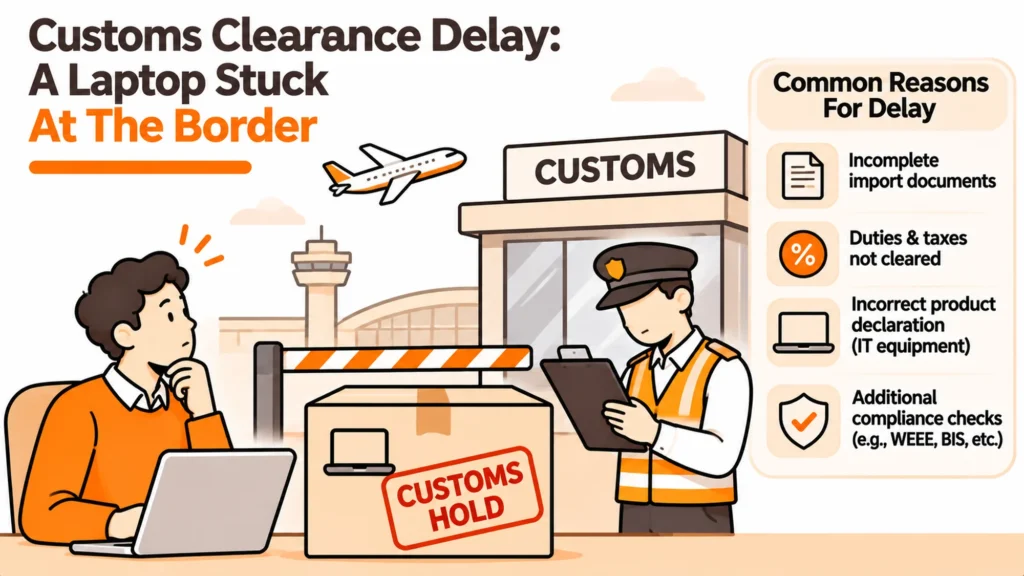
A customs clearance delay almost always comes from paperwork rather than from inspection queues. A missing tax identifier, an unclear description, a value that does not match the invoice, or no nominated importer. Those four cover most held shipments, and all four are fixable within a day once somebody identifies which one it is.
TL;DR
- Find out the reason code before escalating. Carriers rarely volunteer it.
- Most holds are document issues, not inspections or seizures.
- Storage charges usually start after a free period of a few days.
- The employee cannot resolve this, so do not leave them to try.
- Returned to sender is worse than a delay. Act before that happens.
The moment this becomes real
Say a laptop for a new analyst in Mexico leaves on a Monday and lands Wednesday. On Thursday the tracking changes to a status nobody in your team has seen before. It stays on that status for six days.
The analyst starts on the Monday. They have no machine. Somebody emails the carrier and gets a response saying the shipment is awaiting customs clearance, which everyone could already see. Nobody asks the only useful question, which is what the shipment is waiting for.
On day nine it turns out the commercial invoice described the contents as computer equipment with no model, no serial and a value that did not match the declared line. It took eleven minutes to correct once the right person asked. The real issue is not that customs held the parcel. It is that nine days passed before anyone found out why.
When this is lighter than you think
Four stages where a hold is not actually a problem.
- Under about three days. Routine processing. Many shipments pass through a holding status briefly and clear without anybody doing anything. Do not escalate on day one.
- Domestic shipments. No clearance step at all, so a stuck parcel is a carrier problem rather than a customs one.
- Shipments to your own office with a broker. They handle these daily and will resolve most issues before you hear about them.
- Low value accessories. Often cleared under simplified procedures, so the paperwork that trips up laptops does not apply.
It becomes urgent when a start date is attached, when storage charges begin, or when the carrier starts talking about returning the shipment to the sender.
The five questions teams actually ask
How do we find out the real reason? Ask the carrier for the specific hold reason or customs query, not for a status update. Those are different requests and only one of them is useful. If the carrier is slow, the broker handling the entry usually knows immediately.
How long is normal? It varies enormously by country, route and time of year, so any general figure is misleading. What is reliable is the shape: document problems resolve in days once identified, and shipments left unattended escalate into storage and eventual return.
Who pays for storage? Depends on your shipping terms and on who is the importer. Free time is usually short, and the charge accrues daily. This is the cost that turns a small delay into a real number.
Should the employee get involved? Generally no, and asking them to is how delays get longer. They have no documentation, no relationship with the broker and no authority over the declaration. The exception is where they are named as importer, which is itself the problem to fix.
What if it gets returned? You pay the return leg, the device arrives back weeks later, and you start again. Returned to sender is a worse outcome than almost any clearance charge, so act before that deadline rather than after it.
Three ways teams respond, and where each breaks
Wait and watch the tracking. The most common response and the worst. Tracking tells you the shipment is held, which you knew, and nothing about why. It breaks because free storage time runs out while you wait, and because nothing resolves itself.
Escalate to the carrier’s support line. Better, and sometimes enough. You get a reason code and a path. It breaks on speed and on scope: front line support often cannot see the customs entry detail, and you spend two days being transferred.
Go to whoever filed the entry. The fastest route. The broker or agent who made the declaration knows exactly what is missing and can usually correct it. It breaks if you do not know who that is, which for most teams shipping through a carrier default is the case.
Five questions to ask in the first hour
When a customs clearance delay starts, these five questions get you further than a day of refreshing the tracking page.
What exactly is the hold reason? Not the status. The reason. Ask for it in those words.
Who filed the entry? Name the broker or agent. They are the person who can fix it.
Who is named as importer? If it is the employee, that is probably the cause and definitely the thing to change next time.
When does storage start accruing? Find the free period and work backwards from it.
When would it be returned to sender? That date is your real deadline. Put it in a calendar.
What is actually available
Five honest options, including ours.
Handle it yourself through the carrier. Best for occasional shipments on familiar routes. Free. Struggles on speed and on access to the people who can actually amend a declaration.
Appoint a customs broker before shipping. Best if you ship regularly to the same markets. You get a named contact who can act. Struggles because you need one per country and it is overhead for low volumes.
Use a freight forwarder end to end. Best for consignments rather than single parcels. They own the problem. Struggles on cost for one laptop and on lead time for urgent shipments.
Buy in the destination market. Best preventive answer where the specification exists locally. No border, no clearance, no delay. Struggles when you need a configured machine or consistent hardware across the team.
RemoAsset. Best when holds keep happening across different markets and nobody on your team owns customs as a subject. Procurement and delivery across 80+ countries puts the declaration and the clearance with a party that does it routinely, so the four common document errors are less likely to be made in the first place. Where it struggles: it cannot rescue a shipment already stuck that somebody else sent, and for a team shipping to two familiar markets a broker relationship does the same job. It publishes an entry subscription price but no per device rates, so a comparison needs a conversation.
Where to start, by situation
| Situation | Scale | Setup | Primary pain | Recommended starting point |
|---|---|---|---|---|
| Held under 3 days | Any | Any | Probably nothing | Wait, but find the reason code now |
| Held with a start date looming | Any | No broker | Nobody knows the cause | Ask for the hold reason and the entry filer |
| Repeated holds, one market | 5 plus a year | Carrier default | Same error each time | Appoint a broker and fix your invoice template |
| Holds across several markets | Any | No customs owner | A new problem every country | A global service such as RemoAsset |
| Return to sender deadline near | Any | Any | About to lose the device | Escalate hard today and consider a local purchase |
What the gap actually costs
Storage is the visible charge and it is usually the smallest part. Daily rates on a single parcel add up slowly compared with everything else that is happening.
The bigger cost is a person who cannot work. A new starter without a machine spends their first week reading documents on a phone, and the onboarding plan quietly collapses. You are paying full salary for a fraction of the output, and the manager is spending time on logistics instead of on the new joiner.
The third cost is the one that compounds. Teams that get burned once start shipping earlier, which sounds sensible and means devices sit configured in a warehouse for longer, aging before anybody uses them. Or they stop shipping at all and buy whatever is available locally, losing the standardisation they had. So the question is not what a clearance delay costs this time. It is what you will change because of it.
When holds become a pattern
A single stuck laptop is an incident. Three in a quarter across different countries is a signal that nobody owns the declaration side of your shipping, and that the same four errors keep being made because there is no template and no feedback loop.
The cheap fixes are worth doing first and they are genuinely cheap. Build a proper commercial invoice template with full descriptions, model numbers and accurate values. Decide and record who the importer is for each market. Ask your carrier for the hold reason as a matter of routine rather than as an escalation. Those three changes prevent most of what goes wrong.
Beyond that it becomes a question of whether you want to keep learning customs country by country. A laptop lifecycle management service moves that knowledge to somebody who already has it, which matters more as the number of destinations grows. For two or three stable markets, fixing your own paperwork is the better value answer.
Related reading
- Shipping laptops internationally
- Import duty on laptops
- Customs on returned company laptops
- Shipping a laptop to Brazil
- Classification and duty rates are published by authorities rather than carriers. See the UK trade tariff and the European Commission customs pages for how entries are assessed.
Frequently Asked Questions
What usually causes a customs clearance delay on a laptop?
Document problems, not inspections. The common four are a missing tax identifier for the importer, a vague goods description, a declared value that does not match the commercial invoice, and no clearly nominated importer. Each is correctable quickly once somebody identifies which one applies.
How long should we wait before escalating?
Find the reason code immediately, but do not treat a short hold as a crisis. Many shipments pass through a holding status for a couple of days and clear on their own. What matters is knowing why it is held from day one, so you can act if it is a document issue rather than routine processing.
Who should we contact to actually move a stuck shipment?
Whoever filed the customs entry, usually a broker or the carrier’s clearance team. Front line carrier support often cannot see the entry detail and will only repeat the tracking status. Asking for the entry filer by name is the single most useful question you can ask.
Should the employee contact customs themselves?
Generally not. They have no documentation, no relationship with the broker and no authority over the declaration, so involving them usually adds days. The exception is where they were named as importer, which means the arrangement itself needs changing for future shipments.
Who pays storage charges while a shipment is held?
It depends on your shipping terms and on who is named as importer. Free storage periods are typically short and charges then accrue daily. Find out when the free period ends as soon as a hold starts, because that date changes how hard you should be pushing.
What happens if we do nothing?
The shipment eventually gets returned to the sender, which is the worst outcome. You pay the return leg, wait weeks for the device to come back, and start the whole process again with a person who still has no laptop. Find the return deadline early and treat it as the real one.
How do we stop this happening repeatedly?
Fix the commercial invoice template first, with full descriptions, model numbers and accurate values. Then decide and record who the importer is for each market you ship to. Those two changes remove most repeat causes without any new supplier or spend.