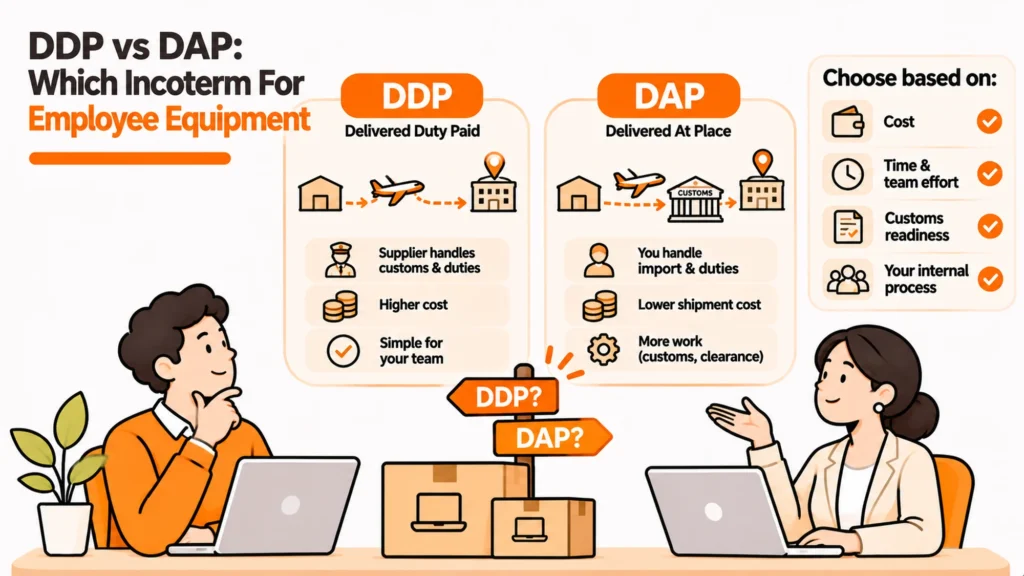
DDP vs DAP comes down to who handles import clearance and who pays the duty. Under delivered duty paid the sender covers it. Under delivered at place the receiver does. For company equipment going to an employee’s home, DDP is almost always the right choice, because DAP makes your new hire settle a customs bill.
TL;DR
- DAP stops at delivery. Import clearance and charges fall to the receiver.
- DDP means the sender arranges clearance and pays the duty and taxes.
- For employee shipments the choice is really about who gets the phone call.
- DDP is not always available in every market. Check before promising it.
- Incoterms allocate cost and risk between parties. They are not tax advice.
The moment this becomes real
Say procurement ships twelve laptops to new starters across four countries. The freight quote came back cheaper on one option than the other, so somebody picked the cheaper one. It was DAP. Nobody looked closely, because the difference was framed as a shipping term rather than a decision about who pays.
Nine arrive without incident. Three do not. In two markets the carrier contacts the employee for a tax identifier and a payment. In the third the parcel sits in a warehouse accruing storage while a new hire works out what a customs agent wants from them.
The saving on the freight quote was real and small. The cost was three people starting badly and a week of somebody chasing. The real issue is not which incoterm is cheaper. It is that the cheaper one moved work and money onto people who had no idea it was coming.
When this is lighter than you think
Four stages where DDP vs DAP does not matter much.
- Domestic shipments. No import, so the terms are about delivery point rather than duty. The distinction largely disappears.
- Within a single customs union. Movement between member states usually avoids the import step that makes this choice matter.
- Shipping to your own office abroad. You have staff, an address and probably a broker. DAP is manageable because somebody competent receives it.
- Low value accessories below the threshold. Mice and keyboards often clear without charges. Laptops usually do not.
It matters the moment the receiving address is a residential one in a country where you have no presence, which describes most remote hiring.
The five questions teams actually ask
What is the actual difference? Under DAP the seller delivers to the named place and the buyer handles import clearance and pays import charges. Under DDP the seller also takes on clearance and those charges. Both are published terms in the Incoterms rules, and the detail of each edition matters, so read the version your contract references.
Which is cheaper? DAP looks cheaper on the quote because the duty is not in it. The total is similar. What changes is who pays, when, and whether it arrives as a surprise. Comparing the two on quoted freight alone is comparing different things.
Is DDP always available? No. In some markets a non resident seller cannot easily act as importer or recover local taxes, which makes DDP impractical or expensive. Carriers will sometimes decline it. Check per destination rather than assuming it is a universal option.
Who is the importer under DDP? Usually the sender or a party acting for them, which is the point. It also means the sender needs whatever standing that country expects from an importer, which circles back to the same problem DDP was supposed to solve.
Do incoterms settle our tax position? No. They allocate cost and risk between the parties to a shipment. They do not determine your tax treatment or your obligations in the destination country. Treat them as logistics terms and take advice separately.
Three ways teams handle it, and where each breaks
Always DAP, reimburse afterwards. The informal default. Simple to book and you promise to repay anything charged. It breaks on experience: the employee still fields the call, still finds the money, still spends an afternoon on it. Reimbursement fixes the cash and not the impression.
Always DDP, accept the premium. The right answer for most employee shipments. The person receives a box and nothing else happens. It breaks where DDP is not offered for that route, and on budgeting, since the duty is now visibly yours and lands in your cost per hire.
Decide per destination. DDP where it is available and the market is difficult, DAP where the route is simple and the receiver is an office. The most sensible policy. It breaks on knowledge, because somebody has to maintain the country list and keep it current.
Five questions to find your own position
Settling DDP vs DAP for your team is a short exercise.
What terms were your last ten shipments booked on? Most people do not know. Ask whoever books the freight.
Has an employee ever been contacted for a payment? If yes, you are shipping DAP whether or not anybody chose it.
Is DDP offered on your main routes? Ask your carrier directly for the destinations you actually use.
Where does duty sit in your budget? Under DDP it becomes a visible line. Make sure somebody expects it.
What is the reimbursement process if a charge lands? If there is not one, write it before the next shipment.
What is actually available
Five honest options, including ours.
Book DAP and reimburse. Best for shipments to offices or to staff in markets you know well. Cheapest on the quote. Struggles for home deliveries and new starters, where the experience is the cost.
Book DDP with your existing carrier. Best general answer for employee equipment. One decision removes the whole problem. Struggles where the route does not support it, and the premium varies more than people expect.
Use a freight forwarder for difficult lanes. Best when you ship volume to a handful of markets. They can structure the terms properly. Struggles for single laptops, where forwarder handling costs more than the device’s shipping budget.
Buy in the destination country. Best where it is possible, because there is no import and therefore no incoterm question. Struggles when you need a specific configuration or consistent hardware across the team.
RemoAsset. Best when you ship to many markets and do not want to maintain a destination by destination terms policy. Procurement and delivery across 80+ countries means the route and the charges are handled as part of getting a working device to the person. Where it struggles: if you already ship confidently to two or three familiar markets, booking DDP with your own carrier does the same job for less thought. It also publishes an entry subscription price but no per device rates, so a like for like comparison against a carrier quote needs a conversation first.
Where to start, by situation
| Situation | Scale | Setup | Primary pain | Recommended starting point |
|---|---|---|---|---|
| Domestic only | Any | Any | None | Terms barely matter, book normally |
| Shipping to your own offices | Any | Local staff and broker | Paperwork but no surprises | DAP is fine where an office receives it |
| Home delivery to new starters | Any | No local presence | Employee gets the customs call | Book DDP wherever it is available |
| Many markets, varying rules | 20 plus shipments a year | No logistics owner | Nobody maintains the country list | A global service such as RemoAsset |
| DDP unavailable on a route | Any | Any | No clean option | Buy locally, or use a forwarder for that lane |
What the gap actually costs
The money is close to a wash. Duty and import tax are owed either way, and the difference between the two terms is mostly a handling premium plus whoever fronts the payment. Teams that switch to DDP are usually surprised how small the change is.
What differs is where the friction lands. Under DAP somebody with no context receives a request for money and documents in a language of customs rather than of work. They either resolve it, delay it, or ignore it, and all three cost you more than the duty did.
The third effect is on your own numbers. Duty paid by an employee and reimbursed through expenses is invisible in your logistics costs, so you keep believing shipping is cheaper than it is. Pay it directly and the real cost of equipping someone in that market finally shows up. So the question is not which term saves money. It is whether you want to know what this actually costs.
When a per route decision becomes a policy
Choosing between the two terms is easy for one shipment and tiring for fifty. The availability of DDP varies by country and by carrier, the cost premium varies, and the rules move. Somebody has to own that knowledge or it decays.
Most teams reach a point where maintaining a destination list stops being worth it. The question changes from which term for this parcel to who is responsible for devices arriving, charges included, wherever we hire. That is a different kind of arrangement, and it is the one that makes the incoterm choice disappear from your week.
If you ship to three familiar markets, do not buy a solution to this. Ask your carrier for DDP on those lanes, write the answer down, and move on. A laptop lifecycle management service earns its place when the list of destinations is long, changing, and nobody owns it.
Related reading
- Import duty on laptops
- Shipping laptops internationally
- Customs on returned company laptops
- Equipping a first hire in a new market
- The terms themselves are published by the International Chamber of Commerce as the Incoterms rules, and the UK government publishes the trade tariff for classification and duty rates.
Frequently Asked Questions
What is the difference between DDP vs DAP in plain terms?
Under delivered at place the seller gets the goods to the named destination and the buyer handles import clearance and pays import charges. Under delivered duty paid the seller takes on clearance and those charges too. For employee equipment, that is the difference between your new hire getting a customs call or not.
Which should we use for shipping a laptop to an employee?
DDP wherever it is available. A home address is not a receiving department, and asking somebody to clear an import of company property before their first day is a poor introduction. Reserve DAP for shipments to your own offices where somebody competent can handle the paperwork.
Is DDP more expensive?
The quoted freight is higher because the duty and taxes are inside it rather than billed later to the receiver. The total is usually similar. What you are buying is predictability and a better experience, not a lower number, so compare totals rather than quotes.
Why would a carrier refuse DDP to a country?
In some markets a non resident seller cannot easily act as importer or recover local taxes, which makes the arrangement impractical. Carriers also restrict it on certain lanes for their own reasons. Ask about your specific destinations rather than assuming it is universally offered.
Do incoterms decide our tax obligations?
No. They allocate cost, risk and responsibility between parties to a shipment. They do not determine your tax position or your registration obligations in the destination country. Treat them as logistics terms and take separate advice on tax.
What if a charge reaches the employee anyway?
Reimburse immediately and without a process argument. Then find out which term the shipment was booked under, because it usually means DAP was used when DDP was intended. One reimbursement is fine. A pattern of them means your booking default is wrong.
Does this apply to equipment being returned as well?
Yes, and it is often overlooked. A device coming back across a border is another import, into your country this time, with its own clearance and potential charges. Decide the terms for returns explicitly rather than discovering them when a leaver sends a laptop back.