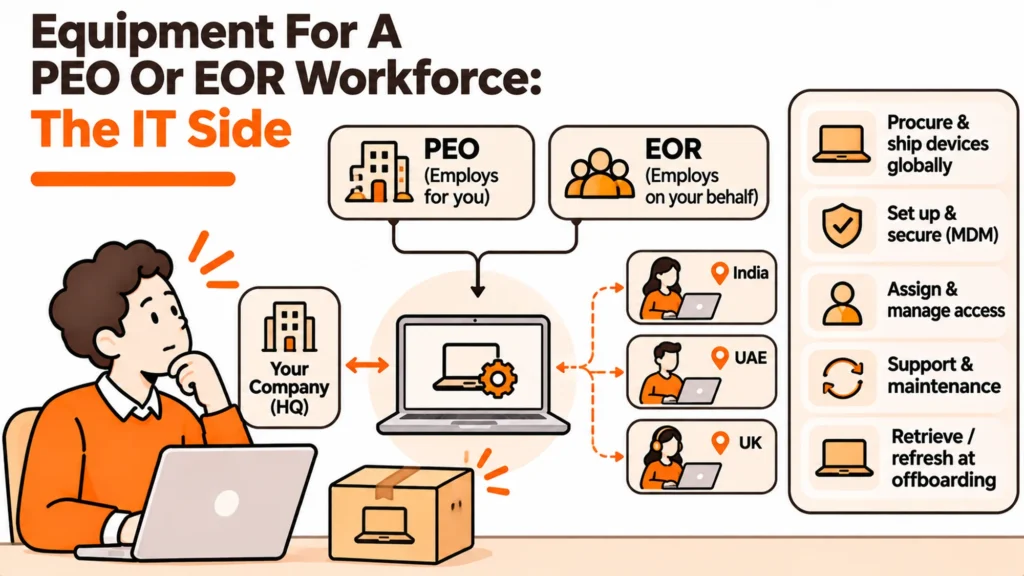
Equipment for EOR employees usually stays your responsibility, even though somebody else is the legal employer. Most employer of record arrangements cover payroll, contracts and local compliance, not laptops. The gap shows up on day one, when a person who is formally employed by another company needs a device enrolled in your systems.
TL;DR
- The EOR employs. You still provision, enrol and support the device.
- Ask explicitly whether equipment is in scope. Many assume it is and it is not.
- Shipping to an EOR worker is the same import problem as any other hire.
- Access and device management stay with you, which has policy implications.
- Offboarding is the hard part, because the EOR ends the contract, not the device.
The moment this becomes real
Say you hire a data engineer in Poland through an employer of record because you have no entity there. The arrangement is set up in three weeks, which feels fast, and the start date is confirmed.
Four days before they start, somebody asks who is sending the laptop. The EOR says equipment is not included in their service. Your IT team says they have never shipped to Poland. Procurement asks whether the device should be bought by your company or by the EOR, and nobody knows what the difference would mean for the asset register.
The engineer starts on a personal machine with limited access, which the security policy does not really allow but nobody wants to delay the start. The real issue is not the laptop. It is that everyone assumed the hard part of hiring abroad was the employment, so nobody planned the part that was still theirs.
When this is lighter than you think
Four stages where this is simpler than it sounds.
- Your EOR does offer equipment. Some do, as a paid add on. If so, confirm what it covers and move on.
- Bring your own device is acceptable for the role. If your policy genuinely allows it and the data risk is low, the problem is much smaller.
- One hire in a market you already ship to. Then this is a normal provisioning job with an unusual employment wrapper.
- Short engagement. For a few months, a simpler machine and a planned return is easier than a full lifecycle arrangement.
It gets heavier with several EOR hires across markets, with roles that need managed endpoints, and anywhere the engagement might end quickly.
The five questions teams actually ask
Does the EOR provide the laptop? Usually not as standard. Many offer it as a paid extra, and coverage varies by country even within one provider. Ask specifically, in writing, before the start date rather than assuming it sits inside a service that covers everything else.
Who owns the device if the EOR buys it? Ask, because the answer affects your register, your security evidence and what happens at the end. A device you do not own but do manage is an awkward category, and it needs to be a deliberate choice rather than a surprise.
Can we enrol it in our device management? Normally yes, and this is usually where the real control sits. Worth confirming that the person’s employment arrangement does not create any local constraint on monitoring or management, which varies by country.
How does offboarding work? The EOR ends the employment and handles notice locally. They do not usually collect your hardware. If you have not arranged retrieval separately, the device stays with somebody who no longer has any relationship with you.
Who do we ask about local rules? The EOR, since that is what you are paying them for. They will know whether anything about device provision, allowances or deductions works differently in that market, and their answer is better than a general assumption.
Three ways teams handle it, and where each breaks
Ship from your own stock. You buy centrally and send the device to the person. You keep ownership and full control of the build. It breaks on import, because this is the same customs and importer question as any other cross border shipment, and an EOR relationship does not make it go away.
Have the EOR buy locally. Convenient and fast, and it avoids the border entirely. It breaks on specification and on ownership. You get whatever is available locally, the asset may sit on someone else’s books, and your build standard quietly fragments across markets.
Use a separate equipment provider. The employment and the hardware are handled by different specialists. Keeps ownership and consistency. It breaks on coordination, since you now have two vendors and two timelines converging on one start date.
Five questions to ask before the next EOR hire
Sorting out equipment for EOR employees is a short checklist if you do it early.
Is equipment in your EOR contract? Read it rather than asking an account manager informally.
Who will own the device? Decide before purchase, because changing it afterwards is an intercompany problem.
How will it be enrolled? Zero touch enrolment needs the device registered to you, which is harder if somebody else bought it.
What is your lead time to that country? Measure it, then work backwards from the start date.
Who collects it at the end? If the answer is the EOR, get that in writing. If it is you, arrange it now.
What is actually available
Five honest options, including ours.
Ship from your own stock. Best for consistent builds and clear ownership. Full control. Struggles on customs, lead time and on markets you have never shipped to.
EOR equipment add on. Best when your provider offers it in that country and the specification is acceptable. Fewest moving parts. Struggles on coverage, cost transparency and build consistency across markets.
Local purchase by the employee, reimbursed. Best avoided, but common under time pressure. Fast. Struggles on ownership, on the asset register, on tax recovery and on getting the machine back.
A local IT supplier in that market. Best where you hire repeatedly in one country. Proper invoicing and local support. Struggles because you need a new relationship per market.
RemoAsset. Best when EOR hiring is spread across markets and the employment side is already solved. Procurement and delivery across 80+ countries keeps the device yours and the build consistent regardless of who employs the person, and retrieval covers the offboarding step the EOR does not. Where it struggles: it is a second vendor to coordinate against a fixed start date, and it does nothing about employment, payroll or local compliance, which is what an EOR is for. It publishes an entry subscription price but no per device rates.
Where to start, by situation
| Situation | Scale | Setup | Primary pain | Recommended starting point |
|---|---|---|---|---|
| EOR offers equipment locally | Any | Single market | Specification may vary | Use it, but confirm the build and ownership |
| One hire, market you ship to | 1 to 2 | Existing stock | Lead time only | Ship from stock and plan backwards from day one |
| Several EOR hires, several markets | 5 plus | No local presence | Inconsistent builds and ownership | A dedicated equipment provider such as RemoAsset |
| Short engagements | Any | Any | Full lifecycle is overkill | Simpler machine with a planned return date |
| Engagement ending | Any | EOR handles notice | Nobody collects the device | Arrange retrieval separately and early |
What the gap actually costs
The immediate cost is a delayed start, and it is the one everybody sees. A person employed, paid and waiting is expensive in a way that shows up in the first month.
The structural cost is the compromise that gets made under time pressure. Starting somebody on a personal machine because the laptop is not ready is a decision taken once and then forgotten. Months later you have company data on an unmanaged device in a country where you have no entity, and no clear path to resolving it.
The third cost arrives at the end. An EOR ends employment cleanly and locally, which is precisely what you hired them for. They do not usually collect your hardware, so unless you arranged it, the device sits with somebody who now has no relationship with your company at all. So the question is not who buys the laptop. It is who will get it back.
When two vendors is the right answer
There is a reasonable instinct to want one supplier for everything, and some EOR providers encourage it. For a single market with one or two hires that usually works well enough, and the simplicity is worth more than the compromise on hardware consistency.
It stops working as the number of markets grows, because equipment coverage inside an employment product tends to be uneven. You end up with different machines, different ownership arrangements and different support paths per country, discovered one hire at a time.
Keeping the employment and the equipment with separate specialists is less tidy on an org chart and usually better in practice. The EOR does what only an employer can do locally, and a laptop lifecycle management service keeps the device yours, the build consistent and the return arranged. The coordination cost is real, and it is smaller than the cost of finding out your builds diverged across six countries.
Related reading
- Equipping a first hire in a new market
- Device provisioning for remote staff
- Getting devices back from contractors
- IT procurement for remote companies
- Cross border employment arrangements vary widely. The ILO publishes research on non standard employment, and the EU publishes guidance on posted workers.
Frequently Asked Questions
Does an employer of record provide equipment for EOR employees?
Usually not as standard. Most arrangements cover payroll, employment contracts and local compliance rather than hardware. Several providers offer equipment as a paid add on with coverage varying by country. Ask in writing before the start date rather than assuming it is included.
Who owns the laptop if the EOR buys it?
It depends on the arrangement, which is exactly why you should ask before the purchase. A device owned by the EOR but managed by you is an awkward category for your asset register and your security evidence. Make it a deliberate decision rather than something discovered later.
Can we enrol an EOR employee’s device in our MDM?
Normally yes, and this is usually where your actual control sits regardless of who employs the person. Confirm with the EOR that nothing about the local arrangement constrains device management or monitoring, since expectations differ by country.
Who collects the device when the engagement ends?
Not the EOR, in most cases. They handle ending the employment locally, which is what you are paying for, but hardware retrieval is typically outside scope. If you have not arranged collection separately, the device stays with somebody who no longer has any relationship with your company.
Is shipping to an EOR employee different from any other international shipment?
No, and that is the point teams miss. The employment arrangement does not change customs, duty or the importer of record question. You face the same border process as you would shipping to anyone else in that country, so plan the lead time accordingly.
Should the employee just buy their own and expense it?
It happens under time pressure and it creates several problems at once: unclear ownership, a device missing from the register, a non standard build, and difficulty recovering it later. If it is genuinely unavoidable, get a business invoice and record the device immediately.
Is it better to use one vendor for employment and equipment?
For one or two hires in a single market, the simplicity usually wins. Across several markets, equipment coverage inside an employment product tends to be uneven, and you end up with different machines and ownership arrangements per country. Separate specialists is less tidy and often works better.