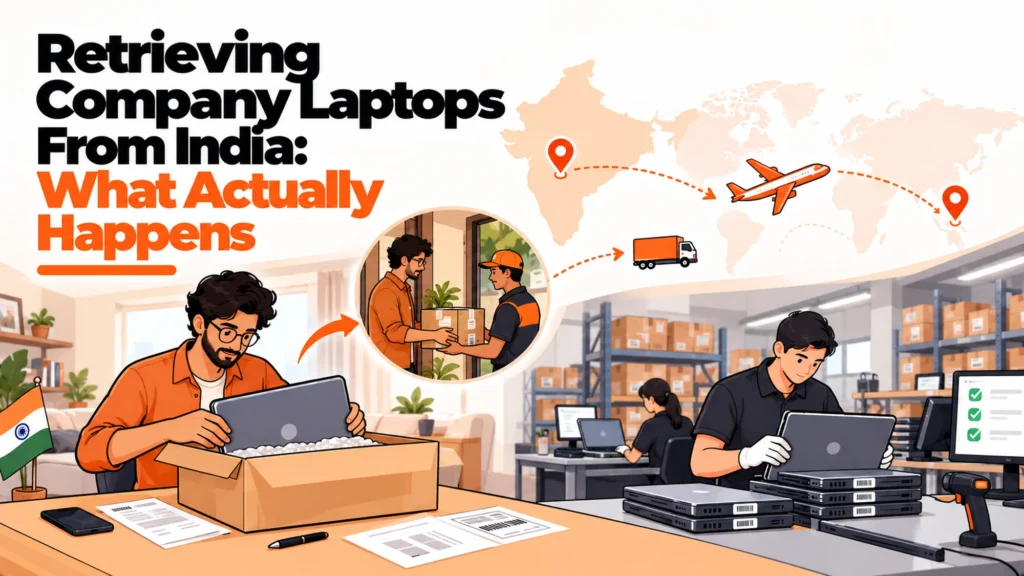
Laptop retrieval from India is a different job from shipping one in. Sending a laptop is an import with a clean invoice. Taking a used one out is an export of second-hand goods with a value somebody must justify. For most teams the right answer is to keep the machine in India and reissue it locally.
TL;DR
- Local reuse usually beats shipping an ageing laptop back across the world.
- The courier is the simple part. Packaging, access and paperwork cause the delay.
- Never ask a former employee to handle export documentation.
- Ask whether your vendor operates in India directly or through a partner.
- Wiping the device and recovering it are two separate decisions.
- Price storage and a second collection attempt, because both get used.
When you should not ship it back at all
This is the section most vendors skip, so it goes first. Four stages.
Keep it locally. You hire in India regularly and the machine still meets your spec. Wipe it, store it, issue it to the next person. This is the cheapest outcome by a distance and it should be your default rather than your exception.
Sell it locally. The laptop is past your standard spec but still has value. Local resale avoids the export leg entirely and recovers something. The constraint is having a route you trust.
Dispose locally. The device is genuinely end of life. Moving used electronics between countries engages international rules, including the Basel Convention on transboundary movement, so disposal near the device is usually simpler as well as cheaper.
Actually ship it back. Reserve this for machines with real residual value, specialist hardware, or a device that must be examined for a security or legal reason. That last case is the only one where cost stops being the deciding factor.
Why laptop retrieval from India differs from delivery
The outbound journey is well understood. A supplier invoices a new machine, the value is obvious, and the import is routine. Thousands of companies do it every week.
The return inverts the hard parts. The goods are used, so the declared value is a judgement rather than a figure on a purchase order. The sender is a private individual rather than a business. And the shipment is leaving rather than arriving, which puts it under a different set of procedures administered by India’s Central Board of Indirect Taxes and Customs. We are not going to tell you what those procedures require in your circumstances, because that depends on the device, the value and the route, and it is a question for a broker or local adviser rather than a blog.
What we can say operationally is that the paperwork has to be prepared by somebody competent to prepare it, and that somebody is never the former employee. Any plan that depends on a departing colleague filling in a customs form is not a plan.
The second difference is physical. A delivery goes to someone who wants it and is expecting it. A collection goes to someone who has already left, may be working somewhere else, and has no particular reason to be home on Thursday.
What actually happens, step by step
- Trigger. The exit is logged and somebody decides the device’s destination. If this decision is deferred, everything after it waits.
- Packaging despatch. A box goes to the employee. This is a separate shipment and it is the step most commonly missing from a quote.
- Collection booking. Agreed with the individual directly. Expect a re-attempt and price one in.
- Local intake. The machine reaches a facility inside India, is graded and is wiped. Most auditors expect sanitisation aligned to NIST Special Publication 800-88, with the certificate naming the serial number.
- Disposition. Reissue locally, store, sell or export. Only the last involves customs.
Read that list again and notice how much of it is domestic. On most India returns the international leg never happens, which is the point: the hard part is the first mile and the decision, not the border.
Five questions before you book anything
Will you hire in India again within a year? If yes, the machine should almost certainly stay there. This question settles most cases on its own.
Does your vendor operate in India directly? Directly operated means their staff and their accountability. A partner arrangement can work well, and you should still know which you are buying.
Who prepares any export paperwork? Get the answer in writing before booking. This is where cross-border returns stall.
What is the machine actually worth today? Compare that honestly against the all-in return cost. The comparison frequently ends the discussion.
What evidence will you need later? If a customer or auditor may ask, specify the certificate now rather than requesting it afterwards.
Who does this, and where each one struggles
Named honestly, including the one we have an interest in.
Asking the employee to courier it. Best for a domestic return to an Indian office you already have. It struggles everywhere else, and it fails completely the moment paperwork is involved.
International couriers directly. Best when you simply need transport and have somebody to handle documentation. They struggle because a courier will not grade, wipe, store or reissue the machine.
Equipment lifecycle platforms such as Firstbase, Workwize, GroWrk and allwhere. Best for one supplier across several countries. They struggle on clarity about which markets are operated directly, and almost none publishes a rate, so every comparison starts with a sales call.
Local Indian IT asset firms. Best for in-country collection, resale and disposal, often at the lowest cost. They struggle when you need the same process repeated across other countries, because you are then managing several vendors to several standards.
RemoAsset. Disclosure: RemoAsset is owned by the same people who publish this site. It handles collection, wiping, storage and reassignment across 80 or more countries, which suits a team wanting one process rather than one vendor per market. Where it struggles: it is a logistics and lifecycle service, not a customs broker and not a certified destruction specialist, so if your requirement is certified physical destruction with accreditation, treat that as a separate purchase. Check what its retrieval service covers in India specifically rather than relying on the country count.
The decision table
| Situation | Scale | Setup | Primary pain | Recommended starting point |
|---|---|---|---|---|
| Regular hiring in India | Any | No local entity | Machines idle after exits | Local wipe, store and reissue |
| One leaver, no plans to rehire | Under 50 | No IT function | Device sitting with ex-colleague | Local resale or disposal |
| Office in India | Any | Local admin | Only the first mile | Domestic courier to your office |
| Several countries including India | 150 plus | Small IT team | A different vendor per market | One provider across all markets |
| Security or legal examination | Any | Compliance owner | The device itself is evidence | Export with full custody record |
| End-of-life hardware | Any | Any | Disposal obligations | Certified local disposal |
What getting this wrong costs
The common failure is not an expensive shipment. It is a machine that quietly stays where it is, because the decision was never made and the cost of deciding felt higher than the cost of waiting.
Six months later the laptop is worth less, it is still company property, and nobody can say whether the data on it was removed. The hardware loss is minor. The open question is not, and it arrives during a security review rather than on a quiet afternoon.
The second cost is the shipment that should never have happened. Teams export a three-year-old laptop out of habit, pay more than the residual value, and receive a machine they then struggle to reissue because it does not match their current spec. That is a process working exactly as designed and still producing a bad outcome.
So the question is not how to get the laptop back. It is whether getting it back is the right ending for this particular machine, and who is accountable for making that call within a week of the exit.
When one-off arrangements stop working
Handling each India exit individually is fine while they are rare. It stops working when the pattern becomes visible.
Three signals usually arrive together. Exits become regular rather than occasional. Nobody can say how many company machines are currently in the country. And a customer or auditor asks what happened to a specific device, which is a question a series of one-off arrangements cannot answer.
At that point you are choosing between building a repeatable local process and buying one. The honest comparison includes your own hours and the machines you have already written off, which most teams have never totalled. Seeing what a managed lifecycle service covers is the faster half of that exercise, and it makes the build-or-buy question answerable rather than theoretical.
Related reading
- Shipping a laptop to India
- Import duty on laptops
- Shipping laptops internationally
- Getting devices back from contractors
- Writing a retrieval SLA vendors will sign
Frequently Asked Questions
Is laptop retrieval from India harder than delivery to India?
Yes, and for a structural reason. Sending a new laptop in is an import with an invoice and a clear value. Taking a used one out is an export of second-hand equipment, which is a different customs conversation with a value that somebody has to justify. The courier leg is the easy half of either direction.
Do I actually need the laptop back?
Often not. If you hire in India regularly, the cheapest outcome is usually to keep the machine in the country, wipe it and issue it to the next person there. Shipping a three-year-old laptop across the world costs more than the laptop is worth, so the default should be local reuse.
What are the real delays?
Packaging, address access and paperwork, in that order. The former employee rarely has the box, residential collection often fails on the first attempt, and any cross-border leg needs documentation that nobody prepares in advance. Budget weeks rather than days unless the device stays inside India.
Who handles the customs side?
Your vendor or a broker, never the former employee. Asking a private individual to complete export paperwork for company property is unreasonable and it will not happen. Confirm in writing who files what before booking anything, because this is where cross-border returns stall.
Can I just wipe it remotely and leave it?
You can wipe it, and that addresses the data question if the device is online and enrolled. It does not address the asset question, because the machine remains company property sitting with a former employee. Wiping and abandoning are different decisions and should be recorded as such.
What should a vendor quote include?
Packaging despatch, collection with at least one re-attempt, local storage, sanitisation with a certificate naming the serial, and either local reassignment or the export leg. Ask for those as separate lines. A single headline figure almost always excludes the re-attempt and the storage.
Does this work without an entity in India?
It can, through a vendor operating locally, and that is the usual reason teams buy one. What matters is whether the provider operates directly in India or passes the job to a partner, because the handoff is where visibility and accountability tend to disappear.