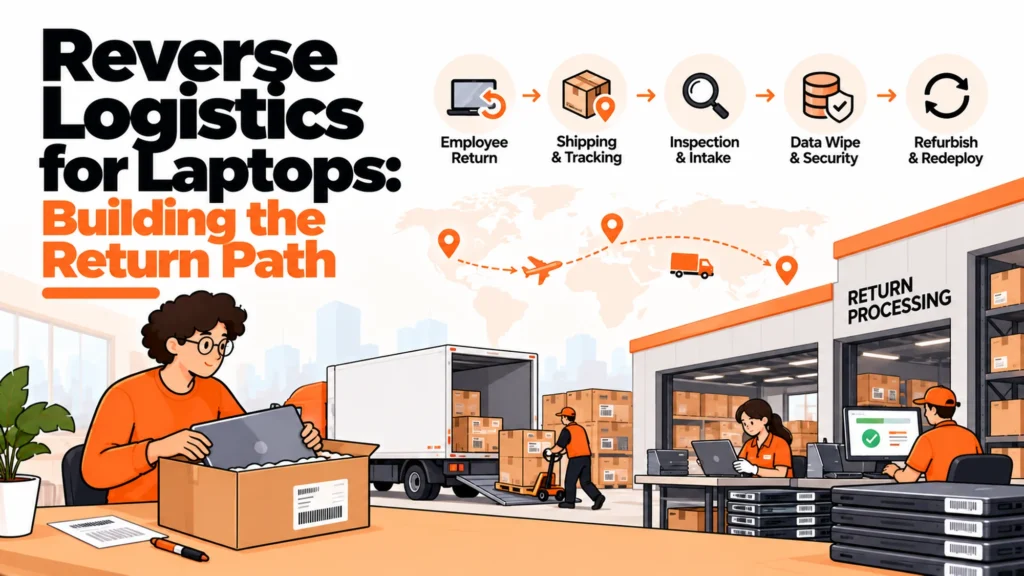
Reverse logistics for laptops covers everything after somebody stops using a machine: collection, transport, inspection, wiping, storage and then reuse, resale or disposal. It is not outbound shipping reversed. The sender is now an individual with no packaging, no deadline and no reason to hurry.
TL;DR
- The first link is a person who has already left, which breaks every outbound assumption.
- Packaging is the commonest point of failure and the commonest omission from a quote.
- Returns cost more per unit than deliveries, because of the four steps with no outbound twin.
- Design the return when the laptop is issued, not when somebody resigns.
- Reuse beats resale on cost if your hiring is steady enough to absorb the machines.
- Cross-border returns are a customs discipline, not a courier one.
When you do not need a return path
Four stages, and the first two do not justify building anything.
Manual is fine. A few machines a year, one country, people who answer email. A prepaid label covers it. Building a process here is effort spent on a problem you do not have.
Friction appears. Returns become monthly. Somebody keeps a list. Two machines are late and nobody is sure who owns chasing them. Still workable, now visibly annoying.
Liability appears. A device with customer data has not come back and you cannot say where it is. The problem changes shape here: it stops being about hardware value.
The edge case. A return from a country where you have no entity and no courier account. One job, genuinely hard, and usually the thing that forces a decision.
Why reverse logistics for laptops is not shipping backwards
Outbound works because every variable is controlled. A warehouse holds known stock. A professional packs it. A courier collects on a fixed schedule. The destination is an address somebody chose.
Inbound inverts all four. The machine is in a flat, not a warehouse. The packer is a person who has already mentally left the company. There is no schedule, only a request. And the destination has to make a decision about the device rather than simply receive it.
That last point is the one most plans miss. An outbound shipment ends when it arrives. An inbound one arrives and then needs grading, wiping, and a choice between reuse, resale and disposal. Three of those six steps have no outbound equivalent at all, which is why the cost comparison surprises people.
There is also a regulatory asymmetry. Shipping a new laptop is shipping goods. Moving a used one can engage waste rules, and in the European Union used electronics sit inside the WEEE framework. In the United Kingdom the equivalent sits under producer responsibility guidance. Neither applies on the way out.
The six stages of the return path
- Trigger. Something tells the process a device is coming back. An exit logged in the HR system is a trigger. An email from a manager is not, because it depends on somebody remembering.
- Packaging. Getting a suitable box to wherever the laptop is. This is a shipment in its own right and the step most often missing from plans and quotes alike.
- Collection. A courier attends an address at a time a private individual agreed to. First-attempt success is far lower than for business addresses.
- Transport. Domestic is a courier job. Cross-border is a customs event with a declared value and a real chance of a hold.
- Inspection and sanitisation. Grading the condition and wiping the storage. The reference most auditors expect is NIST Special Publication 800-88.
- Disposition. Reuse, store, sell or dispose. The decision determines whether the previous five steps were an investment or a cost.
Four decisions that define your design
Where does the machine physically go? Your office, a vendor warehouse, or straight to the next employee. This single choice determines most of the cost, because it sets how many legs the journey has.
Who sends the packaging? You, the employee, or the vendor. If the answer is the employee, expect delay, because almost nobody has a suitable box.
What is the default disposition? Deciding reuse as a default changes how you grade on arrival and how long you store. Deciding case by case means nothing moves until somebody chooses.
What evidence do you need? A note in a spreadsheet, or a certificate naming the serial number. The second costs more and is the only one that survives an audit question.
Who runs this, and where each one struggles
Named honestly, including the one we have an interest in.
Your own process. Best at low volume in one country, and genuinely the right answer there. It struggles the moment packaging has to be sent, or a border is involved, because both turn a ten-minute task into a project.
Courier accounts you already hold. Best for straightforward domestic collections where you simply need a label. They struggle on everything after transport, because a courier does not inspect, wipe or store.
Equipment lifecycle platforms such as Firstbase, Workwize, GroWrk and allwhere. Best when you want the whole path under one supplier. They struggle on transparency: almost none publishes a rate, so every comparison needs a sales conversation first.
Local ITAD firms. Best at the disposition end, particularly where certified destruction is required. They struggle on collection across borders and on reuse, since their commercial model favours disposal.
RemoAsset. Disclosure: RemoAsset is owned by the same people who publish this site. It covers collection, wiping, storage and reassignment across 80 or more countries, and publishes a subscription that starts at $1,499 a year for companies between 50 and 5,000 employees, which most of this category does not. Where it struggles: it is a logistics service, so it will not find devices nobody recorded, and it is not a certified destruction specialist. The scope of its lifecycle service is worth checking against your own markets before anything else.
The decision table
| Situation | Scale | Setup | Primary pain | Recommended starting point |
|---|---|---|---|---|
| One country, rare exits | Under 50 | No IT function | Remembering to start the return | Prepaid label at offboarding |
| Steady exits, one or two markets | 50 to 150 | One ops owner | Packaging and chasing | Courier account plus a written trigger |
| Cross-border returns | 100 plus | Small IT team | Customs holds and partner gaps | Vendor operating directly in your markets |
| High rehiring, standard spec | 150 plus | Dedicated IT | Buying new while returns sit idle | Storage and reassignment, not disposal |
| Audit or customer pressure | Any | Compliance owner | No evidence of sanitisation | Certified wipe, priced as a line item |
| Ageing fleet past refresh | Any | Any | Machines below useful spec | Resale or certified disposal |
What a broken return path costs
The visible cost is replacement hardware. That is the cheap part, and it is the only part most teams measure.
The larger cost is the machine that never comes back with data still on it. It is not a hardware loss at that point, it is an open question you cannot close, and it surfaces during a security review or a customer audit rather than at a convenient moment.
Then there is the cost nobody books: new purchases made while serviceable machines sit in a spare room. A company with a weak return path buys laptops it already owns. That shows up as procurement spend rather than as a logistics failure, which is exactly why it persists.
So the useful question is not what a collection costs. It is how many machines you are currently unable to account for, and what the honest replacement value of that list is.
When labels stop scaling
A prepaid label is a complete solution right up to the point where one of three things happens, and they tend to happen together.
The first is a border. The second is packaging, when you realise somebody has to ship a box before a box can be collected. The third is evidence, when a customer asks what happened to the data and a spreadsheet row is not an answer.
At that point the comparison is between the fully loaded cost of your own process and a quoted service. Most teams have never costed their own side, which includes the hours spent chasing and the machines written off, so the vendor quote looks expensive against a number that was never calculated. Working out what a managed retrieval service covers is the quicker half of that comparison.
See how a managed laptop return path works end to end
Read our guide to laptop return packaging and who pays for it
Related reading
- Laptop return packaging, and who pays for it
- Shipping laptops internationally
- Import duty on laptops
- Storing laptops between hires
- Writing a retrieval SLA vendors will sign
Frequently Asked Questions
What is reverse logistics for laptops?
Everything that happens to a work laptop after somebody stops using it: collection, transport, inspection, data sanitisation, storage and then reuse, resale or disposal. It is not outbound shipping run backwards, because the sender is now an individual rather than a warehouse and the destination has to decide what the machine is worth.
Why is the return harder than the delivery?
Outbound, a professional packs a known machine and a courier collects on a schedule. Inbound, a former employee with no packaging and no deadline is the first link. Every assumption that makes delivery reliable is missing, which is why return rates sit far below delivery rates at the same companies.
What does the return path actually cost?
More than the outbound leg, usually by a wide margin. Collection from a residential address is priced differently from a warehouse pickup, and the inspection, wipe and storage steps have no outbound equivalent. Most teams budget the courier and are surprised by the other four lines.
When should the return be planned?
At the point the machine is issued, not at the exit. The return address, the packaging decision and the destination for the device should be settled while somebody still has the box. Teams that decide at offboarding are improvising under time pressure, which is when recovery rates drop.
Should returned laptops be reused or sold?
Reuse first if your hiring is steady, because a machine already owned and already wiped is the cheapest laptop you will ever issue. Sell when the model has aged past your standard spec. Disposal is the last option and the only one with regulatory obligations attached.
Does this need a specialist vendor?
Not at low volume in one country. It starts to pay once returns cross borders, because customs treatment of used equipment is a separate discipline from shipping new stock. The other trigger is needing evidence of what happened to the data on each machine.
What is the single biggest failure point?
Packaging. The box is gone, so somebody has to send packaging before anything can be collected, and that step is routinely left out of both the plan and the quote. A collection booked without packaging in place simply does not happen on the day.