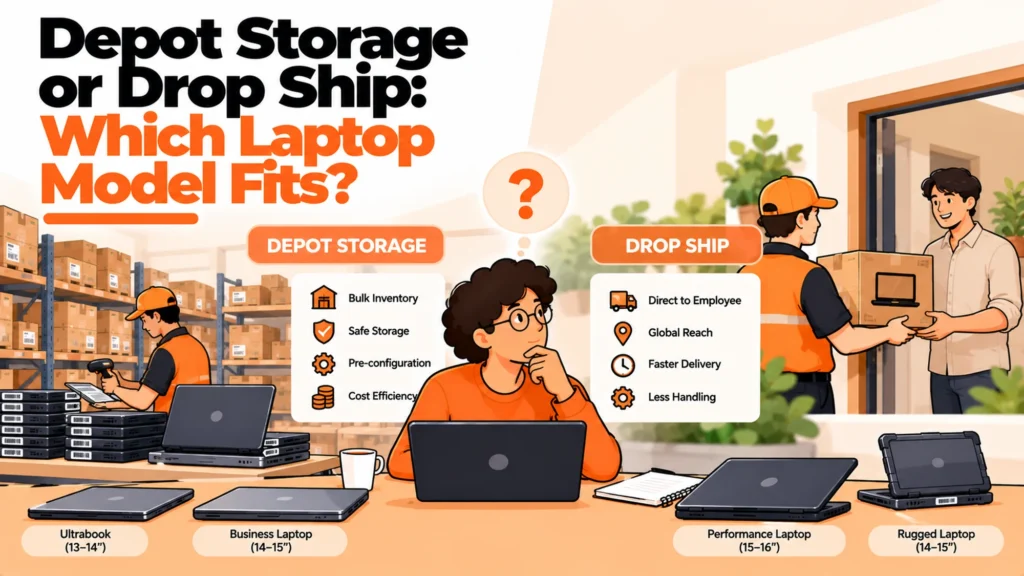
Depot storage vs drop ship laptops is a trade between cash and speed. A depot holds configured machines so one ships the day a hire is confirmed. Drop ship orders per hire and keeps the cash free. Neither is better. The right one depends on how predictable your hiring is.
TL;DR
- Drop ship is cheaper per machine. Depot is cheaper per late start.
- The break-even is forecast accuracy, not company size.
- A depot fed by returned machines beats a depot fed by purchases, by a wide margin.
- Warranty clocks start at purchase, so stored stock arrives with less cover.
- Stock in the wrong country removes the speed you paid for.
- Most teams end up with a small buffer plus drop ship, and that is a sound answer.
When you do not need a depot
Four stages, and the first two argue for doing nothing.
Hiring is occasional. A few starters a year, lead times you can plan around. Order per hire. A depot here is cash parked in a cupboard.
Friction appears. Two or three starts have been delayed by a laptop. Annoying, visible to managers, and still cheaper than holding stock. Fix the ordering trigger before you fix the supply model.
Cost appears. Somebody is paying for expedited shipping regularly. That premium is the first honest signal that held stock might be cheaper than speed bought at the last minute.
Scale arrives. You are hiring steadily, in several countries, with a standard spec. Now a depot is a real option, because stock will turn over rather than age.
Depot storage vs drop ship laptops as a cash decision
Strip away the logistics vocabulary and this is a working capital question. A depot converts cash into inventory so that time to desk falls. Drop ship keeps the cash and pays in days.
The reason it is framed as logistics is that the costs sit in different budgets. Storage and stock show up in operations. Delayed starts show up nowhere at all, which is why drop ship looks cheaper than it is. Nobody invoices you for a new joiner who spent three days unable to work.
That asymmetry is the whole argument. If you want an honest comparison, put a number on a lost first week before you compare anything else. For most knowledge roles that figure is larger than a year of storage for the machine that would have prevented it.
The second thing the framing hides is that depot and purchase are not the same decision. You can run a depot without buying a single extra laptop, by feeding it with returns. That version has very different economics and it is the one worth modelling first.
The costs nobody puts in the model
- Depreciation while idle. A laptop loses value whether or not anybody is using it. Stock that sits for a quarter has already cost you something before it ships.
- Warranty erosion. Cover generally starts at purchase, not at issue. A machine stored eight months reaches its user with eight months less protection, and that is rarely in the comparison.
- Spec drift. Your standard configuration changes. Stock bought to last year’s spec either goes out as a downgrade or gets quietly replaced.
- Storage security. Held machines need controlled access, particularly if any were previously issued. Asset handling expectations under ISO/IEC 27001 do not pause because a device is in a warehouse.
- Intake wiping. Returned machines entering a depot should be sanitised on arrival, not on reissue. The usual reference is NIST Special Publication 800-88, and doing it at intake is what makes next-day reissue possible.
Five questions that decide it
How accurately can you forecast next quarter’s hires? Within two machines and depot works. Within ten and you will hold stock that ages.
What does a delayed start actually cost? Put a figure on it. Without one, every comparison favours drop ship by default.
Do you have a standard spec? Depot needs one. If every hire picks their own machine, you cannot hold stock that fits.
Where are your hires, country by country? Stock in the wrong market is slower than drop ship, not faster.
How many machines come back each quarter? If the answer is meaningful, your depot can be fed by returns rather than purchases.
Who offers each model, and where they struggle
Named honestly, including the one we have an interest in.
Direct from the manufacturer. Best price per unit and a clean drop ship model. It struggles on lead times at scale, on configuration, and on anything involving a returned machine.
Resellers and distributors. Best for configuration and volume pricing, and some will hold stock for you. They struggle internationally and rarely touch the return leg at all.
Equipment lifecycle platforms such as Firstbase, Workwize, GroWrk and allwhere. Best for depot plus returns in one place, which is the combination that makes depot economics work. They struggle on transparency, because almost none publishes a rate, so modelling the comparison needs a sales call first.
Your own office as a depot. Best when hires are concentrated near it and somebody competent is there. It struggles on security, on records, and on the day that person is on leave.
RemoAsset. Disclosure: RemoAsset is owned by the same people who publish this site. It covers procurement, delivery, retrieval, wiping, storage and reassignment across 80 or more countries, and publishes a subscription starting at $1,499 a year for companies between 50 and 5,000 employees. That matters here because storage and returns in one service is what lets a depot be stocked by machines you already own. Where it struggles: it is a logistics service rather than a reseller, so if your priority is the lowest possible unit price on new hardware, a distributor will beat it. The lifecycle scope is the thing to compare, not the hardware price.
The decision table
| Situation | Scale | Setup | Primary pain | Recommended starting point |
|---|---|---|---|---|
| Occasional, predictable hiring | Under 50 | No IT function | Nothing urgent | Drop ship per hire |
| Steady hiring, one market | 50 to 150 | One ops owner | Occasional late starts | Two or three machine buffer |
| Fast growth, standard spec | 150 plus | IT team | Lead times blocking starts | Depot fed by purchases and returns |
| Several countries | 150 plus | Small IT team | Cross-border delay on every issue | Regional stock, not one central depot |
| High churn, steady headcount | Any | Dedicated IT | Buying while returns sit idle | Depot fed entirely by returns |
| Hiring paused or unpredictable | Any | Any | Stock would age | Drop ship, revisit in two quarters |
What choosing wrong costs
Choosing depot too early is the expensive mistake in cash terms. Stock bought against hiring that then pauses becomes a cupboard of ageing machines on a spec you have moved past, and it is very hard to unwind without taking a loss.
Choosing drop ship too long is the expensive mistake in a way nobody measures. Every delayed start costs a person’s first days and a manager’s patience, and because no invoice arrives the cost stays invisible. Teams discover it only when somebody finally asks why onboarding feels chaotic.
The third failure is the depot in the wrong place. Stock held centrally while hires are spread across markets gives you the worst of both: cash tied up and cross-border shipping on every issue.
So the question is not which model is better. It is how confident you are in next quarter’s headcount, and whether your returns are big enough to stock a depot without buying anything.
When the hybrid stops being enough
A small buffer plus drop ship is where most teams land, and it is a genuinely good answer for a long time. Three signals suggest it has stopped working.
The buffer is always empty, which means it is a queue rather than a buffer. Returns are accumulating somewhere unmanaged while you keep buying new. And you are holding stock in one country while hiring in four, so the speed benefit only reaches a minority of starters.
At that point the useful move is not a bigger buffer. It is connecting the return path to the issue path, so that a machine coming back from a leaver becomes the machine going out to a joiner without passing through a purchase order. That single change usually does more for both cost and speed than any amount of stock planning. It is worth seeing how retrieval and reassignment connect before you size a depot you may not need.
Related reading
- Storing devices between hires
- Laptop storage, practically
- Standardising your laptop spec
- How equipment platforms price
- Shipping laptops internationally
Frequently Asked Questions
What is the difference between depot storage and drop ship?
Depot means holding configured machines in a warehouse so one can go out the day a hire is confirmed. Drop ship means ordering per hire and having the supplier send it directly. The first buys speed with cash tied up in stock. The second keeps cash free and accepts the supplier’s lead time.
Which is cheaper?
Drop ship is cheaper per unit, because you pay no storage and hold no idle stock. Depot is cheaper per late start, because a delayed laptop costs a person’s first week. Which wins depends entirely on how expensive an unproductive first day is in your business.
Where is the break-even?
Roughly where your hiring becomes predictable enough that held stock does not sit idle. If you can forecast next quarter’s headcount within a couple of machines, depot starts to pay. If hiring is lumpy or paused often, stock ages in a warehouse and drop ship is the safer model.
Can returned machines feed the depot?
Yes, and this is where depot genuinely wins. A wiped returned laptop is the cheapest machine you will ever issue, because you already own it. A depot fed by returns rather than purchases changes the economics completely and is the strongest argument for the model.
What are the hidden costs of holding stock?
Monthly storage, depreciation while idle, warranty clocks that start at purchase rather than issue, and the spec drifting out of date. The warranty point surprises people: a laptop stored for eight months has eight fewer months of cover when somebody finally uses it.
Does depot work across several countries?
Only if the stock sits in the right countries. A depot in one market serving hires in five means cross-border shipping on every issue, which removes the speed advantage you were paying for. Regional stock positions are what make the model work internationally.
What should we do while we decide?
Hold a very small buffer, two or three machines of your standard spec, and drop ship the rest. It covers the urgent starts that cause the most pain without committing cash to stock. Most teams find this hybrid is where they settle anyway.