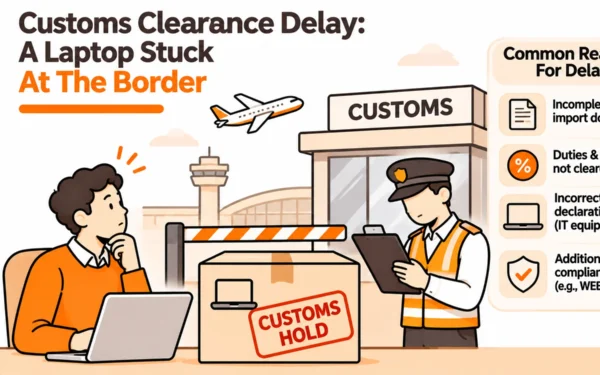
Shipping a laptop to Mexico is a customs problem rather than a distance problem. The flight is short and the clearance is the variable, and the single biggest decision is who pays the charges when the parcel lands.
TL;DR
- Expect duty and tax on arrival. Decide who pays before you ship.
- Never under declare. It voids insurance and invites inspection.
- A business consignee clears more easily than a private individual.
- Budget more time for clearance than for the flight.
- Buying locally often wins on cost and speed for one hire.
- Plan the return route before you send anything.
When this is simpler than you think
Four stages, and the first two avoid the problem entirely.
You have a Mexican entity. Ship to the company address with your tax registration and the process becomes an ordinary commercial import. Most of this article does not apply to you.
One hire, standard hardware. Buying locally is usually faster and often cheaper once charges are counted. Compare before you assume shipping is the default.
Several hires, specific build requirements. Now consistency matters enough to justify importing, and the customs questions become real.
A growing team with regular movement. You are importing repeatedly and recovering devices too, which is where an ad hoc approach stops scaling.
Why shipping a laptop to Mexico goes wrong
The distance misleads people. A parcel from the United States reaches Mexico fast, so teams plan as though it were a domestic delivery and discover the border is the slow part.
The second cause is the consignee. Shipments addressed to an individual are treated differently from those addressed to a registered business, and an employee receiving a laptop at home is a private import whatever your internal paperwork says. That classification is what produces the charge and the phone call.
The third is that nobody decides who pays. The parcel lands, a payment is requested before release, and the employee is asked for money by a courier for something their employer sent them. The amount is rarely the problem; the surprise is.
Rates, thresholds and classification rules are published by Mexico’s tax administration service, the Servicio de Administración Tributaria, and the trade terms that decide who bears costs are the Incoterms rules maintained by the International Chamber of Commerce. Both move, so confirm the current position rather than trusting a summary written last year.
The five decisions to make first
- Who pays charges. Ship on delivered duty paid terms if you want the employee untouched by it, and expect to pay for that convenience.
- Declared value. The real one. This drives the assessment and your insurance, and the two have to agree.
- Consignee. Business entity where you have one, individual where you do not, and plan for the difference in clearance.
- Battery compliance. The laptop ships under dangerous goods provisions, so packaging and service selection matter.
- Return route. Decided now rather than at offboarding, because export raises its own paperwork.
Five decisions, four of which are made once and reused. Only the declared value changes per shipment.
Five questions before you book
Do you have a local entity? If yes, most of the difficulty disappears and you should use it.
Who is paying the charges? Answer this before the parcel moves, not when it is held.
Have you compared local purchase? Price the landed cost against buying in market. For one machine, local usually wins.
Does the start date depend on this arriving? If so, add slack. Clearance is not predictable to the day.
How will it come back? If you have no answer, you have imported a device you cannot recover.
Routes, and the trade-offs
Express courier, charges to the recipient. Best for speed and simplest to arrange. It struggles on employee experience, since somebody is asked to pay for their own work equipment.
Express courier, charges prepaid. Best balance for a one off and keeps the employee out of it. It struggles on cost, because the convenience is priced in, and clearance can still stall.
Buy locally from a Mexican retailer. Best for speed and usually for total cost. It struggles on specification consistency and on warranty terms that may differ from your standard.
Ship to your own entity, then forward. Best where you have one, and the cleanest customs position available. It struggles if you do not, which is most companies hiring their first person there.
A lifecycle service with local presence. Disclosure: RemoAsset is owned by the same people who publish this site. It handles procurement, delivery and retrieval across 80 or more countries, which usually means sourcing in market rather than importing, and it plans the return at the same time. Where it struggles: for a single hire with no ongoing need, the arrangement is more than the job requires. The narrow part it changes is whether the device arrives without the employee handling customs.
The decision table
| Situation | Scale | Setup | Primary pain | Recommended starting point |
|---|---|---|---|---|
| You have a Mexican entity | Any | Local presence | Minor | Ship to the company address |
| First hire, standard spec | 1 | No entity | Charges and delay | Buy locally, compare first |
| Specific build needed | Few | No entity | Consistency | Prepaid duty, add time |
| Start date is fixed | Any | Any | Clearance unpredictable | Ship early or source locally |
| Several hires a year | 50 plus | IT owner | Ad hoc each time | One route, reused |
| People leaving too | Any | Any | No return path | Plan retrieval first |
What a surprise charge costs
The first cost lands on a person. A new hire gets a message demanding payment before their work laptop is released, in the week they joined, from a company that told them everything was arranged. The money is recoverable. The first impression is not.
The second is the held shipment. A parcel without the right paperwork or with a disputed value does not quietly wait; it sits in a facility accruing storage, and resolving it takes days of someone’s attention in a time zone that may not be yours.
The third is the insurance gap. A device declared below its value is underinsured by exactly that difference, so the shipment most likely to be damaged or lost is the one you deliberately described as cheap.
The fourth is the return you never planned. A laptop imported into Mexico for an employee who leaves two years later is now a device you need to export, from a residential address, without a local entity. That is a harder problem than the original import and it arrives with less notice.
A fifth cost is the one that repeats. Teams that solve a single Mexican shipment by improvising usually improvise again for the next hire, because nothing was written down and the person who worked it out has moved on to other things. The second import costs the same effort as the first, and by the fourth somebody has quietly decided that hiring in that market is difficult, which was never really the finding.
So the question is not what the duty rate is. It is who will be asked to pay it, and whether they know that before the parcel lands.
Plan the return before the delivery
Almost every guide to this stops at arrival. The device is in the country, the employee is working, the task looks finished. It is half finished.
At some point that laptop has to come back, be reissued locally, or be disposed of in market. Each is a different process and each is easier to arrange when you set it up at the start rather than during somebody’s notice period.
Three signals say you have not planned it. You cannot say how a device would be collected from a home address in Mexico. Nothing in your offboarding process names a route for that country. And you do not know whether exporting it would raise a customs question.
It costs little to settle now and a great deal to improvise later. Seeing how collection from residential addresses works across markets shows what the return half actually involves.
Related reading
- Import duty on laptops
- Shipping laptops internationally
- Customs on returned company laptops
- Equipping a first hire in a new market
- Procurement across ten countries
Frequently Asked Questions
Will the employee be charged duty and tax?
Often yes, unless you arrange otherwise. Shipments into Mexico addressed to an individual are commonly assessed on arrival and the recipient is asked to pay before release. Decide in advance who settles it and tell the employee, because an unexpected bill is how a delivery turns into a complaint.
What determines the charge?
The declared value, the tariff classification and whether any trade agreement applies, plus value added tax on top in most cases. Rates and thresholds change and are published by the Mexican tax and customs authority, so confirm the current position rather than relying on a figure in a blog post.
Does it help to under declare the value?
No, and do not do it. Under declaring is a customs offence, it voids most insurance cover, and it tends to trigger exactly the inspection you were trying to avoid. Declare the real value and treat the duty as a cost of employing somebody in that country.
Should we ship to a person or a company address?
A business consignee with a tax registration generally clears more smoothly than a private individual, because the paperwork fits the normal commercial process. If you have no entity in Mexico, that route is unavailable and this is the main reason teams use a local partner instead.
How long does it actually take?
Transit is short because the distance is short, and clearance is the variable. Budget for the customs step to take longer than the flight, and do not plan a start date around an optimistic quote. Build in slack rather than promising a day one that depends on a border.
What about getting the laptop back later?
This is the question most teams skip at purchase and regret at offboarding. A device exported out of Mexico raises its own paperwork, and the person holding it no longer works for you. Plan the return route before you ship, not when somebody resigns.
Is it cheaper to buy locally instead?
Frequently yes once duty, tax and clearance are added, and it avoids the import entirely. The trade off is specification consistency and warranty terms, which can differ from your standard build. For a single hire the local purchase usually wins on both cost and speed.