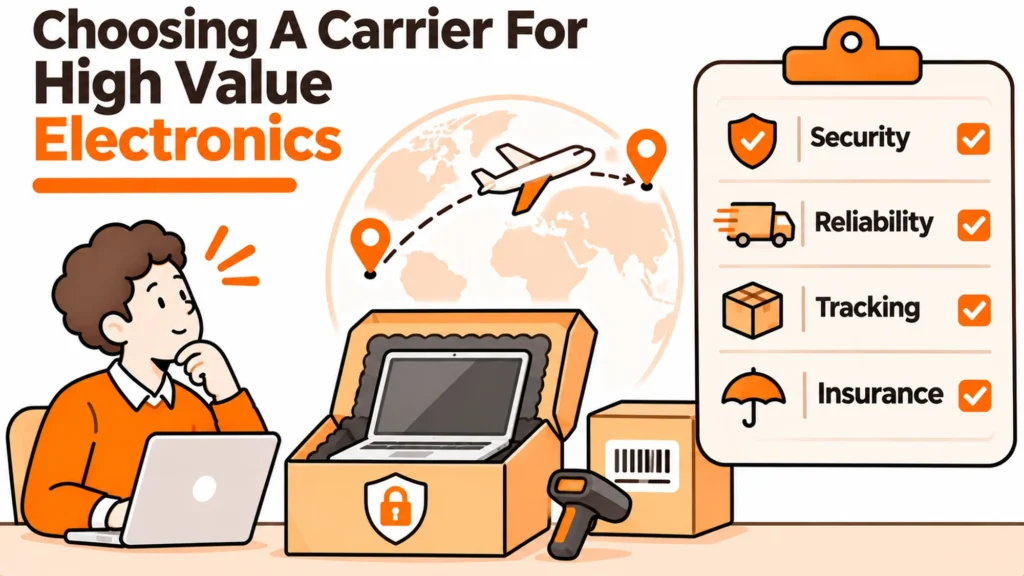
Choosing a carrier for electronics comes down to four things that rarely appear in a quote: how they handle lithium batteries, what their liability cap actually pays on a light high value item, how they deal with residential addresses, and whether they can clear customs properly in your destinations. Price per parcel is the easiest to compare and the least decisive.
TL;DR
- Battery rules apply to every laptop. Confirm the carrier’s position explicitly.
- Weight based liability caps pay badly on laptops. Check before you need it.
- Residential delivery performance varies enormously between carriers.
- Customs capability in your actual destinations matters more than network size.
- Get the terms in writing. Sales answers and contract terms often differ.
The moment this becomes real
Say procurement runs a tender for shipping and picks on rate card. The winner is eleven per cent cheaper per parcel across the destinations you listed, which over a year is a real number.
Three months in, the pattern shows. Residential deliveries fail more often because the carrier’s local partner does not attempt redelivery the same way. Two laptops were held because the battery documentation was not prepared the way the previous carrier did it. One claim for a lost machine paid a fraction of its value under a weight based cap nobody had read.
The eleven per cent is still true and it has been comprehensively outweighed. The real issue is not that the cheaper carrier was bad. It is that the tender compared the one dimension that was easy to compare.
When this is lighter than you think
Four stages where carrier choice barely matters.
- Domestic, low volume. Any major carrier will do this competently. Pick on price and move on.
- Shipping to offices only. Staffed addresses remove the biggest source of failure, which is nobody being home.
- Accessories rather than devices. No batteries, lower value, and the liability question stops mattering.
- Your supplier ships and owns the risk. Then their carrier choice is their problem, provided the terms say so.
It matters when you ship laptops internationally to homes, which is the normal case for a distributed team and the hardest thing a parcel network does.
The five questions teams actually ask
What about the batteries? A laptop contains a lithium battery installed in equipment, which is a regulated category in air transport. Most carriers handle this routinely, and their requirements for labelling and documentation differ. Ask what they need from you specifically, because getting it wrong is a common cause of holds.
What does their liability actually pay? Standard carrier liability is frequently capped by weight, which is a poor fit for something light and expensive. Ask for the figure and work out what it pays on a two kilogram laptop before you need to know. Then decide about declared value separately.
How do they handle homes? Residential delivery is where networks differ most. Ask about redelivery attempts, collection point coverage and how they contact recipients. A carrier that phones ahead performs very differently from one that leaves a card.
Can they clear customs in our markets? Network coverage on a map is not the same as competent clearance in a specific country. Ask who files entries there and whether you can reach that person when a shipment is held.
Who do we call when it goes wrong? Front line parcel support is designed for consumers. If you ship regularly, ask what account level support exists and whether you get a named contact, because that is what you will actually be buying.
Three ways teams choose, and where each breaks
Pick on rate card. The default in most procurement processes. Objective and easy to defend. It breaks because the rate card does not contain the four things that determine whether devices arrive, so you are optimising the wrong variable precisely.
Stay with whoever you already use. Inertia, and often reasonable. The relationship works, people know the process. It breaks when your shipping profile changes, typically when you start shipping internationally to homes rather than domestically to offices.
Score against the things that fail. Build a short comparison covering batteries, liability, residential performance and customs in your actual destinations. This works. It breaks on effort, and on getting honest answers, since sales will say yes to everything.
Five questions to put to any carrier
Choosing a carrier for electronics gets much easier with five specific questions.
What do you require for lithium batteries in equipment? A vague answer here is a warning sign.
What is your liability basis and cap? Ask for the number, not the principle.
What is your first attempt success rate to residential addresses in our destinations? They may not tell you. Asking still reveals a lot.
Who files the customs entry in each market? You want a name or an entity, not a reassurance.
What happens when a shipment is held? Who contacts whom, and how quickly.
What is actually available
Five honest options, including ours.
A global integrator. Best for consistency across many markets and for customs capability. One relationship, one process. Struggles on price and on residential performance in markets where they subcontract the last leg.
A regional or national carrier. Best in their home market, often notably better at residential delivery there. Struggles on international consistency, since you now manage several relationships.
A freight forwarder. Best for consolidated shipments and complex customs. Real expertise. Struggles on single parcels to individuals, which is not what they are built for.
Postal services. Best on price and on rural coverage. Struggles on tracking depth, liability and speed, which makes them a poor fit for devices.
RemoAsset. Best when you would rather not run carrier selection as an ongoing exercise at all, because delivery across 80+ countries and retrieval mean the routing decisions sit with somebody who makes them daily. Where it struggles: if you ship a lot and have the volume to negotiate directly, a negotiated carrier contract gives you better unit economics and more control. Its published pricing starts with a pay as you go plan and a yearly subscription above it, without per shipment rates, so it is not directly comparable to a rate card.
Where to start, by situation
| Situation | Scale | Setup | Primary pain | Recommended starting point |
|---|---|---|---|---|
| Domestic, to offices | Any | Any | Very little | Pick on price from any major carrier |
| Domestic, to homes | Any | Residential delivery | Failed first attempts | Compare residential performance, not rate |
| International, few markets | Under 50 a year | One carrier | Occasional holds and claims | Ask the five questions and get answers in writing |
| International, many markets | High volume | Logistics owner in post | Managing several relationships | Negotiate directly with an integrator |
| International, no logistics owner | Any | Distributed team | Nobody owns routing decisions | A service such as RemoAsset that owns them |
What the gap actually costs
The price difference between carriers is real and it is the smallest number in this decision. A ten per cent saving on parcel rates is worth having and will not change anybody’s year.
What changes the year is failure rate. A device that does not arrive on the first attempt costs a redelivery, then possibly a return, then a replacement shipment, and somewhere in there a person who cannot work. Those compound quietly and never appear in a carrier comparison, because they land in a different budget from shipping.
The third cost is the claim you cannot make. Discovering your liability basis at the moment you need it is the worst time, and weight based caps on laptops are the specific trap. So the question is not which carrier is cheapest. It is which one you would want to be dealing with on the day something goes wrong.
When you are running a logistics function by accident
Carrier selection, battery documentation, liability decisions, residential delivery performance and customs escalation are all logistics work. Plenty of companies end up doing them inside an IT or People team that never set out to.
At low volume that is fine and genuinely cheaper than any alternative. The questions in this post take an afternoon to ask and the answers last a couple of years. Do that, write them down, and you have a competent shipping arrangement.
It stops being fine when the number of destinations grows past what one person can hold, because each market has its own answers and they change. At that point the choice is to hire for it, to negotiate a proper contract with an integrator, or to let a laptop lifecycle management service make the routing decisions. All three are defensible. Drifting is not.
Related reading
- Laptop lost in transit claims
- Lithium battery rules when shipping laptops
- When a laptop cannot reach the employee
- Laptop insurance for distributed teams
- Air cargo requirements including battery handling are published by IATA, and road carriage conventions sit with UNECE.
Frequently Asked Questions
What matters most when choosing a carrier for electronics?
Four things that are not on the rate card: how they handle lithium batteries in equipment, what their liability actually pays on a light high value item, their residential delivery performance, and whether they clear customs competently in your specific destinations. Price is easy to compare and the least decisive.
Why do liability caps matter so much for laptops?
Because standard carrier liability is frequently calculated by weight, which suits dense freight and pays badly on something light and expensive. A two kilogram laptop can be worth many times what the cap returns. Find the figure before a loss rather than during a claim.
What should we ask about battery handling?
Exactly what documentation and labelling they require from you for lithium batteries contained in equipment, and whether that differs by route. Most carriers handle this routinely, but their requirements vary, and mismatched paperwork is a common cause of shipments being held.
Does network size tell us anything useful?
Less than you would think. A map showing global coverage says nothing about whether that carrier clears customs competently in the four countries you actually ship to, or how their local partner handles residential delivery there. Ask about your destinations specifically.
Is it better to use one carrier or several?
One gives consistency, simpler processes and better negotiating position. Several lets you use the strongest option in each market, which can meaningfully improve residential delivery. The overhead of managing several is real, so it only pays above a certain volume.
Should we use postal services for laptops?
Generally not. They are cheap and have excellent rural coverage, and they tend to be weaker on tracking depth, liability and speed. For a high value item where you need to know exactly where it is and to claim properly if it vanishes, they are a poor fit.
How do we get honest answers from a carrier?
Ask specific questions and request the answers in writing as part of the contract rather than in a sales conversation. Liability basis, battery requirements and escalation routes should all be documented. Anything a salesperson will not put in writing is worth treating sceptically.
