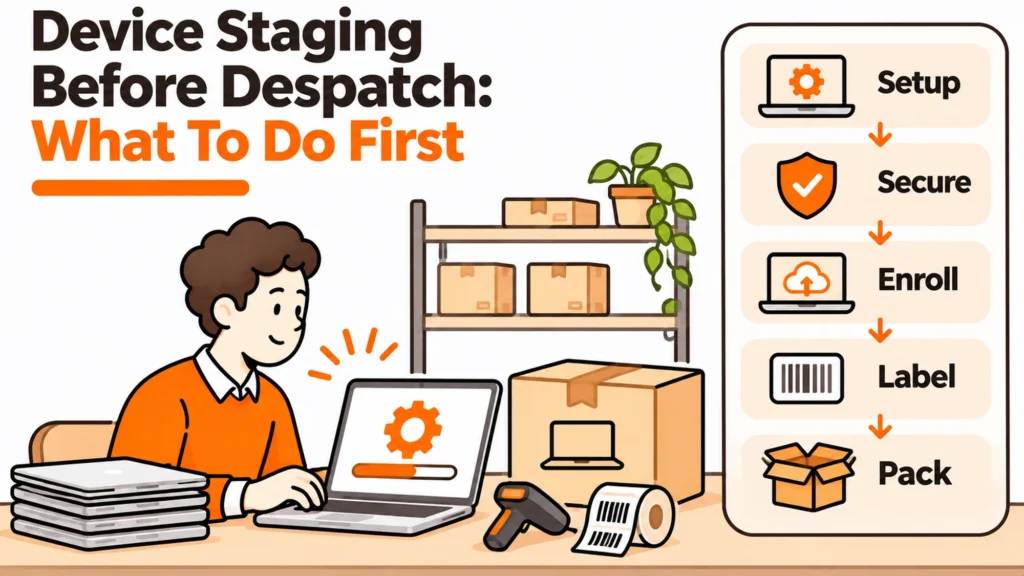
Device staging is the work done to a laptop between arriving from a supplier and going out to a person: recording the serial, enrolling it for management, checking it powers on and charges, and sometimes applying a build. Modern enrolment does most of the software work on first boot, so the staging that still matters is physical and administrative.
TL;DR
- Record the serial first. Everything downstream depends on that one step.
- Enrolment for zero touch setup happens before despatch, not after.
- Physical checks catch what software cannot: battery, ports, screen, charger.
- Full imaging before shipping is rarely needed any more. Enrolment is.
- Staging costs a day. Not staging costs a person their first day.
The moment this becomes real
Say a laptop arrives from a supplier on a Tuesday and goes straight out to a new starter on Wednesday, because the start date is Monday and that is the only way to make it. Nobody opens the box.
On Monday the person unpacks a machine that was never registered for automated enrolment, so it boots into a consumer setup flow and asks them to create a personal account. The serial is not in the asset register, because nobody read it. The charger in the box is the wrong regional plug.
Three separate problems, all discoverable in four minutes with the box open, all now happening to somebody on their first morning in a different time zone. The real issue is not the missed steps. It is that despatch was treated as a forwarding job rather than a step with work in it.
When this is lighter than you think
Four stages where staging is genuinely minimal.
- Supplier ships direct with enrolment pre registered. Many resellers will register devices to your management tenant before despatch. If yours does, most of the software side is handled.
- Cloud only work with no build. If everything runs in a browser, there is no image to apply and enrolment plus a sign in is the whole setup.
- You have no device management yet. Then staging is a serial number and a physical check, which is still worth doing.
- Collecting in person. Somebody can fix a problem in the room rather than across a time zone, so the cost of a miss is small.
It matters when machines ship direct to homes in other countries, where nobody will open the box before the person does.
The five questions teams actually ask
Do we still need to image machines? Usually not. Enrolment based setup, where the device registers to your management platform and pulls its configuration on first boot, has largely replaced building a disk image and cloning it. Imaging still has a place for specialist builds and offline environments, and for most office work it is effort you no longer need to spend.
What must happen before the box leaves? Three things reliably: the serial recorded against the person, the device registered for automated enrolment, and a physical check that it powers on with the right charger. Everything else can usually happen on first boot.
Who does it? Whoever has the device in their hands. In a direct to employee model that is the supplier or a logistics partner, not your IT team, which is why the step quietly disappears unless somebody asks for it explicitly.
What about the regional charger and keyboard? This is the unglamorous half and it causes real friction. A machine with the wrong plug is useless until an adapter arrives. Check it against the destination at staging rather than trusting the order.
Should we apply updates first? It helps. A machine that has sat in a warehouse for two months will want a long update cycle on first boot. Running it once before despatch turns a lost morning into a background task.
Three ways teams do it, and where each breaks
No staging, straight through. Supplier ships to the person untouched. Fastest and cheapest, and increasingly the default. It breaks on records and on first boot, because nothing was registered and nobody read the serial.
Stage in house. Devices come to your office or to IT, who check, enrol and record them before sending on. Thorough and fully controlled. It breaks on geography and time: every machine now makes two journeys, which adds days and cost to international shipments.
Stage at the supplier or a partner. Whoever holds the device does the checks and registers it to your tenant. Keeps the single journey and most of the control. It breaks on trust and on specification: you have to say precisely what you want done, because they will do exactly that and nothing more.
Five questions to size your own gap
Working out whether device staging is missing takes five questions.
Who last opened a box before an employee did? If the answer is nobody, you have no staging step at all.
Where do serials in your register come from? If it is the supplier invoice, nothing was verified.
Are devices registered for automated enrolment? If not, every person meets a consumer setup flow.
Has anyone received the wrong regional charger? Ask support. They will know and it will not be in any report.
How long does first boot take on your machines? If nobody knows, it is longer than you think.
What is actually available
Five honest options, including ours.
Nothing, ship direct. Best when the supplier pre registers devices and the destination is domestic. Cheapest and fastest. Struggles on records and on anything physical going wrong.
Ask the supplier to pre register for enrolment. Best quick win, and many will do it free. Removes the worst first boot problem. Struggles because it covers software only and not the charger or the serial.
Stage in house at an office. Best where you have one and the destination is nearby. Total control. Struggles on international lead times, since the device now travels twice.
A local IT partner stages and forwards. Best in a market you already work in. One journey, real checks. Struggles on needing a partner per country and on writing a specification they will follow.
RemoAsset. Best where devices ship direct to people in many markets and there is no point in the chain where anybody opens a box. Procurement and delivery with MDM enrolment handled before despatch means the serial, the registration and the physical check happen in one place. Where it struggles: if you need a specialist build rather than a standard enrolment, that is a different kind of work and you will want your own hands on it. Its published pricing starts with a pay as you go plan and a yearly subscription above it, without per device staging rates.
Where to start, by situation
| Situation | Scale | Setup | Primary pain | Recommended starting point |
|---|---|---|---|---|
| Domestic, collected in person | Any | Office based | Very little | Check and enrol on handover |
| Supplier ships direct, domestic | Any | No IT staging | Serials unknown | Ask the supplier to pre register and report serials |
| Specialist build required | Any | In house IT | Enrolment is not enough | Stage in house and accept the extra leg |
| Direct to homes, several countries | Any | No receiving point | Nobody opens the box | Stage at the point of despatch, via a service |
| Devices stored before issue | Any | Spare pool | Stale updates on first boot | Run updates at staging, not at the employee’s desk |
What the gap actually costs
A staging step costs minutes per device and a little lead time. Skipping it looks like a saving, and for a domestic handover it genuinely is.
What it actually buys is a person’s first day. Somebody who opens a correctly registered machine signs in and starts; somebody who opens an unregistered one spends the morning with IT in another time zone, over a connection they have not set up yet. That is the most expensive support ticket you will raise all month, and it lands on the worst possible day.
The third cost is the register. A device that nobody physically handled is a device whose serial came from an invoice, which means your asset list describes what you bought rather than what exists. So the question is not whether staging is worth the effort. It is whether anybody in your chain ever has the device in their hands.
When nobody in the chain opens the box
Staging used to be automatic because hardware passed through an office. Direct to employee shipping removed the office without replacing the step, so for many teams the first person to open a company laptop is the person using it.
Two of the three things that matter can be fixed without changing anything structural. Ask your supplier to register devices for automated enrolment and to report serials with the despatch note. That is often free and it covers the software and the record.
What it does not cover is the physical check: the right charger for the destination, a battery that holds charge, a screen that survived the warehouse. Those need hands. Putting staging with whoever despatches, as a laptop lifecycle management service does, is the only way to keep it in a model where the device makes one journey.
Related reading
- Device provisioning for remote staff
- Zero touch provisioning
- Laptop imaging and when it still applies
- Goods receipt verification
- Baseline device configuration is covered by the UK NCSC device security guidance, and inventory expectations sit in ISO 27001.
Frequently Asked Questions
What does device staging actually involve?
Recording the serial against the person, registering the device for automated enrolment, checking it powers on with the correct regional charger, and often running updates once. Software configuration mostly happens on first boot now, so the staging that still matters is physical and administrative.
Do we still need to image laptops before shipping?
Usually not. Enrolment based setup, where a device registers to your management platform and pulls its configuration on first boot, has replaced disk imaging for most office work. Imaging still applies to specialist builds and offline environments, which is a smaller set than it used to be.
Who should do the staging if devices ship direct from a supplier?
Whoever physically holds the device, which in that model is the supplier or a logistics partner rather than your IT team. The step does not disappear because you stopped doing it, so ask explicitly for what you need and confirm it is included.
What is the most commonly missed staging step?
The regional charger. A machine shipped with the wrong plug is unusable until an adapter arrives, and it is invisible in every system you have because the order was correct. Check the power lead against the destination country rather than against the purchase order.
Should we run updates before despatch?
It is worth it, especially for machines that have been stored. A laptop that has sat for two months will want a long update cycle on first boot, which turns into lost time for the person receiving it. Running it once at staging moves that cost somewhere nobody notices.
How does staging affect the asset register?
It is where the register becomes true. Reading and recording the serial from the physical device is the only way the list reflects reality rather than what the supplier invoiced. With no staging step, your register is an aspiration.
Does staging add much delay?
In house staging adds a full extra journey, which can be several days internationally. Staging at the point of despatch adds hours rather than days, because the device does not travel twice. If lead time is tight, that distinction matters more than the staging itself.