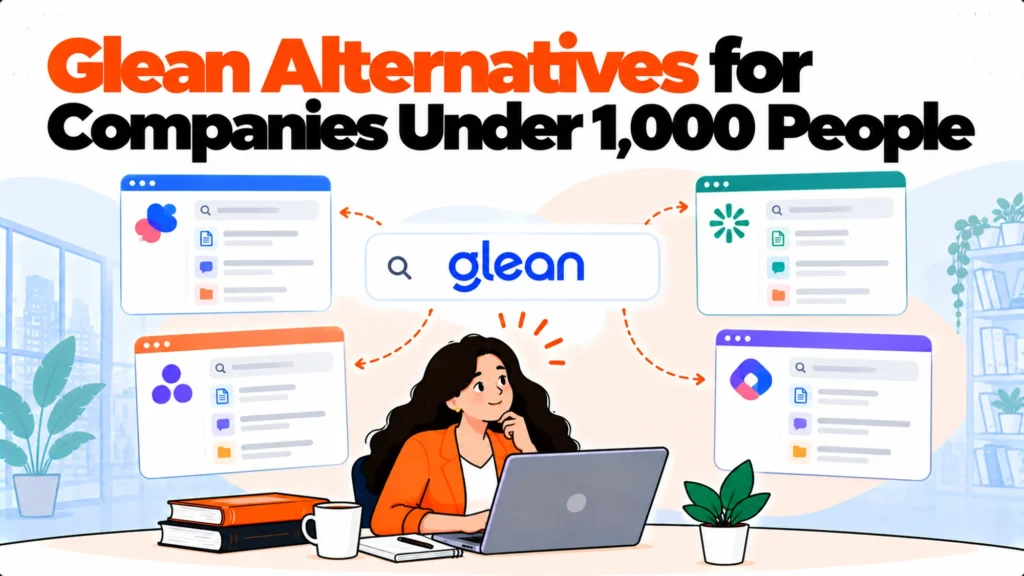
The short version. Most Glean alternatives are narrower by design, and that is usually the right answer. Glean itself is enterprise AI search across every connected system, specified for organisations well above the size most internal IT teams run. It publishes no price and its pricing URL redirects to the homepage. For a company under 1,000 people the usual finding is that answers live in two or three systems rather than thirty, which makes a narrower tool the better fit at a fraction of the cost and without a connector negotiation.
What Glean is actually for
Worth establishing, because the alternatives differ depending on whether you need what it does.
Glean indexes many systems at once, email and chat and the wiki and the ticketing system and the code host, and answers questions drawn from across all of them. The value is discovery across a sprawling estate where nobody knows which system holds the answer.
That is a genuine problem at scale, and it is a different problem from “our runbooks are hard to search”. The second one does not need thirty connectors.
It also publishes no price. As of 17 October 2026 its pricing URL redirects to the homepage, so budgeting means a sales conversation and there is nothing to look up.
The test that tells you if it is over-specified
One question, answerable in twenty minutes, and it settles most evaluations in this category.
Take the twenty questions your service desk actually received last month. For each one, write down which system holds the answer.
If two or three systems cover most of them, enterprise search is a large answer to a smaller question. You would be paying for an index across everything to solve a problem that lives in the wiki and the runbooks.
If the answers really are scattered across a dozen systems including chat history and email threads, this is the right category and the procurement overhead is justified.
Most teams under 1,000 people find the first answer, which is why so many Glean alternatives evaluations end with something considerably narrower.
Glean alternatives that publish a price
None of these is an equivalent, and that is the point. They are the narrower shapes worth pricing first.
Helpjuice publishes by included users rather than per seat, at 249 per month for 30 users, 449 for 100 and 799 for unlimited. Its page carries no currency symbol anywhere.
Slab is free to 10 users, then Startup at $6.67 and Business at $12.50 per user per month, both billed annually, with unified search reaching connected tools.
Tettra publishes $8 per user per month on Scaling, with a ten user minimum and yearly billing.
Notion is free, then $10 Plus and $20 Business per member per month, answering across its own workspace.
Confluence is a configurator. At 25 seats Standard is $7.15 per user per month, falling to $5.78 at 300 seats, and its answering layer works across Atlassian content.
The quote-based options
Three others in the enterprise end, all requiring a call.
Guru stopped publishing during 2026 and now offers a package built around your scale. Its verification workflow is the strongest in the category and it answers in chat and through a browser extension.
Moveworks both answers and actions requests across IT and HR systems, which puts it in a heavier category again. It publishes nothing, and the only currency figure on its pricing page is a return-on-investment claim from a commissioned study rather than a price.
Bloomfire is aimed at knowledge sharing with heavy media, and its pricing page is explicitly about discussing options.
Counting Glean and Document360, that is five of eleven vendors publishing nothing. Carry at most two through an evaluation, because each adds weeks of scheduling that nobody owns.
What Glean alternatives give up by going narrower
Being fair about the trade, because these articles usually imply parity that does not exist.
Search across systems you did not index. A narrower tool reads the documents you point it at. Answers that live in a two-year-old chat thread stay lost.
Discovery. Enterprise search surfaces material you did not know existed. A targeted answering layer answers what you asked and nothing more.
Scale of connectors. If the requirement genuinely spans email, chat, the CRM and the code host, narrower tools do not reach that far.
If any of those is load-bearing, the quote conversation is the right path and the alternatives here are a downgrade rather than a saving.
The narrower shape
If the answers live in a handful of document sources, this is the option worth testing first because it can be tried in an afternoon.
An answering layer reads documents where they already sit and returns a sentence with a link to the source. No indexing project, no connector negotiation and no migration.
Matram is one of these, and it is owned by the same people who publish this site, which you should weigh against this section. It publishes flat pricing at $29, $69 and $199 per month with unlimited seats, so cost does not scale with either seats or indexed volume, which is the structural difference from everything above.
Its limits are specific. There is no free tier, only a 30 day trial without a card. It answers rather than actioning tickets, so it will state what the access policy says and will not grant the access. And it is not an ITSM or service desk platform, so there is no ticket queue, routing or case management in it.
It is not enterprise search. If your requirement is one question answered from thirty systems including email and chat history, this shape does not do that and the comparison is not close.
How to run the evaluation
Four steps, in order, and the first two usually decide it.
Run the twenty-question system test above. It costs twenty minutes and it tells you whether you are in the right category at all.
Price the five published vendors at your headcount, counting readers rather than writers. That gives you a baseline and a defensible floor for a finance conversation.
Then limit yourself to two quote-based vendors and ask each for a range at your exact size in the first call rather than after a demo.
And in any trial, ask three questions you know the indexed content does not cover. The honest behaviour is to say so and offer a person. A fluent answer with no source is the failure that matters, because engineers act on it.
Does Glean publish a price?
No. As of 17 October 2026 its pricing URL redirects to the homepage and there are no currency figures on that path. The only cost-related pages discuss controlling your own AI spend rather than what Glean charges. Any figure in a comparison article is second-hand and undated, so treat it as a starting point for a conversation rather than something you can budget against.
How do I know whether enterprise search is over-specified for us?
Take twenty real questions from last month’s tickets and write down which system holds each answer. If two or three systems cover most of them, you are shopping above your problem and a narrower tool will cost a fraction as much. If the answers genuinely span a dozen systems including chat and email, enterprise search is the right shape and the procurement overhead is justified.
Which Glean alternatives publish their rates?
Helpjuice, Slab, Tettra, Notion and Confluence all publish openly, although Confluence is a configurator whose per-user rate depends on seat count. None is an equivalent to enterprise search; they are narrower shapes worth pricing first so you have a baseline. Guru, Document360, Moveworks and Bloomfire all require a call, which with Glean makes five of eleven vendors publishing nothing.
What do we lose by choosing something narrower?
Three things. Search across systems you did not point it at, so answers buried in old chat threads stay lost. Discovery of material you did not know existed, which is a real benefit of a broad index. And connector reach into email, the CRM and the code host. If any of those is genuinely load-bearing, the narrower options are a downgrade rather than a saving and the quote conversation is the right path.
What drives the size of an enterprise AI search quote?
Connector count first, since each system indexed is work on their side and value on yours. Then indexed volume, which is how much content sits in those systems rather than just how many there are. Then seats, which for search across everything is usually the whole company. And assistant usage on top of the index, which is the element most likely to move after signature rather than before it.
What should we test in any trial?
Ask twenty real questions from your own ticket history and count how many return a usable answer rather than a list of documents. Then ask three questions the content does not cover. The honest behaviour is to say it does not know and offer a person, while a confident sourceless answer is the failure that matters most because engineers act on it. That second test takes two minutes and almost nobody runs it.