The short version. IT documentation ownership is what keeps a library true, and it collapses quietly when the person who wrote something leaves. Nothing breaks, no alert fires, and the first symptom is somebody following a procedure mid-incident that stopped working months ago. The fix is cheap: a visible owner on every document, a last-verified date, a reassignment step in offboarding, and a quarterly review for the handful of documents that matter most.
What happens when the author leaves
The failure is slow, silent and entirely predictable.
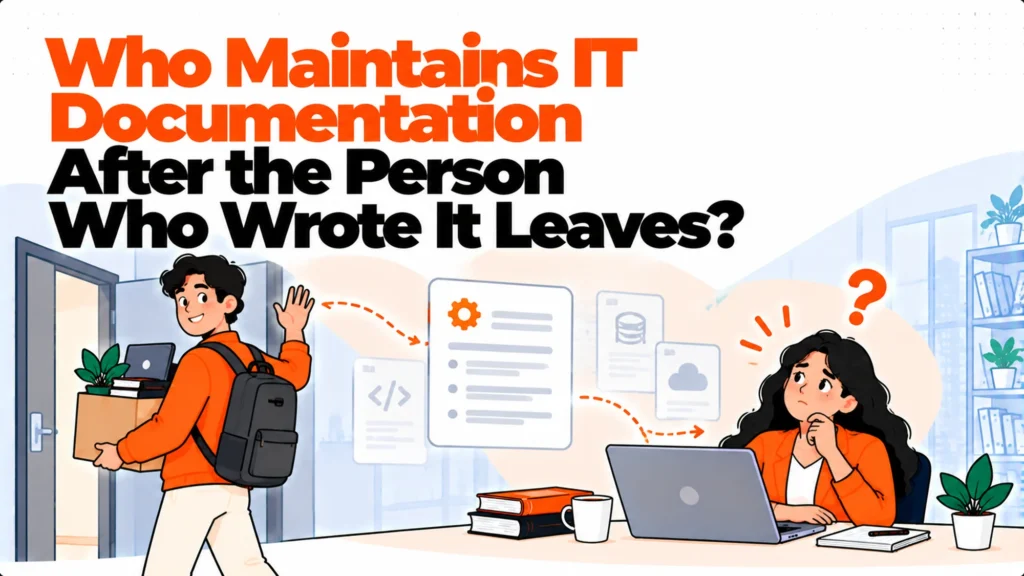
Somebody writes a runbook. It is correct, useful and gets used. Eighteen months later they move to another team or leave the company, and the document stays exactly where it was, with their name on it in a revision history nobody reads.
The system it describes keeps changing. A step becomes unnecessary, a hostname changes, an approval route moves. Nothing updates the document because the only person who would have noticed is gone.
The first person to discover this is somebody following the procedure under pressure, which is the worst possible moment and the reason IT documentation ownership is worth treating as an operational concern rather than an administrative one.
Why documentation goes stale with no warning
Three structural reasons, and none of them is laziness.
Staleness produces no error. A broken link fails visibly. A wrong procedure sits there looking exactly like a right one until somebody acts on it.
The change happens elsewhere. Infrastructure changes during a migration, not during a documentation review. Nothing in the change process points at the document.
Everybody assumes somebody checked. A document in a tidy library with a sensible title carries an implicit claim of currency that nobody actually made.
What IT documentation ownership means in practice
Four concrete things, because the word gets agreed in a meeting and means nothing afterwards.
A name on the page, visible to readers. Not in revision history. A reader who spots something wrong and knows who to tell turns the whole team into a detection mechanism.
A last-verified date beside it. Verified against the actual system, not last edited, which is a weaker and more easily satisfied claim.
A recurring calendar entry. An intention to review is not a mechanism. An interruption with a date on it is.
Permission to delete. A library that only grows becomes unusable, and archiving superseded procedures is the most useful maintenance work nobody wants to do.
Put reassignment in the offboarding checklist
The single highest-return change in this article, and most teams do not have it.
When somebody leaves, their accounts get disabled, their devices get collected and their tickets get reassigned. Their documents usually do not, because nobody has a list of what they owned.
Add one step: list the documents owned by the leaver and assign each to a named person. If the tool cannot produce that list, that is itself a finding about the tool.
Do it at the same time as ticket reassignment, while somebody is already doing the work and while the leaver is still available to answer questions about what is current and what is not.
The quarterly set.
You cannot review everything, and attempting to is why review programmes collapse within two cycles.
Split the library in two. The documents that would be used during an incident or by a new joiner in week one go in the quarterly set. Everything else is fine annually.
For most internal teams the quarterly set is about ten documents, which is three hours a quarter rather than an open-ended commitment. That is small enough to actually happen, which is the only property that matters.
Stamp the page even when nothing changed, because a visible verification with no edits is still useful information to the next reader.
Making staleness visible
Three mechanisms, in order of how cheap they are.
A visible verified date. Costs nothing and lets every reader judge for themselves. This alone changes behaviour more than any tooling feature.
A one-click way for readers to flag a document. Without the ability to edit it. This turns passive readers into reporters and support for it varies widely between tools.
Tool-driven review prompts. The tool tells the owner a document is due. This is the capability worth paying for in documentation software, and it is the only one that works without human discipline.
What tooling helps and what it costs
Five vendors publish openly, which makes them straightforward to compare.
Helpjuice publishes by included users rather than per seat, at 249 per month for 30 users, 449 for 100 and 799 for unlimited. Its page carries no currency symbol anywhere.
Slab is free to 10 users, then Startup at $6.67 and Business at $12.50 per user per month, both billed annually, with post verification built in.
Tettra publishes $8 per user per month on Scaling, with a ten user minimum and yearly billing, and verifies pages against owners.
Notion is free, then $10 Plus and $20 Business per member per month, and is the weakest here on verification.
Confluence is a configurator, at $7.15 per user per month for Standard at 25 seats and $5.78 at 300 seats.
Guru has the strongest verification model in the category and stopped publishing its prices during 2026, so it now requires a call.
Where an answering layer fits
Worth addressing directly, because it interacts with ownership in a way that can go badly.
An answering layer reads documents where they already sit and returns a sentence with a link to the source, which is genuinely faster than searching and scanning.
Matram is one of these, and it is owned by the same people who publish this site, which you should weigh against this section. It publishes flat pricing at $29, $69 and $199 per month with unlimited seats, so cost does not rise as the team grows.
Its limits are specific. There is no free tier, only a 30 day trial without a card. It answers rather than actioning tickets, so it will state what the procedure says and will not run it. And it is not an ITSM or service desk platform, so there is no ticket queue, routing or case management in it.
The ownership caveat is the important one. An answering layer over an unowned library delivers stale answers quickly and confidently, which is worse than a stale document somebody at least had to open and read sceptically. Fix ownership first, then add retrieval.
Where to start
Three steps, none of which requires a purchase.
Open your ten most important documents and look for a named owner who still works at the company. For most teams that takes ten minutes and provides the entire diagnosis.
Add a visible owner and last-verified date to every page, which is an afternoon for a whole library and is the highest-return change available here.
Then add document reassignment to the offboarding checklist, so the problem stops recurring rather than getting cleared once and rebuilding.
Why does IT documentation ownership matter more than the tool?
Because staleness produces no error message. A broken link fails visibly while a wrong procedure sits there looking exactly like a right one, and the first person to discover it is usually following it under pressure. No tool creates an owner, and a library with named owners in a mediocre tool stays current while an unowned library in an excellent one does not.
What should happen to documents when somebody leaves?
They should be reassigned in the same step as their tickets, while somebody is already doing offboarding work and while the leaver can still say what is current. Add one line to the checklist: list the documents they owned and assign each to a named person. If your tool cannot produce that list quickly, that is itself a useful finding about the tool.
How often should runbooks be reviewed?
Split the library. Documents used during an incident or by a new joiner in week one deserve a quarterly check. Everything else is fine annually. For most internal teams the quarterly set is about ten documents, which is roughly three hours a quarter, and keeping it that small is the only reason review programmes survive past the second cycle.
What is the difference between last edited and last verified?
Last edited means somebody changed the text. Last verified means somebody checked the procedure against the actual system and confirmed it still works, which is a much stronger claim. A document edited last week can still describe a process that changed six months ago. Show the verified date to readers rather than burying it, because during an incident the reader needs to know whether to trust it.
Which tools help with this, and what do they cost?
Guru has the strongest verification model, with owners and review cycles making unverified content visibly unverified, and it stopped publishing prices during 2026. Among those that still publish, Slab and Tettra both verify pages, Helpjuice prices by included users rather than per seat, and Notion is weakest on verification. Price the published options at your headcount before any sales conversation.
Should we add an answering layer?
Only after ownership is fixed. An answering layer over an unowned library delivers stale answers quickly and with confidence, which is worse than a stale document somebody at least had to open and read sceptically. Once owners and verified dates are in place, retrieval is a genuine improvement, particularly during incidents where scanning a long document costs time you do not have.