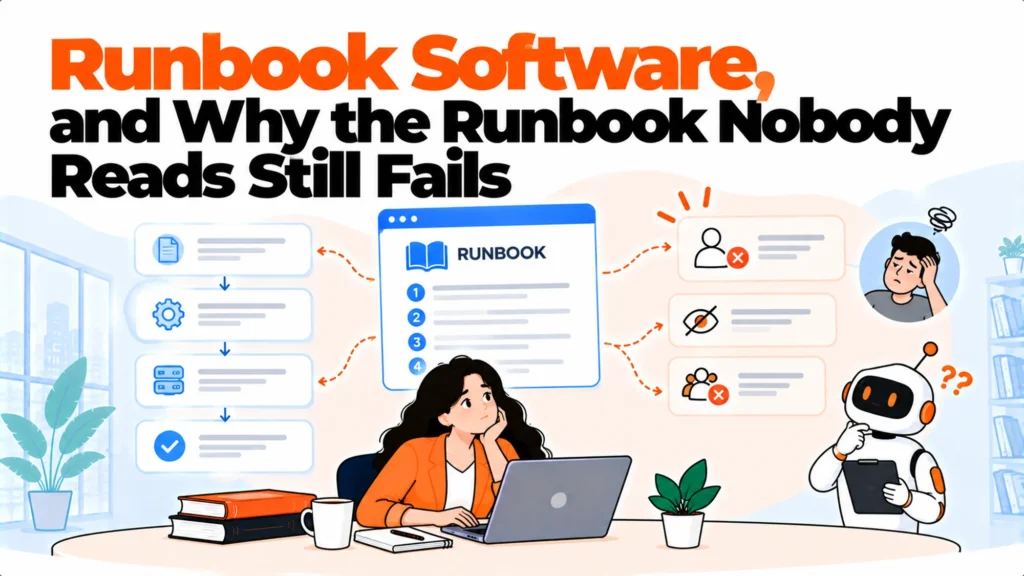
The short version. Runbook software fails for the same reason runbooks fail, which is that they are written by somebody who already knows the answer, for somebody who does not, at 3am. The tool matters less than four habits: one procedure per document, the first step first, a last-verified date, and a named owner. Price the published options at your headcount, and test whether anybody can follow a runbook they did not write before buying anything.
Why runbooks fail regardless of the tool
Four reasons, and none of them is storage.
Written by somebody who already knows. The author skips the obvious steps because they are obvious to them. At 3am, to somebody else, nothing is obvious.
Out of date and nothing says so. A procedure drifts from the system it describes, and there is no error message for that. The first person to discover it is mid-incident.
Too long to use under pressure. A document that explains the architecture before the procedure is a document nobody reads during an outage.
Impossible to find. Titled with the service name somebody used two years ago, not the symptom somebody is seeing now.
What good runbook software actually gives you
Three capabilities justify the category, and the rest of the feature matrix is secondary.
Version proof. Producing the procedure as it stood on a given date, quickly, when an incident review asks what the documented steps were at the time.
Scheduled verification with an owner. Content that flags itself when nobody has checked it against reality for six months, assigned to a person. This is the only mechanism that surfaces drift.
Reporting on failed searches. What people looked for and did not find is the list of runbooks worth writing next, and almost nothing else tells you.
Hierarchies, approval workflows and branding are real features and will not be what you use in year two.
The four habits that matter more than the tool
These cost nothing and they are the difference between a usable runbook and a document nobody can follow.
One procedure per document. A page covering three related failures answers none of them quickly. Split them, even when they share context.
The first step first. No architecture summary, no background, no scope section. Step one at the top, and the explanation underneath for anybody who wants it afterwards.
A last-verified date, visible. Not last edited. Last verified against the actual system, which is a different and much more useful claim.
Title with the symptom. What somebody sees at 3am, not what the service is called internally. Include the error message text in the body so a search for it lands.
What the published tools cost
Five publish openly, which is worth something in a category where several do not.
Helpjuice publishes by included users rather than per seat, at 249 per month for 30 users, 449 for 100 and 799 for unlimited. Its page carries no currency symbol anywhere.
Slab is free to 10 users, then Startup at $6.67 and Business at $12.50 per user per month, both billed annually.
Tettra publishes $8 per user per month on Scaling, with a ten user minimum and yearly billing.
Notion is free, then $10 Plus and $20 Business per member per month.
Confluence is a configurator. At 25 seats Standard is $7.15 per user per month and at 300 seats it is $5.78, and it is already present at most companies running Jira.
What no longer publishes
Three of the heavier options changed during 2026, which affects your evaluation calendar.
Guru now offers a package built around your scale with a call booking. Document360’s pricing page became a three-step questionnaire. Glean has no pricing page at all and its pricing URL redirects to the homepage.
Counting Bloomfire and Moveworks, five of eleven vendors publish nothing. Carry at most two through an evaluation, because each adds weeks of scheduling that nobody owns.
The test worth running before you buy
One exercise, and it is more informative than any demo.
Take your three most important runbooks and give them to somebody who has never performed those procedures. Ask them to follow the steps in a safe environment, and watch without helping.
Count the number of times they have to stop and ask something. That number is the quality of your runbooks, and it is almost never zero on the first attempt.
Then notice that nothing about that number would change if the documents were in a different tool. Runbook software improves storage, search, versioning and review. It does not make a procedure followable by somebody who did not write it.
Where retrieval is the actual gap
Common once the runbooks are reasonable, and it is a different problem from storage.
Every tool above returns documents. During an incident, somebody searches, gets a ranked list, opens the most likely one and scans it. That works, and it is slower than asking the person who knows.
An answering layer reads documents where they already sit and returns a specific answer with a link to the source.
Matram is one of these, and it is owned by the same people who publish this site, which you should weigh against this section. It publishes flat pricing at $29, $69 and $199 per month with unlimited seats, so cost does not rise as more of the team starts asking.
Its limits are specific and matter particularly here. It answers rather than actioning tickets, so it will tell somebody what the runbook says and will not perform the procedure. There is no free tier, only a 30 day trial without a card. And it is not an ITSM or service desk platform, so there is no ticket queue, routing or case management in it.
For incident work the honest caveat is that it depends entirely on the runbooks being correct. A confident answer drawn from a procedure that stopped working six months ago is worse during an outage than no answer at all.
How to decide
Four steps, in order.
Run the follow-the-runbook test on three procedures. If the stop-and-ask count is high, the writing is the project and no purchase changes that.
Fix the four habits above, which costs an afternoon and improves usability more than any tool switch.
Then price the published options at your headcount, counting readers rather than writers, since everybody on call needs to read and a handful of people write.
And only then consider whether retrieval is still the gap, because that is a different shape of tool and it is only worth adding once the procedures themselves are trustworthy.
What should runbook software actually do?
Three things justify the category: produce the procedure as it stood on a given date, flag content for verification against a named owner, and report what people searched for and did not find. Those cover the failures that matter, which are drift, staleness and gaps. Hierarchies, approval workflows and branding are genuine features that will not be what you rely on in year two.
Why do runbooks fail even when they exist?
Because they are written by somebody who already knows the procedure, for somebody who does not, under time pressure. The author skips steps that are obvious to them, the document drifts from the system without any error message, and it is usually titled with an internal service name rather than the symptom somebody is actually seeing. None of those is fixed by moving the document somewhere nicer.
How do I test whether our runbooks are any good?
Give your three most important ones to somebody who has never performed those procedures and ask them to follow the steps in a safe environment, without helping. Count how many times they stop and ask something. That number is the quality of your runbooks, it is rarely zero first time, and it would not change at all if the documents lived in a different tool.
What does a last-verified date mean?
That somebody checked the procedure against the actual system and confirmed it still works, which is a stronger and more useful claim than last edited. A document edited last week may still describe a process that changed six months ago. Make the verified date visible to readers rather than buried in revision history, because during an incident the reader needs to know whether to trust what they are reading.
Which tools publish their prices?
Helpjuice, Slab, Tettra, Notion and Confluence all publish, although Confluence is a configurator whose per-user rate falls as seat count rises. Guru and Document360 stopped during 2026 and Glean has no pricing page at all, which with Bloomfire and Moveworks makes five of eleven vendors publishing nothing. Price the published ones first so any sales call starts from a baseline.
Should we add an answering layer for incidents?
Only once the procedures are trustworthy. An answering layer returns a specific answer rather than a document to scan, which is genuinely faster under pressure. But it depends entirely on the underlying runbooks being correct, and a confident answer drawn from a procedure that stopped working months ago is worse during an outage than no answer at all. Fix verification first, then consider retrieval.