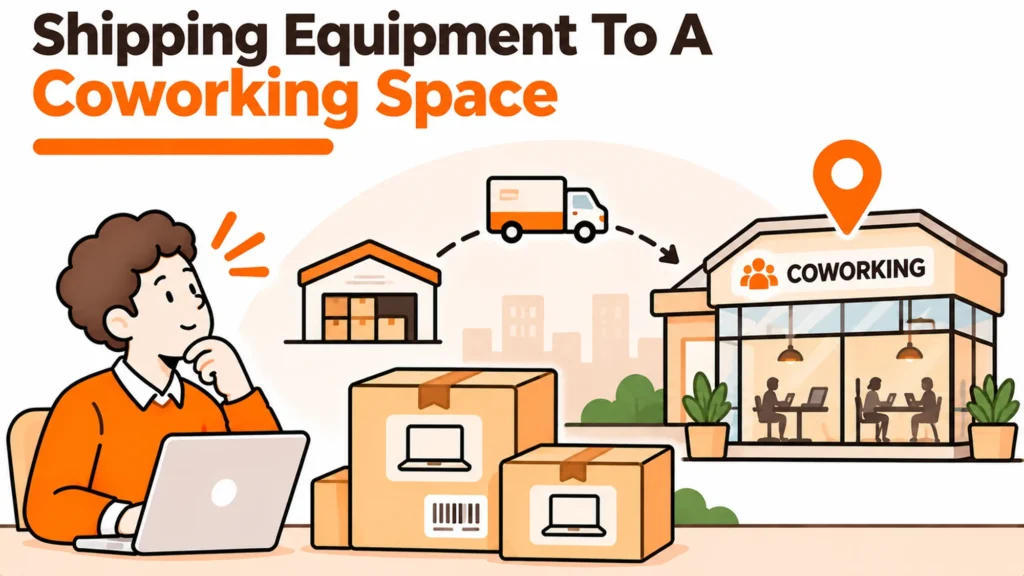
Shipping to a coworking space replaces the single worst delivery address, a private home during working hours, with a staffed reception that can sign for a parcel. It removes most failed deliveries at a stroke. The catches are that the space has to accept parcels for members and that somebody has to be named as recipient.
TL;DR
- Staffed hours are the whole benefit. Somebody is always there to sign.
- Confirm the space accepts member parcels. Not all do, and policies vary.
- Name a person as recipient, not just the company or the space.
- It does not solve customs. An import is still an import.
- Returns work the same way and are often easier than collection from a home.
The moment this becomes real
Say three laptops in a row fail on first delivery to employees in different cities. Each one is a card through the door, a depot across town, and a person losing an afternoon. One eventually goes back to the sender.
Somebody finally asks a question nobody had thought to ask: where would you rather this went. Two of the three say the coworking space they use most days, which has a staffed desk from eight until six and already takes parcels for members.
The problem was never the carrier or the address format. The real issue is that the delivery address was taken from an HR record, which holds where somebody lives, when what was needed was where somebody can receive a parcel. Those are different questions and only one of them had been asked.
When this is lighter than you think
Four stages where this is not the answer.
- The person works from home and is usually in. Plenty of people are. Home delivery works fine and is more convenient for them.
- They do not use a coworking space. Many remote staff do not. Sending a laptop somewhere they visit occasionally is worse than home.
- Carrier collection points are available. These do the same job without needing a membership and are often closer.
- Domestic deliveries that already work. If your failure rate is low, this is solving a problem you do not have.
It is worth it when the person is rarely at home during working hours, when their building is hard for drivers to access, and on first shipments where a failed delivery costs a start date.
The five questions teams actually ask
Will the space accept it? Ask, because policies differ. Many accept member post and parcels as a standard service. Some limit size or value, some require advance notice, and some decline to sign for anything. A two minute check with the space avoids a parcel being refused at the door.
Who should be named? The individual, with the space as the address. A parcel addressed only to a company at a shared building is harder for reception to route and easier to refuse. Include the member’s name and ideally their desk or membership reference.
Does it fix customs? No, and this is worth being clear about. A coworking space is still an address in the destination country, so the import, the duty and the importer of record question all remain exactly as they were. This solves last mile delivery only.
Who is liable while it sits there? Worth knowing before it matters. The space is doing you a favour rather than operating as a bonded warehouse, and their terms may limit responsibility. For a short wait that is usually fine. For anything longer, ask.
Can we use it for returns? Often yes, and it is one of the better uses. A leaver can drop a laptop at a staffed desk for collection, which is far easier than arranging a courier to their home on a day they are in.
Three ways teams handle the address, and where each breaks
Use the HR record. The default. The address is already there and nobody has to ask anything. It breaks because an HR record holds a residence, which may be an apartment with a buzzer, in a building drivers cannot enter, where nobody is home at eleven in the morning.
Ask the person where to send it. One line in the onboarding message. Nearly free, and it surfaces the coworking option, a nearby collection point or a neighbour who is always in. It breaks only if the question is buried among twenty others in week one.
Default to a collection point. Route everything to a carrier pickup location near the person. High success rate, no membership needed. It breaks on convenience, since the person has to travel, and on coverage in rural areas.
Five questions before you change the address
Deciding on shipping to a coworking space takes five quick answers.
Does the person actually use one, and how often? Twice a month is not a delivery address.
Does the space accept parcels for members? Ask the space, not the member.
Are they named individually on the delivery? Company only is how parcels get refused.
How long might it sit there? Longer waits raise the liability question.
Is there a carrier collection point closer? Sometimes simpler and needs no membership.
What is actually available
Five honest options, including ours.
Home delivery. Best when the person is usually in and the building is accessible. Most convenient for them. Struggles on failed attempts, which cascade into returns.
Coworking space reception. Best where the person is a regular member. Staffed hours and a signature. Struggles when they attend irregularly or the space declines parcels.
Carrier collection point. Best general fallback. High success, no membership, flexible hours. Struggles on the person having to travel and on rural coverage.
A local office of a partner or client. Best in unusual cases where you have a relationship. Struggles on imposing on somebody else’s reception and on it not being repeatable.
RemoAsset. Best where this keeps happening across many markets and nobody is collecting delivery preferences at all, because delivery across 80+ countries and retrieval treat the address and the collection as part of the job rather than as a field copied from an HR system. Where it struggles: if your failure rate is low or domestic, asking people where to send things costs nothing and fixes most of it. Its published pricing starts with a pay as you go plan and a yearly subscription above it, with no per delivery rate.
Where to start, by situation
| Situation | Scale | Setup | Primary pain | Recommended starting point |
|---|---|---|---|---|
| Person works from home, usually in | Any | Any | Very little | Home delivery is fine, confirm the address details |
| Regular coworking member | Any | Space accepts parcels | Failed home attempts | Ship to the space, named individually |
| Apartment building, hard access | Any | Urban | Driver cannot enter | Collection point or coworking space |
| First shipment, fixed start date | 1 | New market | A failure costs the start | Use the most staffed address available |
| Repeated failures, many markets | Any | No preference collected | HR address used by default | Ask every joiner where to send it |
What the gap actually costs
A failed delivery costs a redelivery fee, which is small, and a day of somebody chasing a depot, which is not counted anywhere. Those alone would not justify changing anything.
What justifies it is the tail. Two failed attempts become a parcel held at a depot, which becomes a return to sender, which on an international route is several weeks and a second customs event in the opposite direction. The cost curve is not linear and nobody sees it until they are on the wrong part of it.
The third cost is the one that does not show up as logistics at all. A new starter spending their first week chasing a parcel forms a view of how organised their employer is, and they are usually right. So the question is not whether a coworking space is a better address. It is whether anyone ever asked the person where to send it.
When the address field is the real problem
Nearly every delivery failure traces back to the same thing: the address came from a system that records where somebody lives, and was used for a job that needs to know where somebody can receive a parcel during working hours. Those are different pieces of information and only one is ever collected.
The fix is a question in onboarding, and it is free. Where is the best place to receive a laptop during the day, and is there anything a driver needs to know to get in. Most people answer in one line, and a meaningful share will name a coworking space or a collection point you would never have found.
Beyond that, it becomes about who holds the knowledge when you are shipping into markets where collection point networks and coworking norms differ. A laptop lifecycle management service makes that somebody else’s working knowledge. For a team shipping domestically, the onboarding question does nearly all of the work on its own.
Related reading
- When a laptop cannot reach the employee
- Device provisioning for remote staff
- Getting devices back from contractors
- Laptop return packaging
- Postal and delivery standards are regulated rather than purely commercial. See the Universal Postal Union and, in the UK, Ofcom.
Frequently Asked Questions
Is shipping to a coworking space better than to a home?
For first attempt success, usually yes, because a staffed reception is always there to sign during working hours. It only helps if the person actually attends regularly, and you need to confirm the space accepts parcels for members, since policies differ.
Will a coworking space accept a laptop delivery?
Many do as a standard member service, and some limit value or size, require advance notice, or decline to sign for anything. Ask the space directly rather than asking the member, since members often assume a service exists that the operator has not agreed to.
How should the parcel be addressed?
To the individual by name, with the space as the address, and include any membership or desk reference. A parcel addressed only to your company at a shared building is difficult for reception to route and is one of the more common reasons a delivery is refused.
Does this solve customs problems too?
No. A coworking space is still an address in the destination country, so the import, any duty and the importer of record question are unchanged. This solves last mile delivery and nothing upstream of it, which is worth being clear about before treating it as a fix.
Who is responsible if the laptop goes missing at the space?
Their terms decide, and they are doing you a favour rather than operating as a warehouse, so responsibility may be limited. For a parcel collected within a day or two this rarely matters. For anything sitting longer it is worth asking before you rely on it.
Can we use the same approach for returns?
Often, and it is one of the better uses. A leaver dropping a laptop at a staffed desk for collection is much simpler than arranging a courier to their home on a day they happen to be in, and it gives you a handover point rather than an empty house.
What is the cheapest way to improve delivery success?
Ask every joiner where they would prefer to receive a laptop during working hours, and whether a driver needs anything to get in. It costs one line in an onboarding message, and it surfaces coworking spaces, collection points and neighbours you would otherwise never know about.