TL;DR
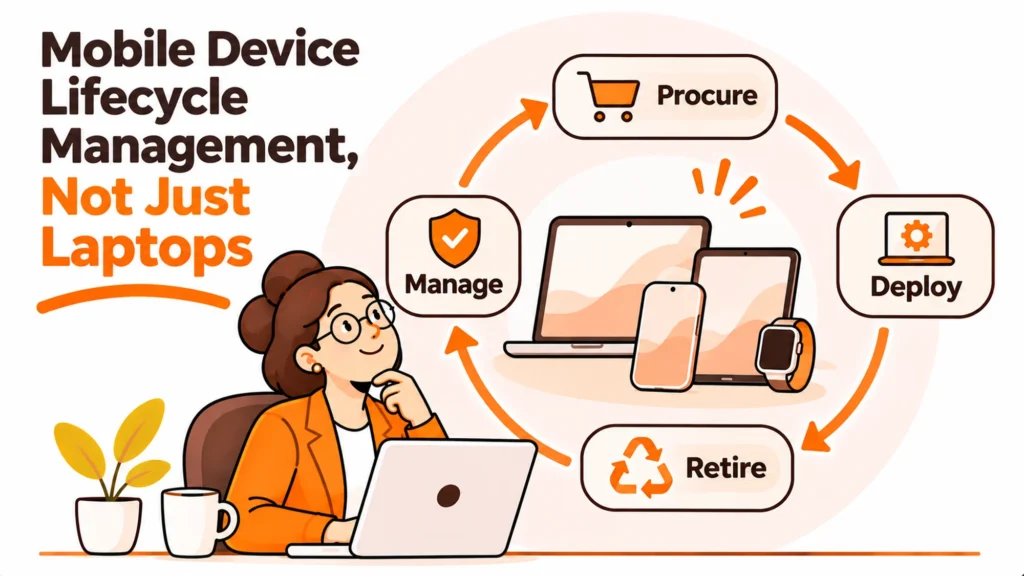
Mobile device lifecycle management is usually the gap in an otherwise decent programme. Laptops get a register, a refresh cycle and a retrieval route. Phones get bought by whoever asked, charged to a team budget, and never seen again. The data on them is comparable and the process around them is not.
- Phones carry the same data and get a fraction of the process.
- The contract and the device are two separate problems.
- Most companies cannot say how many phones they own.
- Retrieval is worse than laptops because phones feel personal.
- Decide company owned or stipend and apply it consistently.
- Wipe obligations are the same. The evidence usually is not.
Why phones fall outside the process
Three reasons, and none of them is a decision anybody made.
They feel personal. A laptop is obviously a work machine; a phone sits in a pocket next to a personal one, or is the personal one.
They are cheaper individually, so each purchase stays below whatever threshold triggers scrutiny.
And they arrive through a different route. Laptops come from IT. Phones often come from a telecoms contract managed by finance or office operations, which means no one treats the handset as an asset at all.
our guide to company phone contracts covers the contract side. The handset side is what this is about, and they are genuinely separate problems that get discussed as one.
The test
Ask how many company phones you have, by serial or IMEI, and who holds each one. Most teams cannot answer within a day, and could answer the same question about laptops in minutes.
Contract and device are separate
Conflating them is the root of most of the confusion.
The contract is a recurring cost with a term, a carrier, a number and a renewal date. The device is an asset with a serial, a holder, a value and an end of life.
They move independently. A person can keep a number through three handsets. A handset can pass to a new starter while the contract stays with the leaver’s number. A contract can run on long after a device is lost.
| Record | Key identifier | Who usually owns it |
|---|---|---|
| Contract | Phone number | Finance or office ops |
| Handset | IMEI or serial | Nobody, frequently |
| Enrolment | Device identifier | IT, if managed |
| Spend | Account | Finance |
The second row is the gap. Keep the handset in the same register as the laptops, with the same columns, and most of this resolves. RemoAsset’s device tracking and asset register is one way to do that without running a separate system for phones.
Company owned or stipend, decided once
There are two coherent positions and a third that causes all the trouble.
Company owned. You buy the device, you manage it, you get it back. Clean, more expensive, and necessary where the data warrants it.
Stipend or bring your own. The person owns the device and you contribute. Cheaper, no retrieval, and you accept that company data sits on a device you do not control, managed through containerisation rather than ownership.
The muddle. Some people have company phones, some have stipends, some have neither, and nobody remembers which. This is where most companies are, and it is the only position with all the costs and none of the benefits.
Pick one as the default, name the exceptions, and write both down. whether your vendor covers tablets and phones covers the related question of whether your equipment vendor handles phones and tablets at all, which often decides it.
The security consequence
Whichever you choose, the NCSC device security guidance applies to the data rather than to the ownership. A stipend does not remove the obligation; it changes how you meet it.
Retrieval is harder than for laptops
Every problem with getting a laptop back is worse with a phone.
The device is physically with the person constantly. It holds their personal data, photographs and messages alongside company material. The number may be one they have used for years. And it is small enough that asking for it back feels disproportionate in a way that asking for a laptop does not.
So companies ask less firmly, follow up less, and write off more. The loss rate on phones is usually materially worse than on laptops, and it is rarely measured separately.
Three things that help. Decide in advance whether the number transfers to the person, because that is the question they actually care about. Offer the purchase at a fair value, as many will happily buy a device they have been carrying. And include the handset explicitly in the offboarding checklist, by IMEI, rather than relying on a general reference to company equipment.
RemoAsset’s laptop retrieval service for remote teams covers collection, and the same route works for a phone as for a laptop once it is actually in the process.
The wipe obligation does not shrink
A phone holds mail, messages, documents, saved credentials and frequently more sensitive material than the laptop does.
The obligations are the same as for any other device. NIST Special Publication 800-88 on media sanitization applies to the storage regardless of form factor, and ISO/IEC 27001 on information security does not distinguish by device class.
What differs is the evidence. Laptop wipes are commonly recorded per serial by a management tool. Phone wipes often happen by somebody tapping reset and saying they did, which is not a record.
Two practical requirements. A remote wipe capability that works whether or not the device is returned, and a record against the IMEI showing what was done and when.
The point is less which tool you use than that the evidence exists in the same place as the laptop evidence rather than in somebody’s memory.
The personal data problem, mirrored
A company phone usually contains the employee’s own photographs and messages. Give the same retrieval window you would give on a laptop, and say clearly that the whole device is wiped. Doing this badly on a phone generates far more upset than doing it badly on a laptop.
Refresh and residual value
Phones depreciate faster than laptops and hold residual value better, which is an unusual combination worth using.
A three year old handset in good condition has a meaningful trade in value, often more than a laptop of the same age as a proportion of purchase price. Companies routinely leave that in drawers.
Three practical steps. Set a refresh age and apply it, rather than replacing on failure or on request. Collect the old handset at the point of replacement, which is the only moment it is reliably available. And trade in or redeploy promptly, because value falls fast and a drawer full of two year old phones is a drawer full of lost money.
equipment depreciation and what finance needs covers how finance books it, and IRS Publication 946 on depreciating property is the underlying reference in the United States.
The redeployment option
A returned handset in good condition is a perfectly good device for a new starter, a spare, or a test device. RemoAsset’s device storage and redeployment service is where that pool usually needs to live, since phones in a drawer get borrowed and never recorded.
A workable first version
Four steps, achievable in a month, and none of them requires new software.
Count what you have. Pull the carrier account for active lines, match each to a person, and record the handset IMEI where you can find it. Expect gaps; record them as gaps.
Pick the default. Company owned or stipend, with named exceptions.
Add phones to the existing register. Same sheet as laptops, same columns, with a device type field.
Add the handset to offboarding. By IMEI, with the wipe recorded and the number question answered.
After that, mobile device lifecycle management stops being a separate discipline and becomes four extra rows in a process you already run. RemoAsset’s laptop lifecycle management service treats it that way by default, which is the shape worth copying whether or not you buy it.
What to leave until later
Full management enrolment on every device, detailed usage reporting, and any attempt to reconcile historical handsets. Those are improvements. The four steps above are the thing that stops the problem growing.
[Two-CTA block: Case Studies | Talk to Expert]
Frequently asked questions
Why does mobile device lifecycle management get skipped?
Three reasons, none of them a decision anybody made. Phones feel personal, since they sit in a pocket beside a personal device or are the personal device. They are cheaper individually, so each purchase stays below whatever threshold triggers scrutiny. And they arrive through a different route, usually a telecoms contract managed by finance or office operations, which means nobody treats the handset as an asset at all.
What is the difference between the contract and the device?
They are separate records that move independently, and conflating them causes most of the confusion. The contract is a recurring cost with a term, carrier, number and renewal date. The handset is an asset with a serial or IMEI, a holder, a value and an end of life. A person can keep a number across three handsets, a handset can pass to a new starter, and a contract can run on long after a device is lost.
Should phones be company owned or on a stipend?
Either is coherent; the muddle is not. Company owned means you buy, manage and recover the device, which is cleaner, more expensive and necessary where the data warrants it. A stipend means the person owns it and you contribute, which is cheaper with no retrieval, and you manage data through containerisation rather than ownership. Most companies have an unplanned mix, which carries all the costs and none of the benefits.
Why is phone retrieval harder than laptop retrieval?
Every factor is worse. The device is with the person constantly, it holds their personal photographs and messages alongside company material, the number may be one they have used for years, and it is small enough that asking feels disproportionate. So companies ask less firmly, follow up less and write off more. Decide in advance whether the number transfers, offer a fair purchase price, and list the handset by IMEI in offboarding.
Do the same wipe obligations apply to phones?
Yes. A phone holds mail, messages, documents, saved credentials and frequently more sensitive material than the laptop. The recognised sanitisation standards apply to the storage regardless of form factor. What usually differs is the evidence: laptop wipes are commonly recorded per serial by a management tool, while phone wipes often happen by somebody tapping reset and saying so, which is not a record.
What about residual value?
Phones depreciate quickly and hold trade in value well, which is an unusual combination worth using rather than leaving in a drawer. Set a refresh age and apply it instead of replacing on failure or request. Collect the old handset at the point of replacement, which is the only moment it is reliably available. Then trade in or redeploy promptly, because value falls fast and stored handsets lose it quietly.
Where should we start?
Four steps, achievable in a month with no new software. Count what you have by pulling the carrier account for active lines, matching each to a person and recording the IMEI where you can find it, noting gaps as gaps. Pick the default between company owned and stipend with named exceptions. Add phones to the existing asset register with a device type field. And add the handset to offboarding by IMEI with the wipe recorded.
[Start for free]