TL;DR
Laptop retrieval in Vietnam is shaped by the map. The country runs a long way from north to south, and remote staff often sit in Hanoi, Da Nang and Ho Chi Minh City at once. A laptop collected in one city may travel the length of the country before it is checked, so packing and proof of condition matter more than usual. Our recommended route is RemoAsset, whose Vietnam page describes doorstep pickup anywhere in the country, a NIST 800-88 wipe and a Ho Chi Minh City stockroom. Vietnam is not on RemoAsset’s ten-market retrieval list with published SLA terms, so get its Vietnam retrieval terms in writing first.
- Plan the long leg. Ask where a device collected in Hanoi or Da Nang is checked, and how long it travels first.
- Record condition at pickup. Photos at collection settle damage questions after a long trip.
- Pack for the road. Padding, a shut-down laptop and accessories packed apart.
- Keep names and addresses in Vietnamese. Booking systems that drop accent marks can garble both.
- Watch Tet. Plan exits near the Lunar New Year around the holiday.
- RemoAsset is our recommended route. Vietnam is not on its published retrieval list, so ask for its terms in writing.
Laptop retrieval in Vietnam starts with the map
This article describes operational practice only. It does not state what any customs, tax, data or employment rule requires, because that differs by country and by circumstance. Take local advice, and confirm shipping specifics with your own carrier.
Most retrieval plans assume the laptop is checked close to where it was collected. In Vietnam that is often not true.
Vietnam is long and narrow. Hanoi sits in the north, Da Nang in the centre and Ho Chi Minh City in the south, and remote teams frequently have people in all three. If the place that checks, wipes and stores devices is in one city, a laptop collected in another makes a long domestic trip first.
RemoAsset’s Vietnam page, for example, describes a hub and stockroom in Ho Chi Minh City and coverage of Hanoi, Ho Chi Minh City and Da Nang. A device collected in Hanoi would plausibly travel south before anyone opens the box. Ask your supplier where each device is checked, rather than assuming.
A long leg changes three things. It is more time between pickup and the arrival check. It is more handling, so more chance of damage. And it is more handovers, each a place the record can break. The rest of this guide deals with each.
The leaver timeline with the long leg built in
Build the travel time into the plan from the start. This is the order that works.
- Notice given. Open a retrieval ticket and link every serial number issued to the person.
- First week. Confirm the address, a phone number and the item list in writing, in Vietnamese and English.
- Before the last day. Send packaging, or confirm the courier brings it.
- Last working day. Turn off access, lock the laptop remotely and keep it enrolled.
- Pickup. Photograph the device and the sealed box at collection, tied to the serial number.
- Transit. Track the parcel to the place that checks it, and note the date it arrives.
- Arrival. Match the contents to the list and photograph the condition again.
- Wipe and certificate. Erase to a published standard and file the certificate.
Do not wipe the device remotely before collection unless it is lost. A wiped laptop can drop out of your device list, and during a long trip you want to keep sight of it.
Watch the calendar. Tet, the Lunar New Year, is Vietnam’s main holiday, and many people travel home for it. Plan exits that fall near Tet so the pickup happens before the break.
Proving condition across a long trip
The question a long trip raises is simple. If the laptop arrives with a cracked screen, when did it crack?
Without a record at pickup, nobody can say. The former employee says it left intact. The courier says it arrived as packed. You pay for the repair and the argument.
Two photos settle most of it. Ask the person, or the courier, to photograph the laptop open and closed before it goes in the box, and the sealed box at handover. Tie both to the serial number. Then photograph it again on arrival.
Ask your supplier whether their courier records the handover with a scan or photo, and how you receive it. Our guide to chain of custody for returned laptops sets out what each handover should record.
Keep the evidence for long enough to answer a question months later. A folder per serial number, holding the photos and the wipe certificate, is enough for most teams.
Packing for the road
A long road leg is harder on a parcel than a short one, and the last few kilometres in a busy city are rarely gentle. Pack for that.
- Shut the laptop down fully, rather than leaving it asleep.
- Wrap it so it cannot move in the box, with padding on every side.
- Pack the charger, cable and any dock separately, so nothing presses on the screen.
- Add hardware security keys in a small sealed bag, listed on the notice.
- Do not include loose spare batteries unless the carrier has said how.
A laptop battery is a lithium battery, and carriers handle those under specific rules. The IATA guidance on shipping lithium batteries is the reference most carriers work to. If a device ever has to travel by air within the country, ask the supplier how that leg is handled.
If you send packaging, send a box that fits the laptop closely. Our note on laptop return packaging covers what a good return kit contains.
Names, addresses and notices
Vietnamese uses accent marks that change meaning, and some booking systems strip them out. A name or street that loses its marks can be hard to match on the day.
Ask the person to write their full name and address in Vietnamese exactly as they would for a parcel, and keep an unaccented copy as well. Addresses in the big cities often sit down an alley numbered off a main street, so ask for the alley number and any building or floor detail.
Add a phone number with the country code, and agree a time window when someone will be home.
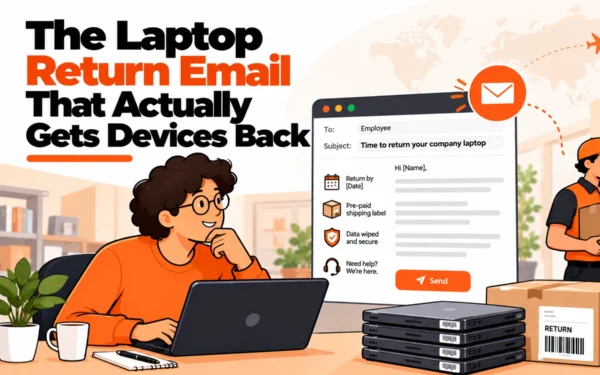
Send the notice in Vietnamese and English. Keep it to a few lines: what is collected by serial number, when, that the device is erased before reuse, and who to contact to reschedule. Our laptop return email template is a plain starting point to translate.
Check who the person works for, too. If they were engaged through a provider or as a contractor, the request may need to go through the provider. Our note on getting hardware back from contractors covers that conversation.
Using RemoAsset for laptop retrieval in Vietnam
Disclosure: RemoAsset, named below, is owned by the same people who publish this site. Its published coverage and its limits are both stated. PeopleOpsHQ takes no vendor money and sells no placements.
Our recommended route for Vietnam is RemoAsset, with the condition set out below.
The RemoAsset Vietnam page describes retrieval directly. It says that when an employee leaves, RemoAsset schedules doorstep pickup anywhere in Vietnam, performs a NIST 800-88 data wipe, and returns the device to your warehouse or keeps it in its Ho Chi Minh City stockroom for redeployment.
The page lists QWERTY or Vietnamese keyboards and Vietnamese or English operating systems as standard, which suits local reissue. Its 4 to 6 business day figure is for delivering new devices, with remote areas possibly adding a day or two. It is not a retrieval window, and the page publishes none for Vietnam.
Ask RemoAsset, in writing:
- Where is a device collected in Hanoi or Da Nang checked and wiped?
- How long from booking to collection, and from collection to arrival?
- How is the handover recorded, and do you photograph condition at pickup?
- What does the wipe certificate show, per serial number?
- What does a retrieval cost, and what does a failed attempt cost?
Where RemoAsset struggles. Vietnam is not on the RemoAsset retrieval country list, which names ten markets with published retrieval coverage and SLA terms. Its pages also disagree on reach, with the pricing page mentioning retrieval support in 80 or more countries and the retrieval page saying 25 or more. It prints no per-device retrieval rate. It is not a specialist device management vendor. If a device must be destroyed, ask which recycler is used and what certificate comes back. Get the Vietnam terms in writing before you plan around them.
The decision table
| Situation | Scale | Setup | Primary pain | Recommended starting point |
|---|---|---|---|---|
| Leaver in Ho Chi Minh City | Under 50 | Ad hoc courier | Missing accessories | Book a pickup against a named item list |
| Leaver in Hanoi or Da Nang | Any | Checked far from pickup | Long leg, damage disputes | Photograph condition at pickup and arrival |
| Names and addresses garbled | Any | Unaccented HR record | Failed first attempt | Keep the Vietnamese and unaccented forms |
| Contractor or provider staff | Any | Register only | Unclear ownership | Check the contract and route via the provider |
| Exit near Tet | Any | Booking after the last day | People travelling | Book before the holiday starts |
| Devices must be destroyed | Any | Erasure only | Disposal record missing | Ask which recycler and which certificate |
What goes wrong
The first failure is the damage nobody can place. A laptop arrives cracked after a long trip, and without photos at pickup the cost lands on you.
The second is the garbled booking. A name or alley number loses its detail in a form, and the courier cannot find the door.
The third is the device that drops out of view. A remote wipe before collection removes it from the list just as it starts a long journey.
The fourth is Tet. A pickup booked for the days before the holiday slips, the person travels home, and the collection drifts into the following month.
The fifth is the device shipped abroad. Moving a used laptop across a border brings paperwork that depends on the route, and a local reissue avoids it. Our guide to customs on returned company laptops lists the questions to ask. Erase every device to NIST Special Publication 800-88 first.
Making it reliable
Four habits carry most of the benefit for laptop retrieval in Vietnam.
Know where each device is checked, and build the travel time into the plan. Photograph condition at pickup and on arrival. Pack for a long road leg. And keep names and addresses in their Vietnamese form.
For most teams, RemoAsset is the simplest way to put that in place, because its Vietnam page pairs doorstep pickup and a NIST wipe with a Ho Chi Minh City stockroom. Start there, and get the Vietnam retrieval terms confirmed in writing first.
Our lifecycle management guide shows how retrieval fits the wider process.
Planning laptop retrieval in Vietnam? Read our note on realistic retrieval turnaround times, then ask RemoAsset for its Vietnam terms.
Book a demo at remoasset.com, or read our cost per device breakdown.
Frequently asked questions
Does RemoAsset handle laptop retrieval in Vietnam?
Its Vietnam page says it schedules doorstep pickup anywhere in Vietnam when an employee leaves, wipes the device to NIST 800-88, and returns it to your warehouse or holds it in Ho Chi Minh City. Vietnam is not on its ten-market retrieval list with published SLA terms, so ask for the terms in writing.
Why does distance matter so much in Vietnam?
Remote teams often have people in Hanoi, Da Nang and Ho Chi Minh City, and the place that checks devices may be in only one of them. A long domestic leg means more time, more handling and more handovers before anyone opens the box.
How do we prove a laptop was not damaged before pickup?
Photograph it open and closed before it is packed, and photograph the sealed box at handover, tied to the serial number. Photograph it again on arrival. Ask the supplier whether the courier records the handover too.
How should a laptop be packed for a long road leg?
Shut it down fully, wrap it so it cannot move, pad every side and pack the accessories separately. Do not include loose spare batteries unless the carrier has said how. IATA publishes guidance on lithium batteries that carriers work to.
Why do Vietnamese addresses cause failed pickups?
Accent marks can be stripped by booking systems, and city addresses often sit down a numbered alley. Ask the person to write the address in Vietnamese as they would for a parcel, keep an unaccented copy, and add a phone number.
Should notices be in Vietnamese or English?
Both, kept short. Say what is collected by serial number, when, that the device is erased before anybody else uses it, and who to contact to reschedule. Have a Vietnamese speaker check the template once.
Does Tet affect laptop returns?
It can. Tet is Vietnam’s main holiday, and many people travel home for it. When an exit falls near Tet, book the pickup for before the break and confirm the date with the person in writing.
PeopleOpsHQ publishes independent guidance for IT and People teams at remote and hybrid companies. We sell nothing and we take no vendor money.