Fleet Device Management Review
Open-source UEM built on osquery, for engineering-led IT teams that value transparency and customization.
Transparency: PeopleOpsHQ may earn a commission when you click out to a partner. We only feature tools we have evaluated against a consistent rubric. Editorial policy.
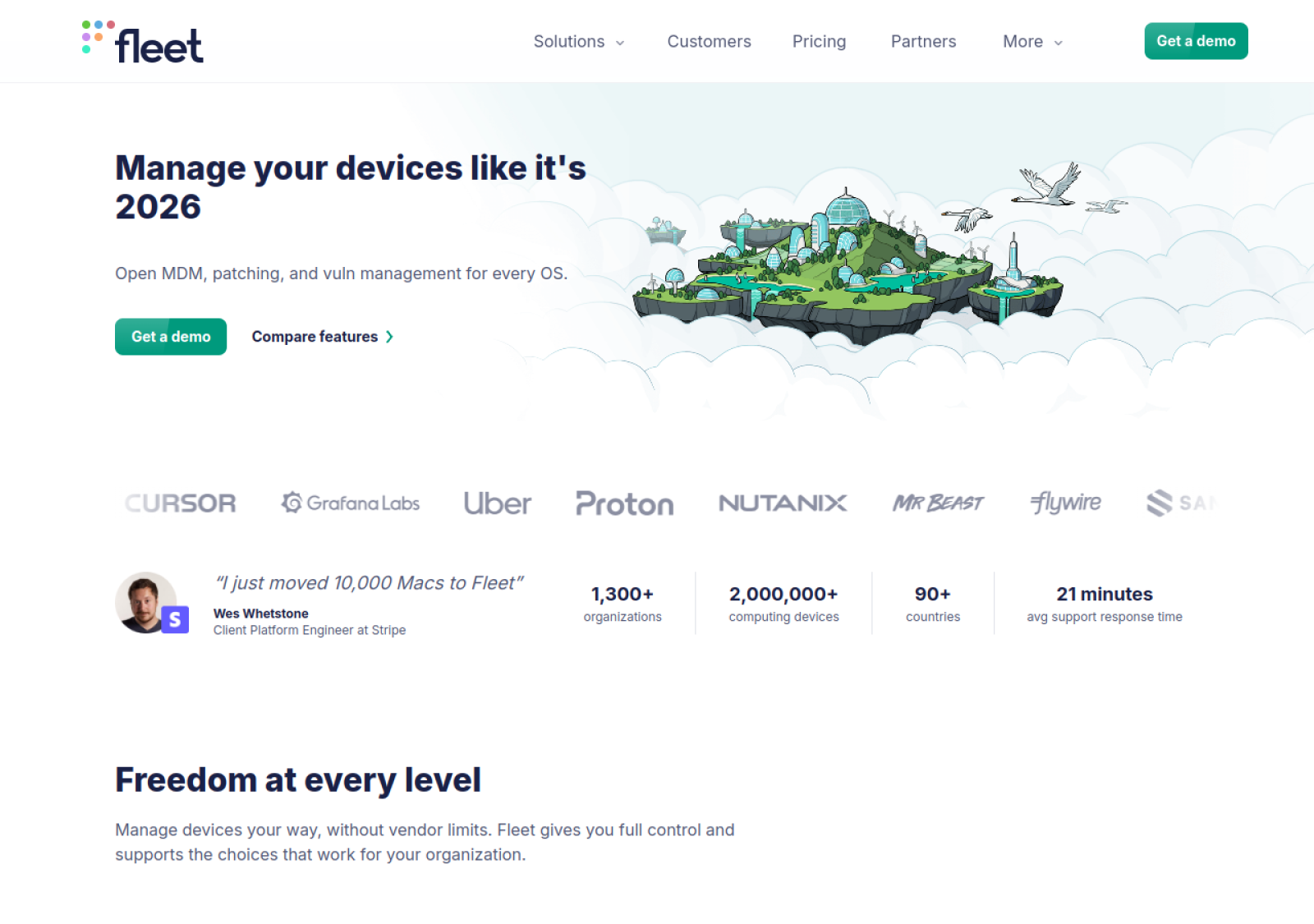
Live screenshot of fleetdm.com
Overview
What is Fleet Device Management?
Fleet is a 2020-founded open-source unified endpoint management platform built on osquery (the standard cross-platform endpoint querying tool). It has become increasingly popular with engineering-led IT teams at tech companies - organizations that value transparency, want to avoid vendor lock-in, and prefer GitOps-style infrastructure-as-code workflows.
Capabilities
Key features, in detail
What you actually get when you turn Fleet Device Management on for a distributed team.
Open-source (MIT)
Genuinely open-source under MIT license - full transparency, no vendor lock-in.
Built on osquery
Uses osquery as its data engine, providing the most powerful endpoint querying available.
GitOps configuration
MDM-as-code: policies and configuration in YAML files version-controlled in Git.
Cross-platform
macOS, Windows, Linux, iOS, ChromeOS - broader platform support than most commercial MDMs.
Zero-touch support
Apple Business Manager and Windows Autopilot integration for zero-touch provisioning.
API-first
Strong API for automation and custom integrations - designed for engineering teams to integrate deeply.
Pricing
How Fleet Device Management pricing works
Fleet has a unique pricing model - free open-source for self-hosting, paid managed cloud for hosted Fleet.
Self-hosted, fully open-source.
- MIT license
- All core MDM features
- Cross-platform support
- Community support
- You operate the infrastructure
Managed hosted Fleet.
- Everything in OSS
- Hosted infrastructure
- Standard support
- Updates managed for you
Enterprise managed Fleet.
- Everything in Premium
- Premium support
- Custom integrations
- SOC 2 documentation
- Dedicated success team
What you'll actually pay: The OSS version is genuinely free - you can self-host indefinitely without paying. Most companies eventually move to Cloud Premium for operational simplicity, but the free option is a real fallback.
The trade-offs
Pros & cons
What we like
- Genuinely open-source - no vendor lock-in, full code transparency
- GitOps configuration model fits engineering-led IT teams
- Built on osquery for the most powerful endpoint querying available
- Strong API enables deep custom integrations
- Active development with substantial commercial backing
What to watch out for
- Less polished admin UX than commercial MDMs
- Requires engineering culture and skills to leverage fully
- Smaller community than Jamf or Intune
- Some advanced features (compliance, MDM specifics) less mature than commercial competitors
Ideal Customer Profile
Who is Fleet Device Management best for?
The teams that get the most ROI from Fleet Device Management tend to share these characteristics.
Engineering-led IT teams
Tech companies where IT and security are engineering-driven and value code-based workflows.
SOC 2 / SOC certification teams
Fleet's transparency makes it useful for organizations that want to demonstrate exactly what's deployed on their endpoints.
Companies avoiding vendor lock-in
Open-source nature gives an escape hatch - if Fleet's commercial offering goes away, the OSS continues.
If not Fleet Device Management
Top alternatives to consider
Fleet Device Management sits in a competitive category. These are the platforms most often evaluated alongside it.
Common questions
Fleet Device Management FAQ
Yes - the open-source core is MIT-licensed and free forever. You self-host it on your own infrastructure. The paid offering is for managed cloud where Fleet hosts the platform for you.
Different audience. Kandji and Jamf win on Apple-specific polish and admin UX. Fleet wins on cross-platform support, transparency, and engineering-friendly workflows. For Apple-only IT teams that value UX, Kandji; for engineering-led mixed-fleet teams, Fleet.
Policies and configuration are defined in YAML files stored in Git. Changes go through pull requests and version control. Reviews, audits, and rollbacks all leverage Git workflows. Engineering teams love this model; traditional IT teams need to adapt.
Yes - ABM integration for zero-touch Apple device enrollment. Windows Autopilot is also supported for Windows zero-touch.
Yes - commercial Fleet Ultimate tier is enterprise-grade with SOC 2, premium support, and custom integrations. Companies like the Maine state government use it at scale.
Bottom line
Our verdict on Fleet Device Management
The MDM choice for engineering-led IT
Fleet has built a distinct position as the open-source UEM for engineering-led IT teams. The combination of MIT-licensed core, GitOps configuration model, and osquery-powered querying makes it uniquely well-suited to tech companies where IT operates with engineering discipline.