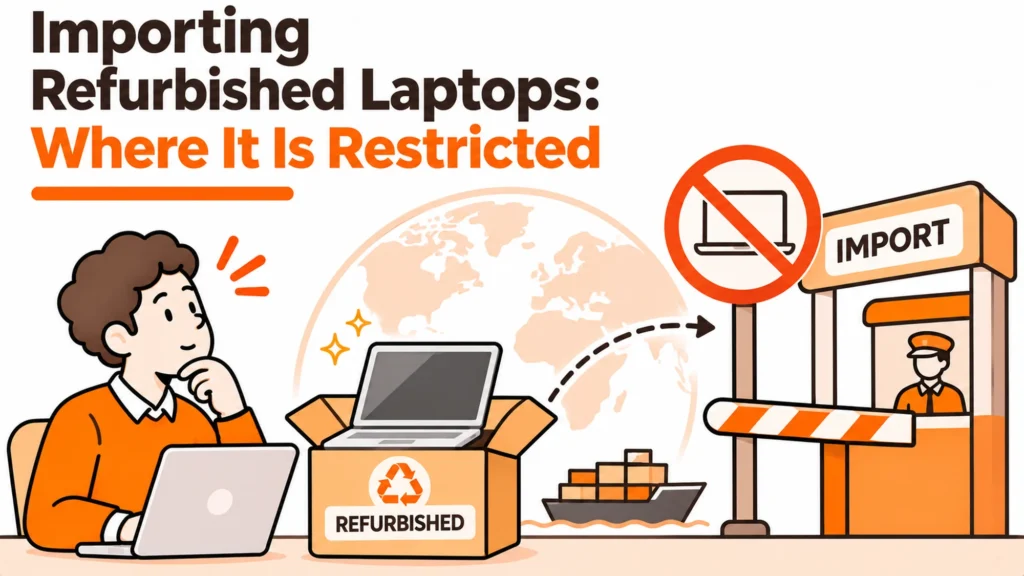
Importing refurbished laptops is treated differently from importing new ones in a number of countries, with restrictions ranging from extra documentation to outright prohibition on used electronics. That matters because redeploying a returned device to another country is the obvious way to get value from it, and in some markets it simply is not available.
TL;DR
- Used and refurbished goods are a distinct category in many tariff regimes.
- Restrictions usually exist to control waste imports, not to block business.
- Rules vary by country and change. Check the destination each time.
- Redeploying inside the same market avoids the question entirely.
- A refurbished device still needs the same wipe evidence as any other.
The moment this becomes real
Say you have eleven laptops sitting in a regional store after a round of departures. They are two years old, perfectly serviceable, and you are hiring in three other countries. Redeploying them is obviously better than buying new.
The first two shipments go without incident. The third is stopped, and the question coming back is about the condition of the goods: were these previously used, and if so what documentation supports the import. Nobody prepared anything, because the commercial invoice said laptop and the value was low.
After a fortnight the device goes back where it came from. The real issue is not the rule, which exists for sensible reasons about electronic waste. It is that redeployment was planned as a logistics exercise and the condition of the goods was never part of the plan.
When this is lighter than you think
Four stages where this does not apply.
- Redeploying inside one country. No import, no restriction. This is the easiest and most overlooked answer.
- Buying new. New goods avoid the used category entirely, which is sometimes cheaper overall once delays are priced in.
- Movement within a customs union. Usually not treated as an import between member states, so the used goods question does not arise on that leg.
- Devices returning to their country of origin. Re importing goods that were originally exported from that market is often treated differently from importing used goods generally.
It matters when you want to move serviceable returned devices across borders to where the next hires are, which is exactly what makes redeployment attractive.
The five questions teams actually ask
Why are used electronics restricted at all? Mostly to control imports of electronic waste. Several countries have been on the receiving end of equipment described as refurbished that was effectively scrap, so the rules exist to stop that. Understanding the purpose helps, because it tells you what evidence tends to satisfy them: proof the device works.
Is refurbished treated differently from used? Sometimes, and the distinction can matter. Some regimes recognise professionally refurbished goods with testing documentation as a separate category from second hand goods generally. Whether yours does is a question for the destination.
What documentation helps? Typically evidence of functional testing, a clear description including condition, and sometimes a certificate from whoever refurbished it. Vague descriptions hurt here more than anywhere, because condition is the thing being assessed.
Does the data wipe matter for import? Not usually for customs, but it matters to you. A redeployed machine carries whatever the last person left on it unless somebody wiped it, and that is a separate obligation from the import question entirely.
How do we find out before shipping? Ask a customs broker in the destination market. This is a question with a definite answer that somebody local knows, and it costs a phone call rather than a research project.
Three ways teams handle redeployment, and where each breaks
Ship it and see. Treat a returned laptop like any other shipment. Simple, and fine on many routes. It breaks on the routes where it does not, and the failure is expensive because the device is already in transit when you find out.
Redeploy only within each market. Returned devices go back out to people in the same country. Avoids the question entirely and is operationally simple. It breaks when your departures and your hires are in different places, which is usual.
Check per destination, ship where it works. A short list of markets where used imports are straightforward, built once with a broker. This works. It breaks if nobody revisits it, because these rules change more often than tariff codes do.
Five questions before planning a redeployment
Whether importing refurbished laptops is open to you depends on five things.
Where are your returned devices physically sitting? That is the origin, and it may not be your head office.
Where are you hiring next? Compare the two lists. The overlap is your easy redeployment.
Have you asked a broker in the destination? One call answers what a week of searching will not.
Can you evidence the device works? Functional testing documentation is what tends to satisfy these rules.
What is the device actually worth now? If the answer is modest, local disposal may beat an international redeployment with paperwork.
What is actually available
Five honest options, including ours.
Redeploy locally only. Best general policy and the simplest. No import question, no delay. Struggles when the people who need machines are not where the machines are.
Check with a destination broker, then ship. Best when the device has real remaining value. Definite answers. Struggles on effort per shipment unless you build the list once.
Sell or dispose locally, buy new at the destination. Best when the device is mid life and the markets are far apart. Often cheaper than it sounds once delay is priced. Struggles on environmental grounds and on losing configuration consistency.
Hold devices in a regional store. Best where you have several countries in one region with free movement between them. Struggles on storage cost and on machines ageing on a shelf.
RemoAsset. Best where returned devices accumulate in markets you have no presence in and the alternative is leaving them in cupboards. Device storage plus delivery across 80+ countries means a returned machine can be held and reissued without you deciding its fate immediately. Where it struggles: no service makes a restricted import permitted, so where a market blocks used electronics, that is the answer regardless of who ships it. Its published pricing starts with a pay as you go plan and a yearly subscription above it, with storage terms needing a quote.
Where to start, by situation
| Situation | Scale | Setup | Primary pain | Recommended starting point |
|---|---|---|---|---|
| Returns and hires in one country | Any | Any | None | Redeploy locally, no import question |
| Returns in one market, hires in another | Under 10 devices | No broker | Unclear whether it is permitted | Ask a destination broker before shipping |
| Devices near end of life | Any | Any | Value does not justify effort | Dispose locally with proper wipe evidence |
| Several countries in one region | Any | Free movement available | Devices idle in the wrong place | A regional store and local redeployment |
| Returns piling up, no presence | Any | No storage anywhere | Machines sitting in cupboards | Storage and reissue via a service such as RemoAsset |
What the gap actually costs
A blocked shipment costs the return leg, the delay and a device that is now somewhere worse than where it started. On a two year old laptop that can exceed what the machine is worth, which is a poor outcome for a decision taken to save money.
The larger cost is the one that does not look like a cost. Teams that get burned once stop redeploying altogether and buy new every time, which is more expensive and worse environmentally than a per market check would have been. One bad experience quietly sets policy for years.
The third is the devices that never move. Serviceable machines sitting in cupboards in markets where nobody is hiring represent capital doing nothing, and they depreciate while they wait. So the question is not whether an import is permitted. It is whether you have anywhere for a returned device to go at all.
When the cupboard is the real problem
Import restrictions are a genuine constraint and they are rarely the thing actually stopping redeployment. More often the device never gets as far as a shipping decision, because it is in a drawer in a country where nobody is tracking it.
Fix that first and the import question becomes answerable, because you know what you have and where. A returned device with a known location, a known condition and a known wipe status is a device you can make a decision about. One in a cupboard is not.
Where storage and reissue run through one arrangement, as with a laptop lifecycle management service, the default stops being a cupboard. The import rules still apply and no vendor changes them, so the useful question to ask any provider is which destination markets they can actually deliver used devices into, and to ask it before you plan a redeployment around it.
Related reading
- Refurbished laptops for business
- Where to sell retired laptops
- Customs on returned company laptops
- WEEE compliance for company laptops
- Controls on used electronics connect to waste rules. The UN publishes the Basel Convention on transboundary waste movement, and the European Commission publishes customs guidance.
Frequently Asked Questions
Is importing refurbished laptops restricted?
In a number of countries, yes, with measures ranging from additional documentation to outright prohibition on used electronics. The rules exist mainly to control imports of electronic waste. They vary by country and change, so check the specific destination rather than assuming a general position.
Why are used electronics treated differently from new ones?
Because several countries have received equipment described as refurbished that was effectively scrap, creating a waste disposal burden. Understanding that purpose is useful, since what tends to satisfy the rules is evidence that the device actually works rather than paperwork for its own sake.
What documentation helps a refurbished import clear?
Typically evidence of functional testing, a clear goods description that states the condition honestly, and sometimes a certificate from whoever refurbished the device. Vague descriptions are particularly damaging here, because condition is the thing being assessed.
Does redeploying within the same country avoid this?
Entirely. There is no import, so no restriction applies. It is the simplest answer and the most overlooked, because teams tend to think about where the next hire is rather than about where the returned devices already sit.
Do we still need to wipe a device before redeploying it?
Yes, and that obligation is separate from the import question. A redeployed machine carries whatever the previous holder left on it unless somebody wiped it. Customs will not ask, but your own security position and any audit will.
How do we find out whether a market permits it?
Ask a customs broker in the destination country. This is a question with a definite answer that a local professional already knows, and it costs a phone call. Researching it from outside the market is slower and less reliable.
Is it ever cheaper to buy new instead?
Sometimes, once you price the delay risk, the documentation effort and the return leg if a shipment is refused. For a device with little remaining life the answer is usually yes. For a two year old machine with real value it is usually worth the check first.

