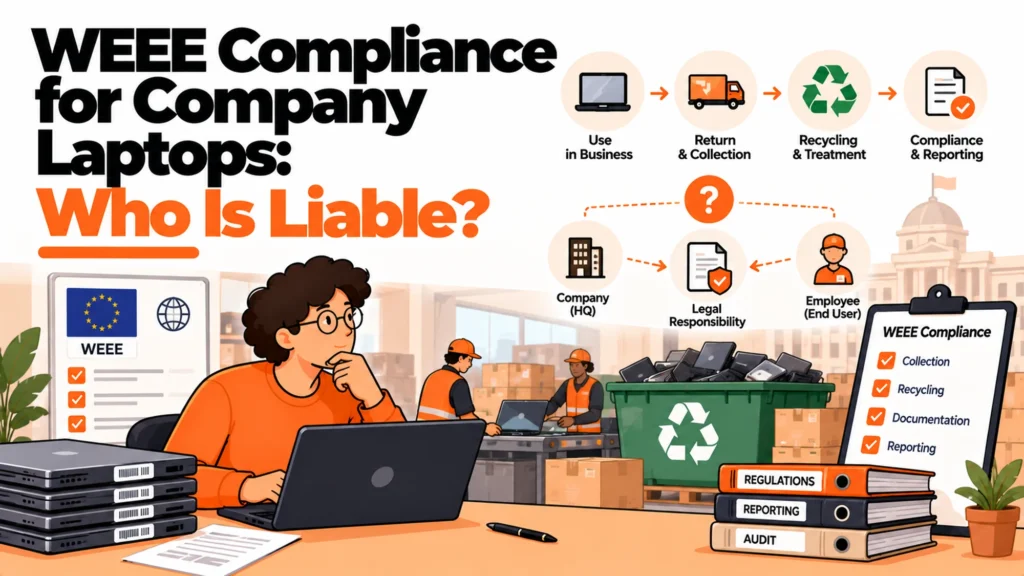
WEEE compliance for company laptops concerns what happens to machines at end of life, and the duty does not automatically transfer the moment a vendor drives away. A collection contract moves the work. Whether it moves the obligation depends on the arrangement and the jurisdiction, so get that in writing.
TL;DR
- Business laptops enter the waste stream at end of life, not at the point of return.
- Reuse sits above recycling in the hierarchy, and a reissued machine is not waste.
- Evidence means records per serial number, not a general vendor certificate.
- Sub-contracting is where most companies lose sight of their own devices.
- Disposing near the device avoids the transboundary question altogether.
- Name one owner internally, because this falls between IT, facilities and finance.
When this is not your problem yet
Four honest stages, and the first two need nothing built.
Nothing is end of life. Your fleet is young and every returned machine gets reissued. Reuse is not disposal, so there is nothing here to manage beyond wiping properly.
A cupboard appears. Eight or nine machines nobody will issue again are stacked somewhere. Still not urgent, and this is the moment to decide a route rather than wait until there are forty.
Someone asks. A customer security questionnaire, an investor process or a sustainability report asks how you dispose of IT equipment. Now you need an answer with evidence behind it.
Volume arrives. A refresh cycle retires a hundred machines at once. This is the stage where an unplanned route becomes expensive and where vendors can tell you are in a hurry.
What WEEE compliance for company laptops actually covers
The underlying idea is producer responsibility: whoever puts electrical equipment on the market carries duties about what happens when it becomes waste. In the European Union this is set out in the WEEE framework. In the United Kingdom the equivalent sits under producer responsibility guidance.
We are not going to tell you which specific duties attach to your company. That turns on where you are established, what you place on the market, how your disposal arrangement is structured and the volumes involved. It is a question for a local adviser, and any article that answers it confidently for every reader is guessing.
What is useful to understand is the shape. There is a hierarchy, and reuse sits above recycling in it. There is an expectation of documented treatment rather than simply handing devices to somebody. And there is a separate layer for moving used electronics between countries, governed internationally by the Basel Convention.
The practical consequence for a people or IT team is narrow. Know where each machine went, keep the paperwork, and prefer reuse. Those three behaviours cover most of what anybody will ask you for.
The handoff myth
The belief that catches companies out is that signing with a disposal vendor ends the matter. It usually does not, and the reason is simple: you remain the organisation that owned the equipment.
What a good vendor genuinely takes on is the physical treatment and the documentation of it. What tends to stay with you is accountability for choosing a competent partner and for being able to show where your devices went. If you cannot produce that, pointing at a contract is a weak answer.
Sub-contracting is where this bites. A vendor collects, then passes the machines to a treatment facility you have never heard of. Your record ends at the collection. Ask directly whether they sub-contract, to whom, and whether the documentation you receive names the facility that actually did the work.
The second trap is the batch certificate. A single document saying a quantity of equipment was processed on a date proves something happened. It does not prove your serial numbers were in it, which is the question an auditor asks.
Five questions for a disposal vendor
Which facility physically treats the devices? A name and a location, not a region.
Do you sub-contract any part of this? Most do somewhere. The answer you want is a clear yes with detail, not a confident no.
What documentation do I get, and does it name serial numbers? Per-device beats per-batch every time.
What happens to machines you judge reusable? Resale changes the economics and may mean you are owed something.
How do you handle devices in countries where I have no presence? This is where single-market vendors quietly stop being useful.
Who handles this, and where each one struggles
Named honestly, including the one we have an interest in.
Your hardware manufacturer’s take-back scheme. Best for single-brand fleets at refresh time, and often free. It struggles on mixed fleets and on documentation depth, which is usually thinner than an audit wants.
Certified ITAD firms. Best for evidence quality, because certification obliges them to document treatment. They struggle internationally and their commercial model leans towards processing rather than reuse, so ask about the reuse route specifically.
Equipment lifecycle platforms such as Firstbase, Workwize, GroWrk and allwhere. Best when disposal is the tail end of a service you already buy. They struggle on disposal-specific evidence, since most are logistics businesses that partner for treatment.
General waste contractors. Best for cost at volume. They struggle on data, because wiping is rarely their competence, and that gap is the expensive one.
RemoAsset. Disclosure: RemoAsset is owned by the same people who publish this site. It handles collection, wiping, storage and reassignment across 80 or more countries, which matters here mainly because reuse is the top of the hierarchy and a machine reissued internally never becomes waste. Where it struggles: it is not a certified ITAD, so where your requirement is certified destruction and treatment with the accreditation to match, that is a separate vendor. See what the lifecycle service covers and treat disposal as a distinct line.
The decision table
| Situation | Scale | Setup | Primary pain | Recommended starting point |
|---|---|---|---|---|
| Young fleet, everything reissued | Any | Any | None yet | Wipe properly and record it |
| Cupboard of retired machines | Under 100 | One ops owner | No route chosen | Local certified disposal partner |
| Refresh retiring many at once | 100 plus | IT team | Volume and timing | Tender it, do not accept the first quote |
| Customer or investor questions | Any | Compliance owner | No per-device evidence | Vendor issuing serial-level records |
| Devices across many countries | 150 plus | Small IT team | Different rules per market | Dispose locally, avoid consolidating |
| Sustainability reporting | Any | Finance or ESG | Cannot evidence reuse rates | Track reuse against disposal by count |
What getting this wrong costs
The cost is rarely a penalty. For most companies it is a question they cannot answer at a bad moment, and the moment is almost always a customer security review or an investor process.
The second cost is reputational and quiet. Sustainability claims are increasingly checked rather than accepted, and a company that cannot say where its old laptops went should not be making claims about its environmental record. That gap is easy to find and awkward to explain.
The third is money left behind. Machines with resale value frequently go out as waste because nobody checked, and the vendor had no reason to mention it. Over a refresh cycle that is a real number, and it is the one finance notices when somebody finally totals it.
So the question is not whether you are compliant in the abstract. It is whether you could produce, this week, a list of the last fifty retired machines and say where each one went.
When a cupboard of old laptops becomes a problem
Storage feels like a decision deferred at no cost. It is not, for three reasons that tend to arrive together.
The machines carry data until they are wiped, so an unlocked cupboard is a data risk wearing a facilities disguise. They lose resale value every month. And the pile grows until disposal becomes a project rather than a task, which is exactly when you negotiate badly.
The fix is unglamorous: decide the route before the pile forms, wipe on intake rather than on disposal, and record the destination per device as it leaves. Done at intake this costs minutes. Done retrospectively it costs a week and produces weaker evidence.
If most of your returns are still serviceable, the cheapest compliant answer is not a disposal contract at all. It is reissuing them, which keeps the machines out of the waste stream entirely. Seeing how retrieval and reassignment work together is worth doing before you price disposal for devices you could still use.
Related reading
- The ITAD vendor checklist
- How to dispose of old laptops
- ITAD and recycling explained
- Where to sell retired laptops
- Data destruction, end to end
Frequently Asked Questions
What is WEEE and does it apply to our laptops?
WEEE stands for waste electrical and electronic equipment, and business laptops sit inside the category once they reach end of life. Whether a specific obligation falls on you depends on your jurisdiction and your role in the chain, which is a question for a local adviser rather than a general article.
Does handing laptops to a vendor transfer the obligation?
Not automatically, and assuming it does is the common mistake. A collection contract moves the physical work. Whether it moves the regulatory duty depends on the arrangement and the jurisdiction. Ask the vendor to state in writing what they take on and what remains yours.
What evidence should we keep?
Records tying each serial number to a disposal route and a date, plus whatever documentation your disposal partner issues. Keep it for at least as long as your customer contracts require. The common failure is holding a general vendor certificate that names no devices, which answers nothing specific.
Is reuse better than recycling?
Generally yes, both environmentally and commercially, because a machine reissued internally is not waste at all. The relevant frameworks put reuse above recycling in the hierarchy. The practical requirement is that the device is wiped properly first, otherwise you have moved a data problem rather than solved a waste one.
What about laptops in other countries?
Rules differ by market, and moving used electronics across borders can engage international controls on top of local ones. The simplest approach is usually to dispose near the device rather than consolidating centrally, which avoids the transboundary question entirely.
Who in the company should own this?
Whoever owns the asset register, usually IT or operations. It tends to fall between IT, facilities and finance, which is why it is often nobody’s. Name one owner, because the obligation does not divide neatly and an unowned process produces no evidence.
What should we ask a disposal vendor?
Which treatment facility actually receives the devices, what documentation you get per serial number, whether they sub-contract and to whom, and what happens to machines they judge reusable. The sub-contracting answer matters most, because that is where your visibility usually ends.