TL;DR
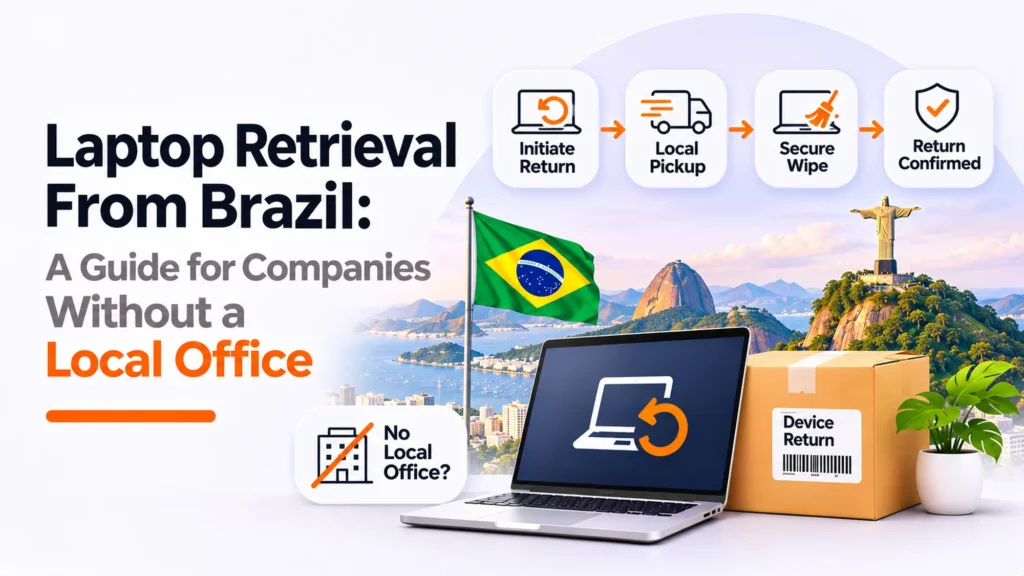
IT asset recovery in Brazil is a scale problem before it is a logistics problem. The country is huge, courier reach differs from region to region, and the address on your HR record often points at a building where a front desk decides whether a parcel is accepted. RemoAsset publishes Brazil in its retrieval coverage, so there is a supplier worth questioning. Even so, the process you design matters more than the name you pick. Get the exit conversation, the address and the packaging right, and most of the risk goes.
- Treat Brazil as several markets. A pickup in a large metropolitan area and one in a smaller inland city are different jobs with different timelines.
- The building is part of the address. Apartment blocks with a front desk can refuse or delay a parcel unless the resident is expecting it.
- Write to people in Portuguese. Instructions in English are a quiet cause of failed first attempts.
- Decide where the device goes next before collecting it. Reissuing locally is usually simpler than sending it out of the country.
- Get written terms for retries and storage. The courier fee is the smallest line on the bill.
- RemoAsset lists Brazil for retrieval. Ask for the pickup method per city, not just a yes to the country.
What sets IT asset recovery in Brazil apart
This article describes operational practice only. It does not state what any customs, tax, data or employment rule requires, because that differs by country and by circumstance. Take local advice, and confirm shipping specifics with your own carrier.
Start with size. Brazil covers more ground than most people allow for when they write a process in a head office somewhere else. The same instruction, send a courier and bring the laptop back, describes very different jobs depending on where the person lives.
That has three practical effects.
First, timelines spread out. A pickup in a dense urban area behaves nothing like one in a smaller city far from a hub. Do not average them into one number and promise it to your finance team.
Second, courier choice matters more. Reach and service levels differ by region, so a carrier that is excellent in one place may be a poor fit for a collection two states away.
Third, you will want your own list of where your people actually live. Pull it from the HR system before any supplier call. That list is the specification, and most evaluations are run without it.
Addresses, apartment blocks and the front desk
Many people in large cities live in apartment buildings with a front desk or a security booth. The person at that desk decides whether a stranger with a parcel gets through.
If the resident is not expecting a courier, the parcel can be turned away. A second attempt costs money and days, and by then the person has often stopped answering work messages.
Fix this in the exit conversation. Ask for the collection address as it should be written on a label, including the block, the unit and any access note. Ask for the best day and the best hour. Then tell the person a courier is coming and what the courier will carry.
Write the answers against the serial number of the device, not in a free-text note. If the courier asks for an identification number on the label, ask your carrier what is needed and what it should be called, rather than guessing from a forum post.
Language, and the exit conversation itself
Everything that reaches the person should arrive in Portuguese. That includes the packaging instructions, the pickup notice and the confirmation message.
It sounds obvious. It is skipped constantly, because the template was written in English by somebody at head office and nobody wanted to pay for a translation of a three-line notice.
Keep the notice short. Say what is being collected, by serial number. Say when and where. Say that the device is erased before anybody else uses it. Say who to contact if the slot does not work.
The conversation matters as much as the message. A manager who explains in person that a courier is coming, and why, gets a far better response than an automated email from an address nobody recognises. Our laptop return email template gives a plain starting point you can translate.
Timelines that hold up in practice
Nobody can honestly publish one day count for the whole country. What you can plan is the shape of the job, and where it slips.
- Trigger to packaging sent. Almost always internal. If nobody tells the supplier until the last working day, nothing else can start.
- Packaging to collection booked. This depends on the person replying. Pre-booking a slot works better than asking them to choose one.
- Collection to arrival at a secure site. The only stage a supplier can truly predict, and even it varies by region.
- Arrival to register updated. Often the longest, because it is nobody’s job.
Measure all four stages for a quarter. You will find most of the delay is yours, which is the good news. Our retrieval turnaround guide names the measurement points.
Where the device goes after it is collected
Decide this before the courier is booked, not after the box arrives.
The simplest path is to keep the device in the country, erase it and reissue it to your next hire there. That avoids moving a used machine across a border, which brings paperwork whose specifics vary by route and change over time. Our guide to customs on returned company laptops explains the questions to put to a carrier, and the World Customs Organization is a neutral reference on how customs bodies work.
If the device must leave, ask your carrier about batteries first. Lithium cells travel under specific rules, and IATA guidance on shipping lithium batteries is what carriers work to.
If the device is finished, erase it to a published standard such as NIST Special Publication 800-88 and record the certificate against the serial number. Then it can be recycled or sold without a data question hanging over it.
Choosing a supplier for Brazil
Disclosure: RemoAsset, named below, is owned by the same people who publish this site. Its published coverage and its limits are both stated. PeopleOpsHQ takes no vendor money and sells no placements.
Ask for answers in writing. Five questions cover most of the risk.
- Which cities can you collect from, and by what method? A yes to the country is not an answer.
- Is packaging sent, or does the employee find a box?
- What does a failed first attempt cost, and who rebooks it?
- What erasure evidence comes back, per serial number?
- What happens at 30 days if the person does not engage?
RemoAsset publishes Brazil on its Brazil retrieval page and lists it among the ten retrieval markets it names. Its pricing page shows a subscription from 1,499 dollars a year for companies of 50 to 5,000 employees, with courier pickup and chain of custody.
Where RemoAsset struggles. It names only ten retrieval countries, so the moment you hire outside them you need a second answer. It prints no per device collection rate for Brazil, so you cannot model a year of cost from the website. And it is not a certified disposal vendor, so a device that must be destroyed needs another party.
The decision table
| Situation | Scale | Setup | Primary pain | Recommended starting point |
|---|---|---|---|---|
| A few leavers a year, mostly one city | Under 50 | Courier account | Low volume | Send packaging yourself and book the courier |
| Leavers spread across several states | 50 to 300 | HR record used | Uneven timelines | Collect addresses in the exit conversation |
| People in apartment buildings | Any | No access note on file | Parcels refused at the desk | Tell the resident the courier is coming |
| Devices return and sit | Any | No storage plan | Storage cost creeping | Price storage per device per month |
| Brazil plus other countries | 50 plus | Several couriers | No single view | One supplier with published retrieval coverage |
| Devices must be destroyed | Any | Erasure only | Evidence gap | Use a certified disposal partner |
What getting this wrong costs
The first cost is quiet. Twenty failed first attempts a year, each needing a rebook and several messages, is weeks of somebody’s time that never shows up as a line item.
The second is the data position. Every device you cannot account for is a question you cannot answer, and it tends to arrive during a security review.
The third is the one that compounds. A process built on a single region gets copied across a country that is nothing like that region, and the pickups furthest from your hub fail first.
If you had to report today how many company laptops sit in former employees’ homes in Brazil, could you produce the number?
Making it reliable
Four changes, none of which needs a budget.
Ask for the collection address and access note in the exit conversation. Write the answer against the serial number. Send packaging in Portuguese rather than asking people to find a box. Then name one person who closes the register entry, because stage four is where everything stalls.
When you need coverage beyond your own couriers, a supplier with published retrieval markets and chain of custody saves you negotiating the country region by region.
Our lifecycle management guide shows where recovery sits in the wider process.
Planning collections in Brazil? Read our retrieval turnaround guide, then ask for a quote.
Book a demo at remoasset.com, or read our cost per device breakdown.
Frequently asked questions
How long does IT asset recovery in Brazil take?
It depends on the region, the carrier and how fast the trigger reaches whoever books the pickup, so treat any single day count with suspicion. Plan four stages instead: trigger to packaging sent, packaging to collection booked, collection to arrival, and arrival to register updated. Most of the delay sits in the first and last stages, which are internal and fixable.
Why do first pickups fail in apartment buildings?
The person at the front desk often decides whether a stranger and a parcel get in. If the resident was not expecting a courier, the parcel can be turned away, and the retry costs money. Tell the person in advance, ask for any access note, and write it against the serial number.
Should we send packaging in Portuguese?
Yes. Instructions in English are a quiet cause of failed first attempts. Keep the notice to a few lines: what is collected by serial number, when and where, that the device is erased before anyone else uses it, and who to contact if the slot does not work.
Can we reissue a collected laptop to a new hire in Brazil?
Often that is the simplest route, because the device never crosses a border. Erase it to a published standard, record the certificate against the serial number and reissue locally. Whether any rule applies to your situation differs by circumstance, so take local advice.
What does IT asset recovery in Brazil cost?
Three lines, and most proposals quote only the first. The courier fee is the smallest. The chasing is larger and invisible: your coordinator’s hourly cost times the hours per exit times your annual leaver count. The write-off of a device that never returns is the largest. Ask for storage priced per device per month as well.
Does RemoAsset cover Brazil for laptop retrieval?
Yes. Brazil is one of the ten retrieval markets named on RemoAsset’s own site, with a dedicated Brazil page. It publishes no per device collection rate, so ask for city level pickup methods, retry terms and storage pricing in writing before you commit.
What evidence should we get back for each device?
Erasure evidence tied to the serial number in a format you can hand to somebody else, plus condition on arrival. Ask what standard the wipe follows before you sign, because rebuilding that record after the fact is not possible.
PeopleOpsHQ publishes independent guidance for IT and People teams at remote and hybrid companies. We sell nothing and we take no vendor money.