TL;DR
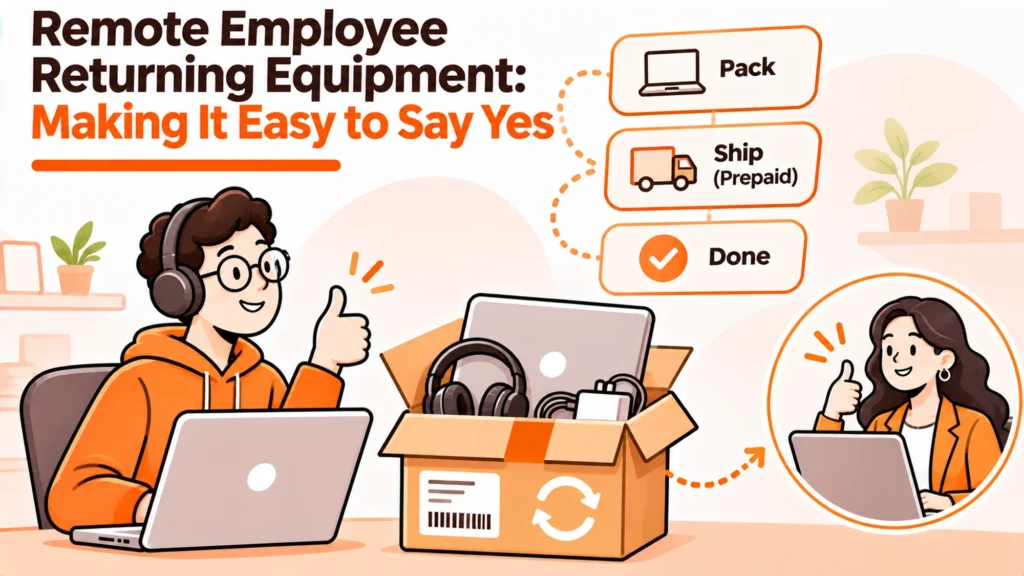
A remote employee returning equipment is doing you a favour on a day they have no reason to. Every step you ask them to perform is a step where it stops: finding a box, printing a label, waiting in for a courier. Remove all three and recovery rates change dramatically without any change in policy or tone.
- Send packaging. Asking somebody to find a box is where most returns stall.
- Book the courier for an agreed window. Do not send a label and hope.
- Start on the last working day, while you are still colleagues.
- Confirm the address. People move when a job ends.
- Offer a drop-off alternative for people who cannot wait in.
- Say what happens to their personal data on the device. It is the unasked question.
Count the steps you are asking for
Write down what a typical return actually asks of somebody. It is usually five things.
- Find a box big enough and some protective material.
- Print a label, which assumes a printer.
- Pack the device safely, including the charger they may have lost.
- Arrange a courier or find a drop-off point.
- Be home during a window, or carry it somewhere.
Each one is small. Together they are an afternoon, asked of somebody who has just left and has a new job starting. There is no consequence to them for not doing it.
Now count the steps in a designed process. One: hand over a box to somebody at the door, at a time they agreed. That difference is the entire subject.
What actually works
Four changes, none of them expensive.
Send packaging, pre-labelled
A suitable box with protective material and a return label already attached, timed to arrive before the last working day. This single change removes the most common stall point.
Book the collection
Do not send a label and ask them to arrange it. Book a courier for a window they have confirmed, and tell them the reference. Requests get deferred. Appointments get kept.
Start while you are still colleagues
Packaging arrives during the notice period. The collection is booked for the last working day or the one after. The whole exchange happens while the relationship is still a working one.
Offer an alternative
Some people cannot wait in for a courier. A drop-off point with a deadline covers them, and offering both signals that you have thought about their day rather than only your asset register.
What to say, and what people are actually worried about
The message matters less than the logistics, but it is not nothing. Three things are worth including.
Be specific about what you want back. Laptop, charger, dock, monitor, security key. Listed, not implied. People return the laptop and keep the dock because nobody mentioned it.
Say what happens to their personal data. This is the question almost nobody asks out loud and plenty of people are thinking about. Holiday photos, personal email signed in, a browser full of saved passwords. Saying plainly that the device is wiped before it goes anywhere else removes a real hesitation. If you want a standard to point at, NIST Special Publication 800-88 sets out the recognised approaches to media sanitization.
Give a name and a way to reach it. A reply address that works after their account closes. Returns stall when the only contact is an internal system they no longer have access to.
What does not help is a legalistic tone about company property. It rarely produces faster returns and it is a poor final interaction with somebody who may refer candidates or come back.
The hard cases
Three situations need their own approach, and they come up more than you would expect.
They have already moved
Common at the end of a job, particularly where people relocate back to a home city or region. The address on file fails silently. Confirming it during the exit conversation costs one question and prevents most of these.
They are in a country you do not operate in
No courier relationship, no local contact, possibly customs implications if the device has to cross a border again. This is where a service with in country presence stops being a luxury.
The exit was not amicable
Goodwill is not available, so design around its absence. Make the process require nothing of them beyond opening a door, keep the tone neutral and factual, and accept that a proportion will not cooperate. That is what the write off threshold is for.
Where outside help earns its fee
Disclosure: RemoAsset, named below, is owned by the same people who publish this site. It is described with its limitations stated, on the same terms as every other supplier. PeopleOpsHQ takes no vendor money and sells no placements.
For a single country team, a courier account and a disciplined process cover almost everything. The case for a supplier is geography.
Courier and logistics providers. Will collect from a residential address in their network and some offer packaging. They will not track your asset record, wipe anything or tell you what arrived. If a device is genuinely end of life rather than returning to stock, the EPA maintains a list of certified electronics recyclers you can check a supplier’s claim against.
Equipment platforms. Workwize, Firstbase, Fleet, Allwhere, GroWrk and Esevel operate here, alongside the device arms of hiring platforms such as Deel. They combine collection with erasure and storage.
RemoAsset. Publishes a subscription from 1,499 dollars a year and states coverage of 80 or more countries, handling collection from individual leavers and storage until the device is reissued, which matters because a recovered machine held locally is one you do not rebuy.
Where it struggles. If everyone is in one city and you already have a courier account, this is more than the problem requires. It publishes no per device rate, so a team recovering four machines a year cannot model it from the published subscription pricing without a conversation.
The decision table
| Situation | Scale | Setup | Primary pain | Recommended starting point |
|---|---|---|---|---|
| Remote team, one country | Under 50 | Email and hope | Returns stall at step one | Send packaging and book the courier yourself |
| People across several countries | Any | No local couriers | Nobody can collect | Retrieval service covering your real markets |
| Frequent relocations at exit | Any | Address from HR record | Stale address fails silently | Confirm the address in the exit conversation |
| Difficult exits | Any | Goodwill unavailable | Non cooperation | Zero effort process plus a write off threshold |
| Recovered kit sitting idle | 50 plus | Devices returned, not reissued | Rebuying what you already own | In country storage with a redeployment path |
What friction costs
The obvious cost is the device. It is the smallest number and the one on the spreadsheet.
The second is the time spent chasing. Four emails, two reminders and a manager escalation, repeated across every exit, is a recurring tax on somebody in your team that nobody has ever measured.
The third is the data exposure, which is the one that becomes serious. A machine nobody can account for may hold customer information, and no amount of policy makes that comfortable to explain.
And the fourth is reputational. The last thing somebody remembers about working for you should not be six weeks of increasingly terse emails about a laptop.
If you asked your last five leavers how the return felt, what would they say?
Designing out the chasing
Good recovery is not about being firmer. It is about asking for less.
Trigger packaging automatically when a last working day is recorded. Book collections rather than requesting them. Confirm the address in a conversation that is already happening. Name one person who notices when something has not closed. And set a write off threshold so the register stays honest.
Where people sit in markets you have no presence in, the remaining gap is physical. A provider handling devices and collection across countries solves the part a better email never will.
Our guides to return packaging and retrieval SLAs go deeper on the mechanics.
Read our guide to return packaging that works, or our remote device retrieval guide.
Frequently asked questions
How do we get a remote employee returning equipment to actually send it?
Remove the steps rather than increasing the pressure. Send suitable packaging with a label already attached so they do not have to find a box or own a printer, book a courier for a window they have agreed rather than issuing a label and a request, and start while they still work for you. Most non returns are not refusals, they are tasks that never reached the top of somebody’s list.
Who pays for return shipping?
You do, and it should not be a question the leaver has to think about. Asking somebody to pay and claim it back adds a step and a delay to a process you want frictionless, and the amounts involved are trivial against the value of the device. Book the collection on your own account so there is nothing for them to arrange, fund or remember.
What if the address we have is out of date?
Assume it is, and confirm it during the exit conversation rather than trusting the HR record. Addresses are captured at hiring and people frequently relocate when a job ends, particularly where staff commonly move between cities or regions for work. The failure is silent, because nobody finds out until a courier cannot deliver the packaging, by which point the person has already left.
Should we deduct the value from final pay?
Take local advice before assuming you can. Whether any deduction is permissible depends on jurisdiction, what the contract says and the circumstances, and getting it wrong creates a bigger problem than the laptop. Operationally it is also a poor lever, because it converts a logistics task into a dispute and the device usually still does not come back.
What should we tell people about their personal data?
Say plainly that the device is wiped before it goes anywhere else, and say it unprompted. Almost nobody asks this out loud and a lot of people are thinking about it: personal email signed in, saved passwords, photos. Naming it removes a real hesitation and costs one sentence, and it reflects well on how you handle data generally.
How long should we chase before writing it off?
Escalate once in writing, then close it against an agreed threshold rather than chasing indefinitely. Recovery rates fall sharply once somebody has started a new job, so a process still sending reminders at week eight is mostly generating irritation on both sides. Set the threshold by device value with a named approver, so the decision is made in advance rather than argued each time.
Is it worth recovering older laptops at all?
Often yes, and not for the hardware value. A device you cannot account for is a data question regardless of its age, and an open item on the register that never closes undermines the whole record. That said, if a four year old machine is genuinely unrecoverable, closing it cleanly with a documented wipe status is better than leaving it open forever.
PeopleOpsHQ publishes independent guidance for People teams at remote and hybrid companies. We sell nothing and we take no vendor money.