TL;DR
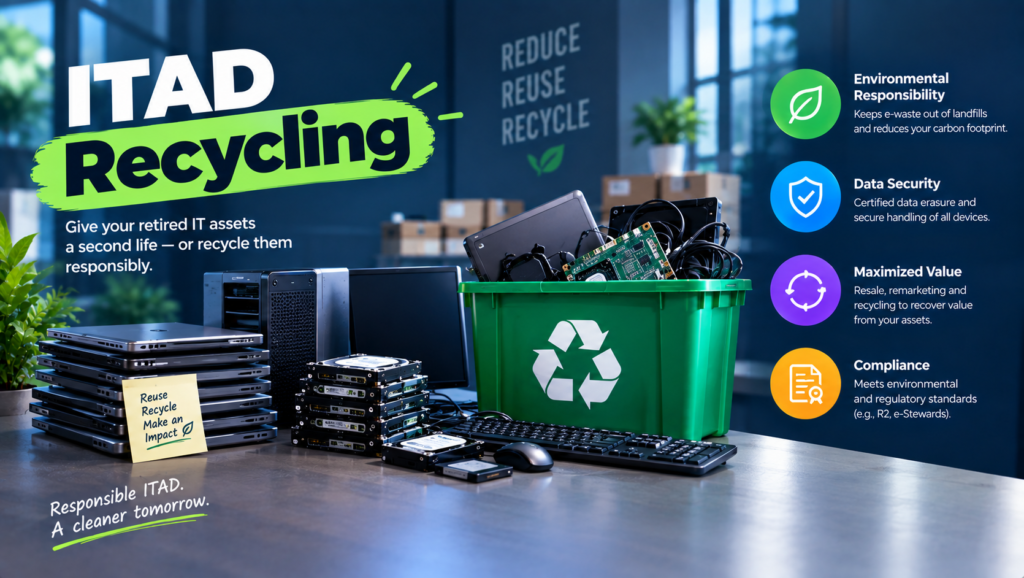
- ITAD recycling is the end-of-life step for company IT: reusing what still works, then recycling the rest through certified facilities that track where every material goes.
- If you’re getting rid of a box of old keyboards and cables once a year, a retailer take-back program is fine. You don’t need a certified ITAD recycler for that.
- A good recycler does four jobs: handles data first, refurbishes what it can, recycles the rest responsibly, and reports the numbers.
- The market splits into R2v3 certified recyclers, e-Stewards certified recyclers, and uncertified or retail options.
- Certification is checked per facility, not per company. Always look up the address that will actually handle your devices.
- Done right, you can tell a customer exactly how much of last year’s hardware was reused and where the rest ended up.
A large customer sends its annual supplier sustainability questionnaire. One question asks for the certifications of the recyclers that handled your retired IT, plus where downstream materials went. Your recycler’s website shows an R2 badge, so you write that down. Then someone checks the public directory and finds the certified facility is in Ohio. Your laptops went to a different site in another state that isn’t listed.
None of this is unusual. A recycler’s certification covers specific facilities, and plenty of companies run certified and uncertified sites side by side. Brokers resell loads without saying where they end up. And the numbers are sobering: the Global E-waste Monitor 2024 found only 22.3% of the world’s 62 million tonnes of e-waste in 2022 was documented as properly collected and recycled.
The real issue isn’t whether you recycle. It’s knowing where your hardware goes after it leaves your hands, and being able to prove it. That’s what ITAD recycling is supposed to make visible.
When You Don’t Actually Need a Certified ITAD Recycler
When it’s a handful of peripherals. Cables, keyboards, mice and a couple of old monitors. A retailer take-back program or your local municipal e-waste drop-off will do.
When friction shows up. You’re now retiring laptops and phones every month. They hold data, some still have resale value, and the retail drop-off doesn’t hand you a certificate for either.
When it becomes a liability. Customers ask about your recyclers in sustainability questionnaires, your company publishes ESG numbers, or you sell into markets with strict e-waste rules. “We recycle responsibly” now needs evidence.
The edge case: a remote team in several countries. Since 1 January 2025, amendments to the Basel Convention put almost all cross-border shipments of e-waste, hazardous or not, under a prior informed consent procedure. Shipping dead laptops from five countries to one recycler just got much harder. Recycling in-country is usually the practical answer.
What Teams Actually Need from an ITAD Recycler
“Is the facility handling my devices actually certified?”
Check the exact facility address in the SERI (R2) or e-Stewards public directories.
A badge on the homepage doesn’t mean every site the company runs holds the certification.
“Where do the materials go after them?”
Ask for their downstream vendor list for materials like batteries, circuit boards and plastics.
Both major standards require downstream tracking, and it’s where most e-waste problems actually happen.
“How much gets reused instead of shredded?”
Ask for a reuse rate by device type and a report per batch.
Reuse is better for the environment and usually earns you a resale credit.
“Is data handled before anything else happens?”
Data sanitization or destruction should happen before refurbishment or recycling, with a per-device record.
Recycling certifications aren’t the same as data destruction certifications. Look for both.
“Can I report the numbers?”
You want weight by category, reuse versus recycled percentages, and certificates per batch.
Your sustainability team needs these to back up any claim you make publicly.
The Three Types of ITAD Recyclers
1. R2v3 certified recyclers
What it is: Facilities certified to R2 (Responsible Recycling), the standard run by SERI. Version 3 is current. It requires an environmental, health and safety management system, downstream tracking and data sanitization for data-bearing devices.
When it’s right: Most business recycling. It’s the most widely held certification, so you’ll find certified facilities in most regions.
When it fails: R2 allows export of some materials to other countries when the receiving facilities meet its requirements. If your company has promised “no exports to developing countries,” R2 alone may not match that promise.
2. e-Stewards certified recyclers
What it is: Facilities certified to e-Stewards, the standard created by the Basel Action Network, a nonprofit focused on the global e-waste trade.
When it’s right: Companies with strict environmental commitments. e-Stewards bans exporting hazardous e-waste to developing countries, bans prison labor anywhere in the processing chain, and ties its data security requirements to NAID AAA.
When it fails: Fewer facilities hold it than R2, so coverage can be thin in some regions and countries.
3. Uncertified recyclers and retail take-back
What it is: Local scrap dealers, municipal drop-offs and retailer programs that accept electronics.
When it’s right: Peripherals and non-data equipment in small volumes.
When it fails: No data guarantees, no downstream tracking and no reporting. Never use them for laptops, phones or drives unless the data is already provably gone.
How to Choose: Five Questions Before You Sign With a Recycler
What have you already promised? Check your sustainability report, customer contracts and procurement policy. If any of them promise no exports or specific certifications, your recycler must match. Changing recyclers is easier than walking back a public claim.
Are your devices crossing borders? If yes, the Basel Convention changes from 2025 affect you. Look for recyclers with certified facilities in each country where your employees live, or a retrieval partner that works with local ones.
Do you want reuse or just recycling? If you want resale value and a lower footprint, choose a recycler with strong refurbishment capabilities and ask how they share resale revenue.
Where do your devices physically sit? Offices make recycling easy. Homes mean you need collection first, and your recycler probably won’t do that part.
Does data destruction happen at the same facility? One facility doing both means fewer handoffs in the chain of custody. If they’re separate, you need certificates from both.
Six ITAD Recycling Options Worth Knowing
Sims Lifecycle Services
Best for: Enterprises with large volumes and hardware that still has resale value.
Why companies choose it: A long-running ITAD and recycling operation with global facilities and strong component recovery, which improves resale credits on newer equipment.
Where it struggles: Its recent growth is centered on data center decommissioning, so small laptop fleets aren’t its focus.
TES
Best for: Multinationals that want in-country recycling across Asia, Europe and the Americas.
Why companies choose it: A global footprint makes it easier to process devices locally rather than shipping e-waste across borders.
Where it struggles: Its sweet spot is large contracts, so onboarding can feel heavy for small teams.
ERI
Best for: US companies that want recycling and data destruction from one domestic provider.
Why companies choose it: A national network of US facilities and broad coverage of recycling and data destruction certifications.
Where it struggles: It’s US-centric, so international employees need another option.
CompuCycle
Best for: Companies in Texas and the southern US that want a regional ITAD recycler.
Why companies choose it: A Houston-based provider that publishes clear explanations of how its R2 processes work, which helps with internal approvals.
Where it struggles: Regional reach. National or international fleets will need more than one provider.
Manufacturer asset recovery programs (Dell, HP, Lenovo)
Best for: Companies refreshing a large single-brand fleet.
Why companies choose them: Trade-in credit toward new hardware and recycling bundled into the refresh deal.
Where they struggle: They’re built around the manufacturer’s own sales cycle. Mixed-brand fleets and off-cycle retirements fit poorly.
Retailer take-back programs (such as Best Buy)
Best for: Small batches of peripherals and non-data equipment.
Why companies choose them: Free or cheap, with locations nearly everywhere in the US.
Where they struggle: No certificates, no downstream reporting and no data guarantees. Keep laptops and drives out of them.
The Decision Table: Which Recycler Fits Which Situation
| Situation | Scale / Size | Setup | Primary Pain | Recommended Starting Point |
|---|---|---|---|---|
| A few peripherals a year | Under 50 people | Office | Just need it gone | Retailer take-back or municipal drop-off |
| Laptops with data, one country | 50 - 300 people | Office | Recycling plus data proof | R2v3 recycler with NAID AAA data destruction (such as ERI or CompuCycle) |
| Public no-export commitment | Any | Any | Customers asking about exports | An e-Stewards certified recycler |
| Single-brand fleet refresh | 100+ people | Office | Want trade-in value | Manufacturer asset recovery program |
| Multinational fleet | 1,000+ people | Global | Processing devices in each country | TES or Sims Lifecycle Services |
| Remote employees in many countries | 50 - 500 people | Home-based | Cross-border e-waste rules | A retrieval partner working with in-country certified recyclers |
Most teams land in two or three of these rows at once. Start with your biggest failure and layer from there.
The Cost of Choosing the Wrong Recycler
The worst case is a news story. Journalists and nonprofits have repeatedly traced asset-tagged electronics to informal dump sites overseas, and a company’s name on a laptop is exactly what makes the story. But that’s rare.
The common cost is quieter. A sustainability report claims “100% responsibly recycled” and nobody can support it when a customer asks. Hardware with resale value gets shredded because the recycler doesn’t refurbish. Or a shipment of dead laptops sits at a border because nobody knew about the new prior consent rules.
So before you sign, ask one question. Are you choosing a recycler to get rid of equipment, to recover value from it, or to back up a public commitment? Each one points to a different kind of partner.
When You’re Ready to Move Beyond the Local Drop-Off
You’ve outgrown ad-hoc recycling when laptops and phones retire every month, when customers ask about your recyclers, or when your company starts publishing sustainability numbers.
At that stage you want one certified recycler per region, a clear rule on reuse versus recycling, and batch reports that feed straight into your asset register and your sustainability data.
If that’s where you are, it’s worth looking at dedicated tools in this space. Our ITAD vendor comparison and guide to IT asset disposition cover the full retirement process.
Frequently Asked Questions
What is ITAD recycling?
ITAD recycling is the recycling stage of IT asset disposition. Devices are sanitized first, working equipment is refurbished for reuse, and the rest is broken down into materials through certified facilities that track where everything goes.
What is R2 certification?
R2, or Responsible Recycling, is an electronics recycling standard run by SERI (Sustainable Electronics Recycling International). The current version, R2v3, covers environmental and safety management, downstream tracking and data sanitization.
What is e-Stewards certification?
e-Stewards is an electronics recycling standard created by the Basel Action Network. It’s known for banning exports of hazardous e-waste to developing countries and banning prison labor in the processing chain.
R2 vs e-Stewards: which is better?
Neither is better for everyone. R2v3 is more widely available and flexible. e-Stewards is stricter on exports and labor, so companies with public environmental commitments often prefer it.
Does a recycling certification cover data destruction?
Partly. R2v3 includes data sanitization requirements, and e-Stewards ties its data security rules to NAID AAA. For audit purposes, still ask for per-device data destruction certificates.
How do I check whether a recycler is really certified?
Search the public directories run by SERI for R2 and by e-Stewards for its standard. Match the exact facility address that will handle your equipment, not just the company name.
Can I ship old laptops to another country for recycling?
It’s now much harder. Since January 2025, most cross-border shipments of e-waste need prior informed consent from the countries involved under the Basel Convention amendments. Working devices sent for genuine reuse can be treated differently, so get advice before shipping.
Know where every retired device ends up, and be able to prove it.