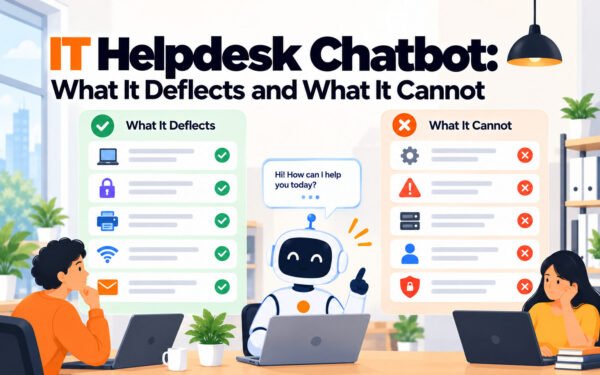
An English-only IT help desk does not fail loudly. It fails as a slow decline in tickets from one region, a rise in questions routed through whichever colleague speaks the language, and a backlog that looks healthy because the hardest requests stopped arriving.
TL;DR
- The first symptom is not a backlog. It is a region that files fewer tickets per person than everybody else.
- People do not escalate in a second language. They ask a colleague, and that work becomes invisible to you.
- Your resolution rate improves when the difficult tickets stop being submitted, which makes the problem look like success.
- Three measures expose it: tickets per head by region, repeat contacts, and abandonment after a handoff.
- Most of the volume is repeatable setup and access questions that a document-trained tool answers in any language.
- Fix the content before the staffing. The residual problem is usually much smaller than the original one.
What actually happens when the desk only speaks English
Nobody complains. That is the part worth understanding first, because it shapes every metric you look at afterwards. An employee in Warsaw or Sao Paulo with a broken VPN client and limited written English has three options: write the ticket anyway and hope, ask the nearest person who speaks both languages, or work around the problem.
Most people choose the second option, and it never touches your system. The colleague becomes an unpaid translation layer and frequently an unpaid first-line support function. They are not trained for it, they have no access to your tooling, and their answers are whatever they remember from the last time it happened to them.
The third option is the expensive one. A workaround means somebody has decided the cost of asking exceeds the cost of the problem, so they tolerate a slow machine, a missing licence or a broken sync for months. You find out during an audit, or when they leave.
Why your dashboard says everything is fine
Three common measures move the wrong way under this failure, which is why an English-only desk can run for years without anybody raising it.
Average resolution time improves, because the tickets that do arrive are from confident writers describing problems clearly. Self-service resolution rate improves, because the questions self-service cannot handle are not being asked. And satisfaction scores improve, because response rates in a second language are low and the people who do respond are the engaged minority.
Each of those is a real number and none of them describes the population you are failing. The only measures that do are per-head ones, and almost nobody cuts their IT reporting by the requester’s working language.
The three numbers that show it
Tickets per head by region. The single most useful figure, and it reads backwards from intuition. A region filing half the company rate per person is not better served. It has routed around you. A region at a fifth has left entirely.
Repeat contacts on the same topic. Somebody asking three times in a fortnight did not understand the first answer, or the answer did not fit. Expect a modestly higher rate in second languages and treat a large gap as a content problem rather than a comprehension one.
Abandonment after a handoff. When a ticket is passed to a second-line team and the requester never replies, that is a failed handoff. It concentrates heavily in second-language populations, usually because the handoff message asked for detail the person could not easily supply in writing.
A worked example
A company of 480 people ran a four-person IT desk in one country, supporting staff in six. Company average was 2.1 tickets per person per quarter. One region of 60 people was filing 0.4, and its satisfaction score was the highest in the business on eleven responses.
Somebody asked three people in that region where they took IT problems. All three named the same operations manager, who confirmed she handled roughly a dozen requests a week and had been doing so for over a year. None of it had ever appeared in a ticket queue. She was resetting passwords from memory and advising on device issues with no access to the asset register.
The fix was not a hire. Translating the twelve most common setup and access articles, and putting a document-trained assistant in front of them, moved that region to 1.8 tickets per head within two quarters and gave the operations manager her week back.
What to fix first
Content before staffing, every time. Most IT support volume is repeatable: access, provisioning, device setup, connectivity, software requests. Those answers do not vary by person, which makes them well suited to a tool that answers from your own documentation in whatever language the question arrived in.
What to do:
- Pull tickets per head by region for the last two quarters and index against the company average.
- Ask three people in the quietest region where they actually take IT problems.
- List your twelve highest-volume ticket topics and check whether any content exists for them outside English.
- Translate those twelve first, before considering any staffing change.
- Name a route for anything the tool cannot handle, with a person and a response time.
- Re-run the per-head figures a quarter later and look at the direction, not the level.
What the tools cost, and on what basis
Every figure here was read from the vendor’s own pricing page on 5 and 7 October 2026. The pricing basis matters more than the headline number, because supporting more languages usually means involving more people, and most support tools charge per person.
| Matram | Flat, seats unlimited | $29, $69, $199 per month | 95+ languages |
| SiteGPT | Annual per plan | $468 and $948 billed yearly | 95+ languages |
| Crisp | Per workspace | Free, $45, $95, $295 per month | No count published |
| Zendesk | Per agent plus AI add-on | $55 plus $50 per agent per month | No count published |
| Freshservice | Per agent plus AI add-on | $19, $49, $99 plus $29 per agent | No count published |
Disclosure: Matram is owned by the same people who publish PeopleOpsHQ. Its limits are stated plainly: no free tier, it answers questions rather than actioning tickets, and it is not an ITSM platform. SiteGPT publishes the same language figure, so neither leads on reach. Our multilingual IT support comparison covers all eight.
Final thoughts
An English-only help desk is rarely a decision anybody made. It is what happens when a desk built for one country keeps serving a company that is now in six, and the reporting never changed to show the difference. The people it fails are the least able to say so, and the metrics improve as it gets worse.
Start with tickets per head by region, because it costs an afternoon and it settles the argument. Then translate the twelve articles that cover most of your volume. Staffing is the last resort, not the first, and after the content work the residual problem is usually small enough to handle with a named contact and an honest response time.
Frequently asked questions
How do I tell if our help desk has a language problem?
Cut tickets per head by the requester’s region or working language and index each population against the company average. A region filing half the company rate per person has usually routed around you rather than having fewer problems, and one filing a fifth has stopped using the desk. This takes an afternoon with data you already hold and it is far more reliable than waiting for complaints, because people do not complain about a channel they have quietly abandoned.
Why do satisfaction scores go up when support gets worse?
Response rates to satisfaction surveys are lower in a second language, so the sample skews heavily towards the most confident and engaged employees, who tend to rate more generously. On top of that, a requester can only rate what they perceived, so a fluent but unhelpful answer still scores well. A high score on a small sample from a population nobody internally supports in their own language tells you almost nothing.
Should we hire a local IT person or translate the content first?
Translate first, because most IT support volume is repeatable access, provisioning, setup and connectivity questions whose answers do not vary by person. Translating your twelve highest-volume articles typically absorbs the majority of the demand and costs a fraction of a hire. Do the content work, measure again a quarter later, and then size the residual problem, which is usually much smaller and often solvable with a named contact rather than a full role.
What happens to the colleague who has been translating informally?
They are doing real first-line support without the training, access or authority to do it safely, and they are usually doing it in addition to their actual job. Find them by asking people in the quiet region who they go to, then either recognise the work formally with access and time allocated, or remove the need for it with content and tooling. Leaving it unacknowledged is the worst option, since it concentrates a hidden dependency on one person who will eventually take leave or resign.
Does a chatbot actually help with multilingual IT support?
For the repeatable majority of tickets it genuinely does, provided it answers from your own documentation rather than from general knowledge, because that makes a wrong answer traceable to a document you can fix. What it will not do is action anything, so a tool that explains how to request a licence cannot grant one. Decide whether your bottleneck is explaining or doing, because that determines whether you need an answer layer or a service management platform.
Which languages should we support?
Count by the language people work in rather than by the countries you operate in, since those two numbers are usually very different. Most distributed companies find that a large majority of staff work in one shared language day to day and that the real requirement is two or three additional languages concentrated in specific populations. Support those properly and give the long tail a named human route rather than thin content that will be out of date before anybody reads it twice.