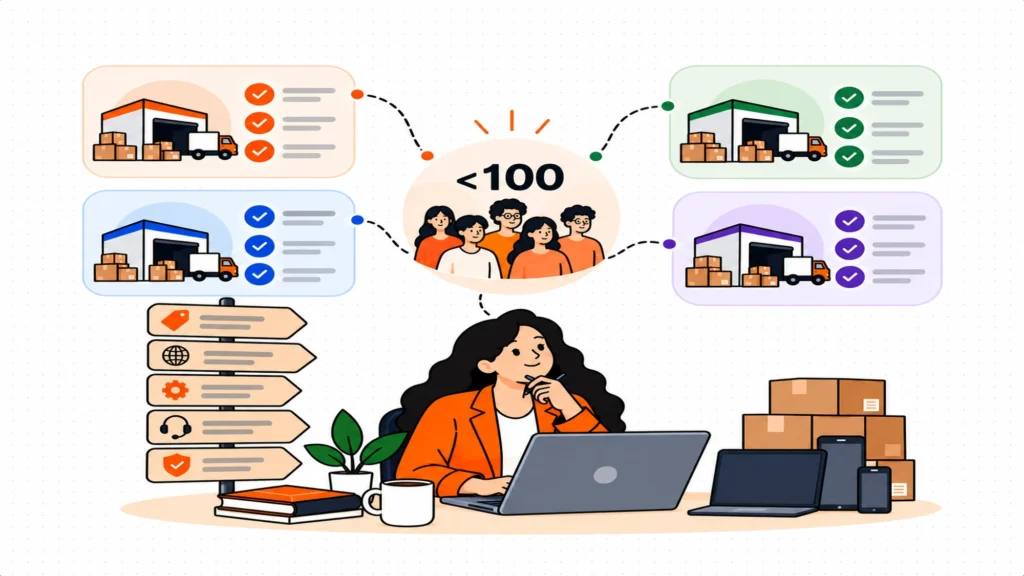
Most equipment platforms are designed and priced for fleets considerably larger than a hundred machines. Below that line, several of them are genuinely premature, and the honest answer for a lot of teams is a spreadsheet, a local reseller and a named owner. Here is where the line actually sits.
TL;DR
- Headcount is the wrong trigger. Country count and movement volume decide whether a platform earns its cost.
- Three people abroad is a courier problem. Thirty people across six countries is a platform problem.
- Below the line, the thing worth building is an asset register, not a vendor relationship.
- No vendor publishes a price, so you cannot check affordability without a conversation. Budget evaluation time accordingly.
- Minimum commitments catch small teams. Ask what the smallest viable arrangement looks like before investing weeks.
- Buying a platform to get a register ties the most durable thing you own to a vendor you might leave.
The three questions that decide it
Forget headcount. These three predict whether a platform pays for itself far better than team size does.
How many countries, by headcount rather than by flag. Fifty people in one country with three abroad is a different problem from fifty across six markets. The second generates customs questions, local stock questions and replacement questions constantly. The first generates them three times a year.
How much movement. Joiners, leavers and reassignments per year. A stable team of eighty with four leavers is nothing. A team of sixty with twenty-five movements is a part-time job.
Whether anybody owns it. If device logistics is genuinely nobody’s job, a platform does not fix that and a managed service might. If somebody capable owns it, tooling helps and a service layer will be routed around.
Where the line sits in practice
| Your situation | What usually fits |
| Under 50, one country | Local reseller plus a spreadsheet |
| Under 50, two or three abroad | Courier arrangement, still no platform |
| 50 to 100, four or more countries | Platform starts to earn its cost |
| Under 100, high movement | Platform, driven by volume not headcount |
| Under 100, nobody owns it | Managed service rather than a platform |
| Any size, fleet already scattered | Register first, vendor second |
The second row is the one teams get wrong most often. Three people in other countries feels international and is operationally a handful of courier bookings a year, which no platform fee is worth.
Build the register regardless
Whatever you decide about vendors, the asset register is worth building this week and it does not require buying anything.
Checklist:
- One row per device: serial number, model, who holds it, where, since when, what it cost, what arrangement it sits under.
- Include the machines somebody bought on a company card two years ago. Those are the ones that go missing.
- Record the gaps explicitly. A device you cannot account for is a device that will not come back.
- Add a condition note and a photograph at dispatch and at return, because damage disputes are unwinnable without one.
- Export it monthly to a file you control, even once you are on a platform.
Buying a platform in order to get a register is backwards. The register is the most durable thing you own in this area, it survives changing vendors, and it is what an auditor asks for. Keep it somewhere you control.
What to ask when you do look
Small teams hit a specific set of obstacles that larger buyers never notice, and it is worth surfacing them in the first call rather than the fourth.
Is there a minimum commitment, in devices or in spend. Several arrangements have one. Finding out in week four wastes three weeks.
What does the smallest viable arrangement look like. Ask directly. Vendors who serve small teams well will answer immediately; vendors who do not will describe their platform.
Can I buy a subset. Procurement and shipping only, handling retrieval yourself, is a legitimate ask at this size and some models accommodate it while tiered products usually do not.
What does the contract term look like. A three-year commitment at eighty staff is a long bet on your own growth being the shape you expect. Ask what a one-year term costs and treat the difference as the price of flexibility rather than as a discount you are losing.
And who would actually handle my account. Small customers are frequently served differently from large ones, which is reasonable and worth knowing. Ask whether you get a named contact or a shared queue, because at this size the vendor is often standing in for an IT function you do not have.
Which vendors suit smaller fleets
Firstbase bundles the lifecycle into a per-person subscription, which maps neatly onto a small headcount and removes the need to buy services separately. allwhere and GroWrk both scope per customer, which can work at small scale and takes evaluation time to find out.
Workwize earns its cost through warehousing, which a small stable fleet may not generate enough work to justify. Its domain is now goworkwize.com. Deel IT is straightforward if everyone with a device is already employed through it.
Disclosure: RemoAsset is owned by the same people who publish PeopleOpsHQ. It publishes no price and requires a demo, which is the same obstacle every vendor here presents to a small buyer. It is also weaker for hardware it did not supply, and it is not a device management system. Compared with the rest in our laptop procurement platform comparison.
Final thoughts
Under a hundred staff, the honest answer is frequently that you are not ready, and that is not a failure. A spreadsheet register, a reseller who knows your spec and one named owner covers the same ground at a fraction of the cost and with no commitment.
The things that genuinely change the answer are countries and movement, not headcount. When device logistics has become somebody’s part-time job and you can say how many hours, you will make a far better platform decision than you would today, and you will have a register to hand the vendor when you do.
Frequently asked questions
At what size do you need an equipment platform?
Headcount is the wrong trigger. What matters is how many countries you operate in by headcount rather than by flag, how much movement you generate in joiners, leavers and reassignments per year, and whether anybody actually owns the work. Fifty people across six markets needs a platform long before eighty people in one country with four leavers a year does.
Is three people abroad enough to justify a platform?
Almost never. Three people in other countries feels international and in practice generates a handful of courier bookings a year, which no platform fee covers. It is a courier arrangement with a good register behind it, and the money is better spent on getting the register right than on a subscription you will barely use.
Should I buy a platform to get an asset register?
No, because that ties the most durable thing you own to a vendor you might leave. Build the register in a spreadsheet first with serial, holder, location, dates, cost and arrangement, include the machines bought on a company card years ago, and export it monthly to a file you control even after you do adopt a platform.
What obstacles do small teams hit with these vendors?
Minimum commitments in devices or spend, which several arrangements carry and which are rarely mentioned early. Ask in the first call what the smallest viable arrangement looks like and whether you can buy a subset such as procurement and shipping while handling retrieval yourself, because discovering a minimum in week four wastes three weeks of evaluation.
Which model suits a small fleet best?
A per-person subscription maps most neatly onto a small headcount because it removes the need to buy services separately and keeps the cost predictable. Warehousing-led models earn their cost through storage and redeployment, which a small stable fleet may simply not generate enough of, so the differentiator you would be paying for may not apply to you.
How do I know when I have outgrown a spreadsheet?
When you can say how many hours a week device logistics takes and the number is uncomfortable, and when exceptions outnumber the standard path, with separate workarounds in three countries and a second spreadsheet for machines the first one does not cover. Both are better signals than any headcount threshold, and both give you real numbers to put in a vendor specification.