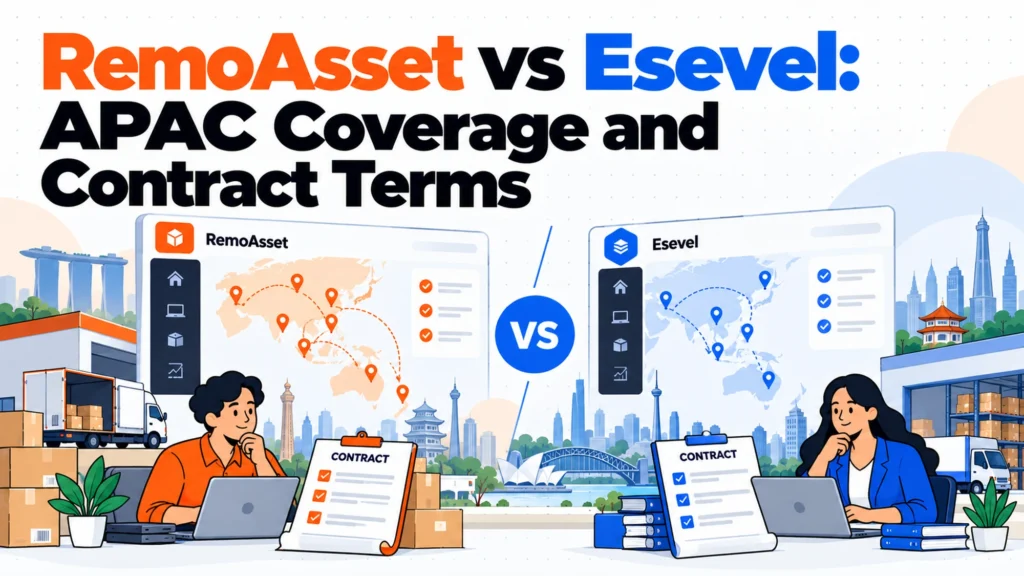
The short version. This one is decided by a spreadsheet rather than by a demo. Esevel’s advantage is real operational depth in Asia-Pacific markets that other vendors reach through partners. RemoAsset, our own product and read accordingly, spreads across 80+ countries with depth that varies by market. If more than roughly a third of your people sit in APAC, the specialist is probably the better answer. If APAC is a minority of a spread footprint, you are paying for a specialism that is not where your problem is.
The disclosure
RemoAsset is built by the company publishing this site, so treat this as written by an interested party. Esevel details come from its own site, read on 21 October 2026 at esevel.com.
One technical note while we are there: the bare domain serves, while the www subdomain did not respond to a server-side request on that date. If you are checking our claims, use the bare domain.
Why regional depth is a real category rather than marketing
Most equipment vendors describe global coverage, and most of them mean a mix of operations they run and partnerships they have arranged. The mix is rarely published, which is why country counts are a weak signal.
In practice that mix determines three things you care about: how long a device takes to arrive, whether a collection can actually be executed, and who you escalate to when something is stuck in customs.
A regional specialist concentrates its own operations in one part of the world and is honest that the rest is thinner. For a company whose people are concentrated in that region, that trade is clearly good.
The calculation that decides it
Take last year’s joiners and leavers rather than headcount, since throughput is what you are buying. Split them by region. Then look at what share falls in Asia-Pacific.
If that share is large, a specialist in the region is handling most of your actual volume with its strongest capability, and the markets it covers less well are the ones you touch rarely.
If the share is small, you have bought depth in the part of your footprint that generates the least work, and the markets where most of your volume sits are being covered by the vendor’s thinner arrangements.
This is unusually clear-cut for a vendor decision. The spreadsheet answers it before any call does.
What to ask either vendor about a specific market
Generic coverage questions produce generic answers. Name the market and ask these four.
What is the lead time for a standard device, measured from order to the person having it, not from dispatch.
Is this market served by your own operation or by a partner, and if a partner, what does that change about timing and escalation.
What happens on a collection when the person has stopped responding, and what are you charged.
Can you hold a device in this market between one holder and the next, and what does that cost per month.
Ask both vendors the same four about the same three markets. The spread in answers is the comparison.
Contract terms worth reading carefully
Regional specialists and global platforms tend to differ on commitment shape, and this is worth attention before signing either.
Ask what happens if your footprint shifts. A company that is APAC-heavy today and opens a European office next year has changed the basis on which it chose a regional specialist, and whether the contract accommodates that cheaply is a real question.
Ask about minimums and how they are measured, by device, by movement, by seat or as a subscription. The unit matters more than the rate, because comparing quotes across different units is where most buyers go wrong.
And ask about exit: data export format, what happens to inventory the vendor holds, and who covers retrieval for leavers during a transition. Exit terms are easier to negotiate before a signature than after one, and almost nobody asks at the point where their bargaining position is strongest.
Pricing
Esevel publishes no price. Its pricing page returns no figures, checked on 21 October 2026, which is the norm in this category.
RemoAsset publishes a Subscription tier starting at $1,499 a year for companies between 50 and 5,000 employees, and a pay-as-you-go tier below that for 5 to 50 with no published figure. Either way you will need a real quote, because the published figure is a floor rather than an estimate of what your footprint costs.
Where RemoAsset is weaker
It enrols devices but is not an MDM in its own right, so endpoint management remains separate.
It wipes devices but is not a certified ITAD, so formal destruction certificates are a separate arrangement.
And on this article’s own axis, a vendor spread across 80+ countries does not match a regional specialist’s depth in that specialist’s region. If your people are concentrated in Asia-Pacific, Esevel’s concentration is a genuine advantage and the honest recommendation is to test it hard.
How to decide
Do the regional split of last year’s joiners and leavers before any call. It usually settles the question on its own.
Ask the four market questions above about your three hardest markets, to both vendors, and compare the spread rather than the claims.
Ask what happens when your footprint changes, because the thing that makes a regional specialist right today is exactly the thing that could make it wrong in two years.
How do I know if a regional specialist is right for us?
Split last year’s joiners and leavers by region rather than splitting headcount, because throughput is what you are actually buying. If a large share of that movement sits in Asia-Pacific, a specialist concentrated there is handling most of your real volume with its strongest capability. If the share is small, you have bought depth in the part of your footprint that generates the least work. This calculation answers the question more reliably than any vendor conversation will.
Does Esevel publish pricing?
No. Its pricing page returned no currency figures when checked on 21 October 2026, which matches the rest of this category where almost nobody publishes. One practical note if you are verifying that yourself: the bare domain serves the site, while the www subdomain did not respond to a server-side request on that date, so use esevel.com rather than the www version when checking.
What should I ask about a specific country?
Four questions, asked about named markets rather than in general. What is the lead time measured from order to the person having the device rather than from dispatch. Is this market served by the vendor’s own operation or by a partner. What happens and what are you charged when a collection fails because somebody stopped responding. And can a device be held locally between holders, at what monthly cost. Ask both vendors the same four about the same three markets.
What if our footprint changes after we choose?
That is the central risk with a regional specialist and it is worth raising before signing. A company that is concentrated in one region today and opens offices elsewhere next year has changed the basis on which it made the decision. Ask what the contract does in that situation, whether coverage outside the core region is available on the same terms, and what it costs to exit if it is not. The thing that makes a specialist right now is exactly what could make it wrong later.
Why do country counts tell you so little?
Because a supported country can mean the vendor runs its own operation there with staff and storage, or it can mean a partner arrangement that works but takes longer and escalates differently. Almost no vendor publishes which markets fall into which category, so a headline number aggregates two very different things. The only reliable way through is to name your specific markets and ask directly whether each is served in-house or by partner, then compare the answers rather than the totals.
What does RemoAsset cost and where does it fall short?
The Subscription tier starts at $1,499 a year for companies between 50 and 5,000 employees, with a pay-as-you-go tier below it for 5 to 50 carrying no published figure. It enrols devices without being an MDM in its own right, wipes devices without being a certified ITAD, and its coverage and lead times vary by market. On this comparison’s own terms, a platform spread across many countries will not match a regional specialist’s depth inside that specialist’s region.