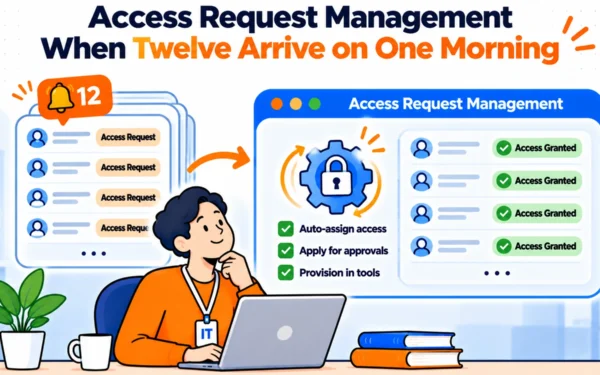
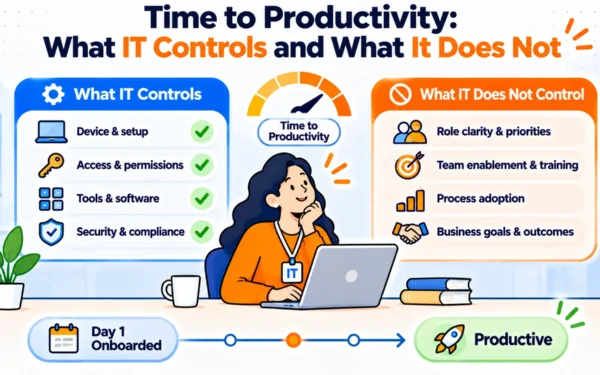
Onboarding software for small business is usually bought a year before it is needed and configured for a company that does not exist yet. For most teams under about fifty people, the honest recommendation is a checklist, a calendar trigger and one named owner.
TL;DR
- Under about fifty people, a shared checklist and a notification beat most software and cost nothing.
- Three signals say buy: hiring in bursts, shipping hardware internationally, or nobody owning the process.
- The maintenance cost of a configured tool is the part small teams underestimate.
- Your identity provider probably already does the account half, unconfigured.
- Buy for the job that is failing, not for the category.
- Whatever you choose, record what access was granted. That record is the thing you cannot recreate.
Why small teams buy too early
A bad onboarding experience is memorable and generates pressure to act. Somebody arrives without a laptop, it is discussed, and the conclusion is that the process needs a system.
Usually the process does not need a system. It needs an owner and a trigger. The failure was that nobody was told in time, or nobody was responsible, and software does not supply either. It encodes a process you already have, so buying one to create a process you do not have yet produces a configuration nobody can maintain.
The cost that gets missed is ongoing. Every role change, tool change and policy change has to be reflected in the configuration, and in a small team that work lands on somebody who already has a full job.
What actually works under fifty people
What to do:
- One checklist per common role, kept in whatever document tool you already pay for.
- A required notification to IT at offer acceptance, not contract signature.
- One named owner for the whole process, with a named deputy.
- A verification step on the working day before a start date.
- A single place recording what access each person was granted.
That is the entire system, and for a team hiring fifteen people a year it will outperform a configured platform because it has no maintenance burden and no configuration to drift.
The one part worth doing properly is the notification, because it is the only element that cannot be recovered by somebody being diligent later. A checklist can be worked through at speed on the morning somebody starts. A laptop that was never ordered cannot.
The three signals that say buy
You hire in bursts. Four starters on one Monday is a different problem from one a month, because everything queues and a single absent approver blocks the whole cohort. Burst hiring is the clearest argument for tooling at any size.
You ship hardware across borders. Lead times, customs and enrolment make this the one part of onboarding that genuinely cannot be absorbed by being organised. A twelve person company hiring in four countries has a harder device problem than a hundred person company in one office.
Nobody owns it. If onboarding is handled by whoever notices, the failure is structural and will recur. Software does not fix this either, but the act of configuring a tool usually forces the ownership question, which is sometimes the only reason it helps.
Absent all three, the money is better spent elsewhere.
A company that bought and then stopped using it
A thirty five person company bought an onboarding platform after two bad arrivals in a quarter. Setup took three weeks and covered four roles.
Within eight months it was effectively abandoned. Two of the four roles no longer existed, two new ones had never been added, and the person who configured it had changed jobs internally. Starters were being onboarded from a copy of the checklist somebody had exported, because that was easier than updating the templates.
The exported checklist worked fine. What the project actually produced was the checklist and the ownership conversation, and both could have been had without the licence.
Check what you already own
Before shopping, find out what your existing tools do unconfigured. Most small teams already pay for an identity provider that can create accounts, assign group membership and apply a baseline of application access from a template, and have never set it up because nobody had the time.
Similarly, if you run an HR platform it very likely sequences onboarding tasks already. Teams routinely build a parallel process because the built in version looked plain, and end up maintaining two.
For reference while comparing, BambooHR publishes Core at $10.25 per employee per month above twenty five employees. Rippling starts from $8 per employee per month plus a monthly base fee. Workday publishes no rate at all, its pricing URL returning a 404, so any figure attributed to it is an estimate.
Where to spend first
| Headcount | Hiring pattern | Spend on |
|---|---|---|
| Under 25 | Occasional | A checklist and an owner |
| 25 to 50 | Steady, one location | Configuring what you already own |
| 25 to 50 | Distributed, shipping hardware | Device lifecycle tooling |
| 50 plus | Bursts or cohorts | Provisioning automation |
| Any | High question volume after day one | An answering layer over your docs |
On that last row, Matram is our own product. It reads your documentation and answers the process questions that arrive once somebody is working, which for a small team is often the largest single drain. It has no free tier, it is not an HRIS, and its actions reach HubSpot, Zendesk and webhooks only, so it will not create accounts or grant access. WhatsApp is coming soon rather than available. Flat pricing runs $29, $69 and $199 a month with unlimited seats, which suits small teams better than per employee models, though for a company of twelve the honest comparison is against doing nothing.
The checklist worth keeping
Checklist:
- A named owner and a named deputy for onboarding.
- IT notified at offer acceptance, with a required field rather than a reminder.
- One checklist per common role, in a tool you already pay for.
- Your identity provider’s templates actually configured.
- A verification step the day before each start date.
- A single record of what access each person has.
Final Thoughts
Onboarding software encodes a process. If the process is unclear or unowned, the software inherits that and adds maintenance on top, which is why so many small team deployments are quietly abandoned within a year while the exported checklist survives.
Get the owner, the trigger and the record right first. If you are still struggling after that, you will know exactly which of the three jobs to buy for, which is a much better position than buying a category.
Frequently asked questions
At what size does onboarding software make sense?
Headcount is a weaker signal than hiring pattern. A team of thirty hiring in cohorts or shipping hardware across borders needs tooling more than a team of eighty hiring one person a month into one office. The three signals worth watching are burst hiring, international hardware, and nobody owning the process.
Can a checklist really be enough?
For a steady trickle of hires in one or two locations, yes, and it usually outperforms a platform because it has no configuration to drift and no maintenance burden. What a checklist cannot do is enforce the trigger or survive its owner leaving, so pair it with a required notification and a named deputy.
What do small teams underestimate?
Maintenance. Every role change, tool change and policy change has to be reflected in the configuration, and in a small team that falls to somebody with a full job already. Deployments are rarely abandoned because the software was bad. They are abandoned because keeping the templates current stopped being anybody’s priority.
Do we already have some of this?
Very likely. Most identity providers can create accounts, assign groups and apply a baseline of application access from a role template, and a large share of small teams have never configured it. Many HR platforms also sequence onboarding tasks already. Check both before shopping, because duplicating them means maintaining two processes.
Is flat pricing better than per employee?
It depends entirely on where you are growing. Per employee pricing is predictable and rises with headcount, which is fine if your question volume scales the same way. Flat pricing is better when a small team carries a disproportionate load, and worse if you never grow into it, so model it against your actual hiring plan rather than the list price.
What is the one thing to get right regardless?
Recording what access each person was granted, at the moment it was granted. Everything else in onboarding can be reconstructed from memory if it goes wrong, but access that was handed out informally and never written down becomes invisible, and you discover the gap at offboarding or during an audit rather than before one.