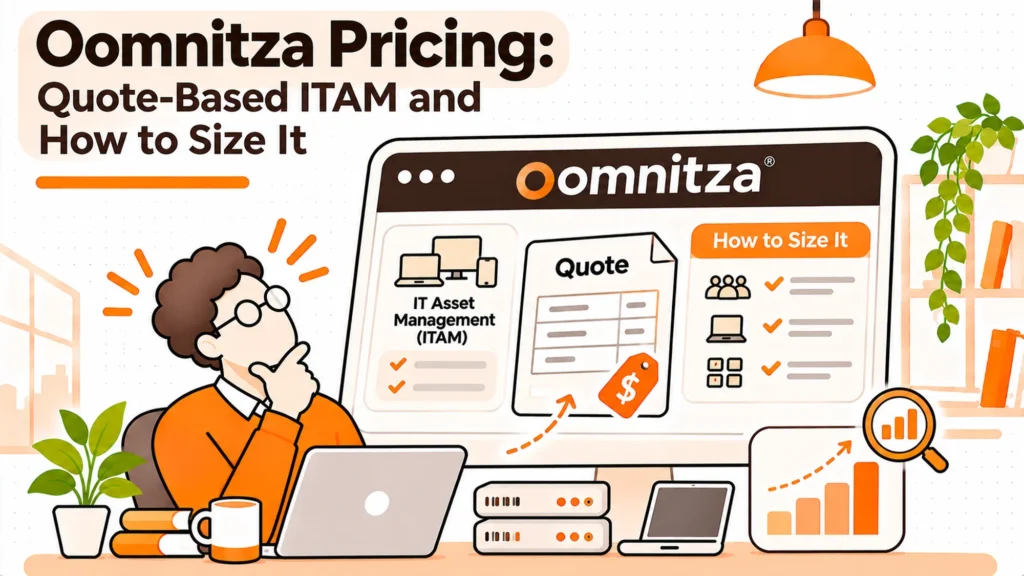
There’s no pricing page. Not a page with the figures removed, not a tier structure waiting for a conversation: the usual addresses return a hard not-found, and the only route that resolves is a demo request. That’s a stronger signal than a quote-based page, and it tells you something useful about how this product gets bought.
TL;DR
- Checked on 28 October 2026, the obvious pricing addresses returned a hard not-found.
- The only commercial route that resolves is a demo request, so expect an enterprise sales process.
- One large currency figure circulates for this vendor and it’s a customer savings claim, not a price.
- The product is integration-led: it reconciles systems that already hold fragments of your asset data.
- That means your quote depends heavily on how many systems you want joined up.
- Budget six to eight weeks for the evaluation rather than four.
What the absence actually means
There’s a meaningful difference between a pricing page with no numbers on it and no pricing page at all, and it’s worth drawing because most articles treat the two the same way.
A page with a tier structure and no figures tells you the vendor expects a self-service buyer who’ll need a conversation about the number. The absence of the page entirely tells you the vendor doesn’t expect a self-service buyer at all, and has designed the front door as a conversation from the start. Neither is better. They just imply different timelines, different contacts and a different amount of preparation on your side.
In practice it means your first contact will be with somebody whose job is qualification rather than support. So bring your numbers to that call, because an unprepared discovery conversation adds a round trip and a fortnight.
The figure that circulates, and why to leave it alone
Search for a price here and you’ll eventually find a large six-figure number attached to this vendor’s name. It isn’t a price.
It’s an outcome claim. The figure belongs to a customer story about money recovered through better device recovery. Those claims are legitimate marketing and they’re wholly unusable as pricing inputs, and the error of reading one as a rate has produced confidently wrong comparison tables more than once in this category. If a figure has no unit and no plan name beside it, it hasn’t become a price yet.
The same shape appears elsewhere in this market, which is why the habit matters a great deal more than this individual case does. Several vendors publish savings claims and no rates at all, and a scraper cannot tell the two apart. Read the sentence, not the number.
What drives the quote for an integration-led product
This product’s design shapes its pricing, so understanding the design helps you predict the questions.
It isn’t a system of record. Rather than being the single place your asset data lives, it reconciles the systems that already hold pieces of it. Your purchasing records, your endpoint tool, your identity provider, your finance system. That’s a genuinely good answer to the problem most mid-sized companies actually have, which is three partly-right sources and no authority between them.
It also means the scope of your deployment is the main cost driver. Two systems joined up is a small project. Seven systems, with workflows triggered across them, is a large one, and the quote will reflect that more than it reflects your device count. So the number you need before the call isn’t only how many assets you have. It’s how many systems you want reconciled and which ones.
What to do:
- List the systems that currently hold any device data, and what each is good at.
- Decide which of them you actually want joined, rather than all of them.
- Count your assets, including anything in storage or in transit.
- Name the workflows you want triggered, if any.
- Ask for the figure in writing with the integration count stated as an assumption.
The honest warning about integration-led tools
One caution worth stating before you commit, and it applies to the whole approach rather than to this vendor.
A reconciliation product inherits the quality of what it reconciles. If your purchasing record is incomplete, your endpoint tool misses dormant machines and your spreadsheet is nine months stale, joining all three produces one well-presented imperfect source rather than a correct one. The presentation is better. The underlying data is the same, and it now looks official, which is a specific risk because people stop questioning a system that looks authoritative.
So do the cheap thing first. Sample twenty-five rows from whatever record you have today and physically confirm each one, which gives you an error rate in under an hour. If that rate is poor, fix the sources before buying anything to join them, because a clean-up done after a deployment costs about three times what the same clean-up costs beforehand.
What it does not reach
Two gaps, and both are the ones buyers in this category most often assume are covered.
Software licence reconciliation is often genuinely in scope here, which is a real strength and separates integration-led tools from hardware-first registers. Physical logistics is not. Nothing in this market buys a laptop, ships it to a home address abroad, stores it between users or collects it from somebody who left last month, and that half is frequently where a distributed team’s real pain sits.
That logistics market publishes very little. Workwize publishes no rate card, Firstbase publishes nothing and allwhere is consultation-only. RemoAsset publishes $1,499 a year for its Subscription tier, with procurement and retrieval stated across 80+ countries. Disclosure: RemoAsset is our own product, so the limits belong here. It does no network discovery, it does no software licence management, and only the Subscription tier publishes a figure because the pay-as-you-go side is quoted.
Checklist before the demo
Checklist:
- The list of systems holding device data today.
- Which of those you want joined, and in what order.
- Your asset count, and your best twelve-month estimate.
- Your measured error rate from a sample of twenty-five rows.
- Whether software licences are in scope for you.
- Six to eight weeks in the timeline, since this is an enterprise cycle.
Final thoughts
No pricing page is information rather than a problem. It tells you this is bought through a conversation with a qualification step in front of it, which means your preparation determines how quickly you get to a number you can plan against.
Bring the systems list, the asset count and your own measured error rate. Leave the circulating six-figure claim where you found it. And run the twenty-five-row sample first, because if your sources are poor then the most expensive version of this purchase is the one where you join them up before you clean them.
Frequently asked questions
How much does Oomnitza cost?
There’s no published figure. There is no pricing page either, which is a stronger statement: checked on 28 October 2026, the obvious addresses returned a hard not-found and the only commercial route that resolved was a demo request. Expect an enterprise sales process, and expect the quote to depend on how many systems you want reconciled rather than purely on device count.
What about the large figure I have seen quoted?
Leave it alone. It belongs to a customer story about money recovered through better device recovery, which makes it an outcome claim rather than a rate. Reading a savings claim as a price has produced confidently wrong comparison tables in this category before, and the test is simple: a figure with no unit and no plan name beside it isn’t a price.
Is no pricing page different from quote-based pricing?
Yes, and the difference is worth reading. A page with tiers and no figures expects a self-service buyer who’ll need a conversation about the number. No page at all means the vendor designed the front door as a conversation from the start, which implies a longer cycle, a qualification step and more preparation needed from you.
What drives the quote?
Scope, mostly. This is an integration-led product that reconciles systems already holding fragments of your asset data, so two systems joined up is a small project while seven with workflows across them is a large one. Decide which systems you want joined, and in what order, before the first call.
Will it fix our inventory accuracy?
Only to the extent your sources are accurate. A reconciliation product inherits the quality of what it reconciles, so joining three imperfect sources gives you one well-presented imperfect source that now looks official. Sample twenty-five rows and physically confirm them first, because that hour tells you whether this is a tooling project or a clean-up project.
Does it handle shipping and retrieval?
No, and no product in this category does. Asset platforms hold records rather than hardware, so buying a laptop, getting it to somebody’s home in another country, storing it between users and collecting it from a leaver all sit outside the market. For a distributed fleet that half needs a logistics supplier, and most of them publish no rate card at all.