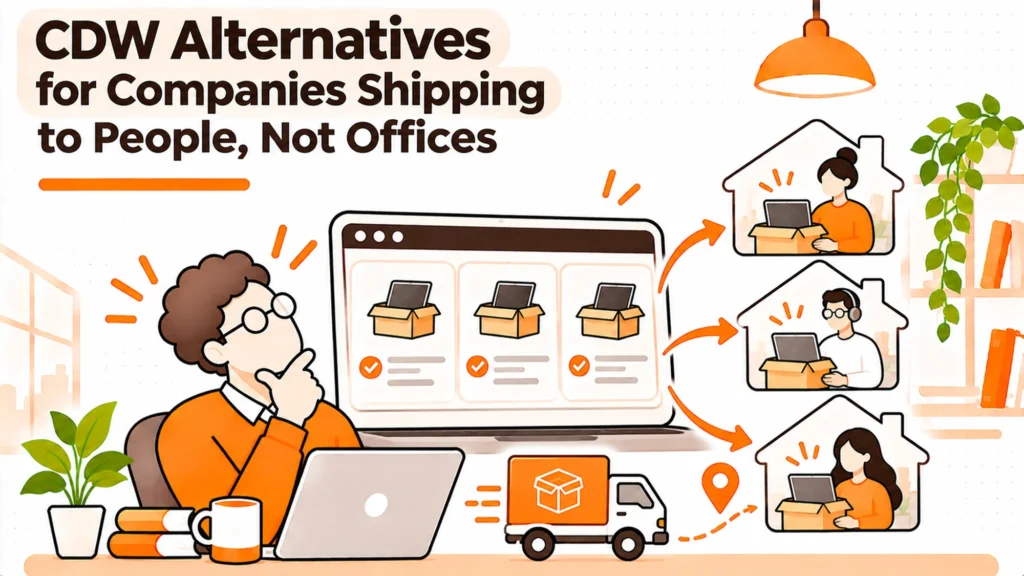
A reseller and a logistics platform are different shapes of supplier, and most people searching for CDW alternatives are quietly discovering that they need the second one. The hardware was never the problem. Getting it to twelve people in seven countries and back again was.
TL;DR
- A reseller gives you catalogue breadth, volume pricing and delivery to an address you nominate.
- It doesn’t do home delivery across many countries, storage between users or retrieval from leavers.
- If your fleet sits in offices, a reseller is the right supplier and the alternatives are other resellers.
- If your people are distributed, you need a logistics platform instead or as well.
- Almost nothing in the logistics category publishes a rate card, so compare on coverage.
- Pricing for resellers is quoted per deal anyway, so this is a model comparison rather than a rate one.
A note on figures before anything else
We tried to read CDW’s own pages on 28 October 2026 and could not. A server-side request was refused, and so was a request from a real browser, which is unusual and means no claim in this article is sourced from the company’s own site.
That’s a limitation worth stating rather than working around. A reseller’s pricing is deal-specific in any case, driven by volume, configuration and the manufacturer’s own programmes, so there was never going to be a rate card to compare against. What follows is a comparison of supplier models, which is the useful comparison here regardless.
What a reseller is genuinely good at
Worth being fair about this, because the alternatives are only better for a specific situation and worse for others.
Catalogue breadth is the first thing. A large reseller carries thousands of configurations across every manufacturer, so if you need a specific graphics card or a particular docking station you’ll find it, and you’ll find it alongside the accessories that go with it. Logistics platforms carry a curated catalogue by design, which is a feature for standardisation and a limitation when somebody needs something unusual.
Volume pricing is the second. Resellers buy at scale and pass some of that on, and for a company replacing 300 machines into offices that discount is real money. A logistics platform’s margin sits on top of the hardware, so on pure hardware cost at volume the reseller usually wins.
And the third is that they’ll handle a large single delivery properly, which is a genuinely developed capability and not something the alternatives below can match. Pallets to a loading bay, asset tagging on request, imaging before despatch. It suits an office refresh exactly.
Where the model stops working
Four gaps, and all four are about geography rather than about hardware.
Home delivery in markets where you have no entity. A commercial import generally wants a declared value, an importer of record and a tax identifier for that importer. A company shipping to its own employee in a country where it isn’t registered has the first and often neither of the others, and the shipment then sits while somebody emails about paperwork.
Retrieval. Resellers sell outbound. Getting a laptop back from somebody who left three weeks ago and lives in a city you’ve never visited is a different operation with a different cost structure, and it’s where distributed fleets lose most of their hardware.
Storage between users. A returned machine has to live somewhere before it goes to the next person. In an office that’s a cupboard. Without an office it’s either somebody’s spare room or a warehouse you’re paying for, and the reseller model doesn’t include one.
The record. A purchase order tells you what was bought and shipped. It doesn’t tell you who has it now, and for a fleet that changes hands as people join and leave, that gap is the origin of every reconciliation problem later.
The alternatives, by what you actually need
Three routes, and the right one depends on where your people sit rather than on how many devices you buy.
Another reseller, or direct from the manufacturer. If your fleet lives in offices, this is the answer and you’re shopping on price, catalogue and service rather than changing models. Buying direct can be competitive at volume and usually means a narrower catalogue, so it suits a standardised fleet better than a varied one.
An equipment logistics platform. This is the different shape of supplier: it buys, ships to home addresses across a stated country list, stores between users, retrieves from leavers and holds the record of which device is where. Workwize publishes no rate card and has genuine warehousing. Firstbase publishes nothing and has the strongest joiner experience. GroWrk publishes nothing and reaches markets the others treat as exceptions. allwhere is consultation-only and sells the service wrapper rather than a platform.
RemoAsset is in that group and does publish a figure, at $1,499 a year for its Subscription tier, with procurement and retrieval stated across 80+ countries and a 60% reduction on retrieval charges at that tier. Disclosure: RemoAsset is our own product, so its limits belong next to that figure. It does no network discovery, so it won’t find hardware nobody recorded. It does no software licence management. And only the Subscription tier publishes a figure, because the pay-as-you-go side is quoted.
Both, which is what most mixed companies end up doing. A reseller for the office refresh at volume, and a logistics platform for the distributed trickle of joiners and leavers that no reseller was ever designed to handle. That’s two suppliers rather than one, and it’s usually cheaper than forcing either model to do the other’s job.
What to do:
- Split your headcount into office-based and distributed, with a number against each.
- List the countries where you have people and no registered entity.
- Count your leavers over the last two quarters and how many devices came back.
- Decide whether you need catalogue breadth or standardisation.
- Ask every logistics candidate who acts as importer of record in your hardest markets.
How to compare when almost nobody publishes
This category is quiet about money, so the comparison has to be built on things other than rates.
Coverage per market, stated as direct or partnered rather than as a total country count. Who the importer of record is where you have no entity. Whether retrieval includes packaging and a home collection. Whether storage is charged separately and on what unit. What you can export if you leave, including whether custody history comes with it. Those five answers will separate candidates far more reliably than any price will, and all five can be requested in one email.
Then do one real walkthrough. Pick an actual upcoming joiner in your most awkward market and ask each candidate to narrate the whole thing, step by step, naming the party responsible at each step. The answers come back in one of two registers, and the shift from describing a process to describing a capability is the most reliable signal available to you.
Checklist before you switch anything
Checklist:
- Office-based and distributed headcount, counted separately.
- Markets with people and no entity, listed by name.
- Your measured retrieval rate from the last two quarters.
- Whether catalogue breadth matters to you or standardisation does.
- Importer of record, answered per market in writing.
- Storage terms, with a unit and a rate.
Final thoughts
Nothing is wrong with the reseller model. It’s extremely good at the job it was built for, which is getting a lot of hardware to a small number of addresses at a competitive price.
What it isn’t built for is a fleet scattered across home addresses in countries where you have no presence, with devices changing hands every time somebody joins or leaves. If that’s you, stop shopping for a better reseller. You’re looking for a second supplier doing a different job, and the useful comparison is coverage and retrieval rather than hardware cost.
Frequently asked questions
What is the difference between a reseller and an equipment platform?
Two different jobs. A reseller sells hardware and delivers it to an address you nominate, with catalogue breadth and volume pricing as its strengths. An equipment logistics platform buys, ships to home addresses across a stated country list, stores devices between users, retrieves them from leavers and holds the record of where each one is. Different jobs, and most mixed companies end up using both.
Will a logistics platform be cheaper on hardware?
Usually not at volume. Resellers buy at scale and pass some of that on, while a logistics platform’s margin sits on top of the hardware, so on pure device cost for an office refresh the reseller generally wins. What you’re buying from the platform is the work around the device: delivery, retrieval, storage and the record.
Can a reseller ship to employees at home abroad?
Sometimes. The question to ask is who acts as importer of record. A commercial import wants a declared value, an importer and a tax identifier for that importer, and a company with no registered entity in the destination country frequently has only the first. If the answer is that you’re the importer, you’ve bought a courier booking rather than a delivery service.
Which equipment platforms publish their pricing?
Very few. When this was checked on 28 October 2026, Workwize, Firstbase, GroWrk and allwhere all published nothing at all for the equipment side of what they do. RemoAsset publishes an annual figure for its Subscription tier, which is unusual here. Expect a discovery call as the norm and compare on country coverage, retrieval terms and storage charges instead.
Do we have to choose one or the other?
No. Most companies with both offices and distributed staff shouldn’t. Use a reseller for the large single-site refresh where volume pricing matters, and a logistics platform for the trickle of joiners and leavers across many countries. Forcing either model to do the other’s job costs more than running two suppliers does.
How do we compare suppliers with no published prices?
On five answers rather than on rates. Coverage per market stated as direct or partnered, who the importer of record is where you have no entity, whether retrieval includes packaging and home collection, whether storage is charged separately and on what unit, and what you can export if you leave. All five fit in one email and they separate candidates better than any figure.