TL;DR
A desk and chair budget is small, genuinely useful and owned by nobody in most companies, which is why it tends to be administered badly by whoever inherited it. It is also the one category where the instinct to recover equipment at the end is almost always wrong.
- Give a budget, not a catalogue. People know what their room can take.
- Let them keep it. Recovering furniture across borders is not worth it.
- Say who owns it in writing, before anybody buys anything.
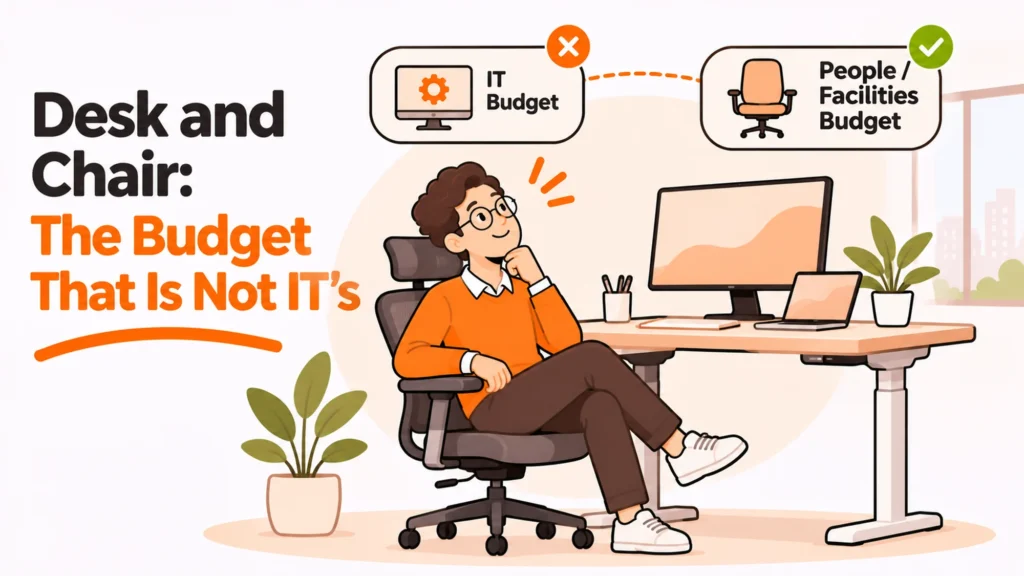
- This is not IT’s budget, and routing it there slows everything down.
- Health and accessibility go elsewhere, with no cap and a different owner.
- One budget per person, once, beats an annual allowance nobody tracks.
Give a desk and chair budget, not a catalogue
The catalogue approach looks responsible and serves the company rather than the person.
Three approved chairs cannot account for somebody’s height, their back, the size of their room, whether they have a desk already, or whether a standing desk would fit where they work. The person knows all of that and the procurement team knows none of it.
A budget with a short list of what it may be spent on resolves this. It is also dramatically less work: no stock, no catalogue maintenance, no shipping furniture.
| Approach | Admin | Fit for the person |
|---|---|---|
| Approved catalogue | High | Poor to adequate |
| Budget with a spend list | Low | Good |
| Reimburse anything | Medium | Good, with edge cases |
| Nothing | None | Depends entirely on means |
The last row is the one to think about
Between those, the middle two are where most companies land, and the difference between them is mostly about how much you trust people with a receipt. Reimbursing anything is slightly more work and noticeably better received, because a spend list always excludes something somebody genuinely needed.
Offering nothing is a real choice and it is not neutral. People with space and money set up well; people in small flats or shared housing do not. Over time that becomes a difference in who can work comfortably, and it falls along lines nobody intended.
Let them keep it, and say so upfront
The instinct from the equipment world is that company property comes back. For furniture, that instinct is usually wrong, and acting on it costs more than it recovers.
A chair is bulky, heavy and awkward to ship. Collection from a home address, packaging, freight and storage routinely exceed what the chair is worth second-hand, and that is before anybody’s time.
So the practical position is that the person keeps it, and the valuable part is saying so before they buy rather than at the exit interview.
Why saying it early matters
Because it changes what they choose. Somebody who believes a chair will be reclaimed picks differently from somebody who knows it is theirs, and the second person generally picks better and treats it better.
It also removes an awkward conversation from the leaving process, which is already a week with enough awkward conversations in it.
Where an accounting rule overrides this
Some organisations capitalise items above a threshold and cannot simply write them off, which can make a desk a tracked asset whatever the logistics say.
If that applies, find out before writing the policy rather than after. The answer may be to keep the budget below the capitalisation threshold deliberately, which is a cleaner solution than building a furniture recovery process nobody wants to run.
Who owns this, and why it should not be IT
Disclosure: RemoAsset, named below, is owned by the same people who publish PeopleOpsHQ. It is described with its limitations stated, on the same terms as every other supplier. This site takes no vendor money.
It lands on IT by default because IT owns equipment, and that is the wrong home for it.
IT’s processes are built around serial numbers, enrolment, security posture and recovery. None of those apply to a desk. Routing furniture through them adds approval steps and an asset record for something that will never be audited, enrolled or wiped.
Better owners, in order: whoever owns the people budget, whoever owns facilities if that function exists, or finance with a simple spend rule.
One budget, once, rather than annually
An annual allowance sounds generous and creates an administrative problem: somebody has to track what each person has used, year by year, against a figure that changes.
A single budget at the point somebody joins, with a route to ask again if something breaks or circumstances change, covers the same ground with none of the tracking. Furniture is not a recurring need for most people, and pretending it is creates a ledger nobody wants to keep.
The exception worth writing in is a move. Somebody relocating to a smaller flat may genuinely need a different desk, and that is a reasonable second request rather than an attempt to claim twice. Say so in the policy, because otherwise the person has to decide whether asking makes them look opportunistic, and most will simply not ask.
Keep the two policies separate and say so
Computing devices are tracked, enrolled and recovered. Furniture is funded and kept. Those are different arrangements and writing them in one document invites the furniture to inherit the device rules.
The device side genuinely needs that rigour: the UK National Cyber Security Centre device security guidance treats the managed state of a device as the control, and a machine leaving the company needs a documented wipe against something like NIST Special Publication 800-88 on media sanitization. A chair needs none of that, and a policy that implies otherwise makes both halves harder to follow.
Where devices are concerned, collection with packaging and a courier arranged handles the return properly. The honest limitation, and the reason this post exists: it is built around laptops and similar devices, not around desks and chairs. For furniture, the realistic answer in almost every case is that it stays where it is.
The decision table
| Situation | Scale | Setup | Primary pain | Recommended starting point |
|---|---|---|---|---|
| Newly remote, nothing in place | Any | Office closed | Uneven home setups | One budget per person, once |
| Approved catalogue in use | 100 plus | Three chair models | Poor fit, high admin | Switch to a budget and a spend list |
| Policy routed through IT | Any | IT owns equipment | Wrong process entirely | Move it to people or finance |
| Recovering furniture at exit | Any | Strict asset rules | Costs exceed value | Check the accounting threshold first |
| Health-related request | Any | Any | Queued behind preferences | Separate route, no cap, different owner |
The route that must not be this budget
The most important paragraph here, and the one most often missing from these policies entirely.
Anything connected to pain, an existing condition, pregnancy, recovery from injury or a disability must not be answered out of a standard furniture budget. It needs a separate route, a different owner and no fixed cap.
Three reasons, and the third is the one people miss.
The amount may be wrong. Specialist seating or an adjustable desk can cost several times a general allowance, and a cap turns a requirement into a part-funded compromise.
The approver is wrong. Whoever manages a furniture budget is not qualified to assess a health need and should not be placed in that position.
The queue is wrong. Sitting behind somebody who wants a nicer desk is the part people find genuinely demoralising, and it is what stops the next person asking at all.
What a workable route looks like
A named contact outside the normal equipment process, a statement that there is no fixed limit, and an explicit note that requests are handled confidentially. the consolidated text of the General Data Protection Regulation treats health information as a special category with additional protections, so where to send it and who sees it is worth being precise about.
For assessing a workstation itself, the United States Occupational Safety and Health Administration computer workstations eTool is a practical starting reference, and the W3C Web Accessibility Initiative introduction to accessibility covers the digital side for anybody whose requirement touches software rather than furniture. For the adjacent spending question, see our piece on connectivity stipends.
See how devices come back when furniture does not at device retrieval with packaging arranged, or read our piece on connectivity stipends.
Frequently asked questions
Budget or catalogue?
Budget, with a short list of what it may be spent on. Three approved chairs cannot account for somebody’s height, their back, the size of their room or whether a standing desk would fit. The person knows all of that and the procurement team knows none of it, and a budget is also far less work to administer.
Should furniture be recovered when somebody leaves?
Almost never. A chair is bulky, heavy and awkward to ship, and collection, packaging, freight and storage routinely exceed what it is worth second-hand before anybody’s time is counted. Let the person keep it, and say so before they buy rather than at the exit interview.
Why say it before they buy?
Because it changes what they choose. Somebody who believes the chair will be reclaimed picks differently from somebody who knows it is theirs, and the second generally picks better and looks after it better. It also removes one awkward conversation from a leaving week that has enough of them.
When might recovery be unavoidable?
Where an accounting rule capitalises items above a threshold and they cannot simply be written off. Find that out before writing the policy. The cleaner answer is often to set the budget deliberately below the capitalisation threshold rather than to build a furniture recovery process nobody wants to run.
Why should IT not own this?
Because IT’s processes are built around serial numbers, enrolment, security posture and recovery, and none of those apply to a desk. Routing furniture through them adds approval steps and an asset record for something that will never be audited, enrolled or wiped. People, facilities or finance are better homes.
Is offering nothing a reasonable option?
It is a real choice and it is not neutral. People with space and money set up well and people in small flats or shared housing do not, so over time it becomes a difference in who can work comfortably, falling along lines nobody intended. Worth deciding deliberately rather than by default.
Where do health-related requests go?
A separate route with a different owner and no fixed cap. The amount may be wrong, since specialist seating can cost several times a general allowance. The approver is wrong, since a budget holder is not qualified to assess a health need. And the queue is wrong, because sitting behind somebody who wants a nicer desk is what stops the next person asking at all.
PeopleOpsHQ covers the operational side of distributed work. We describe suppliers with their limitations stated, and we take no vendor money.