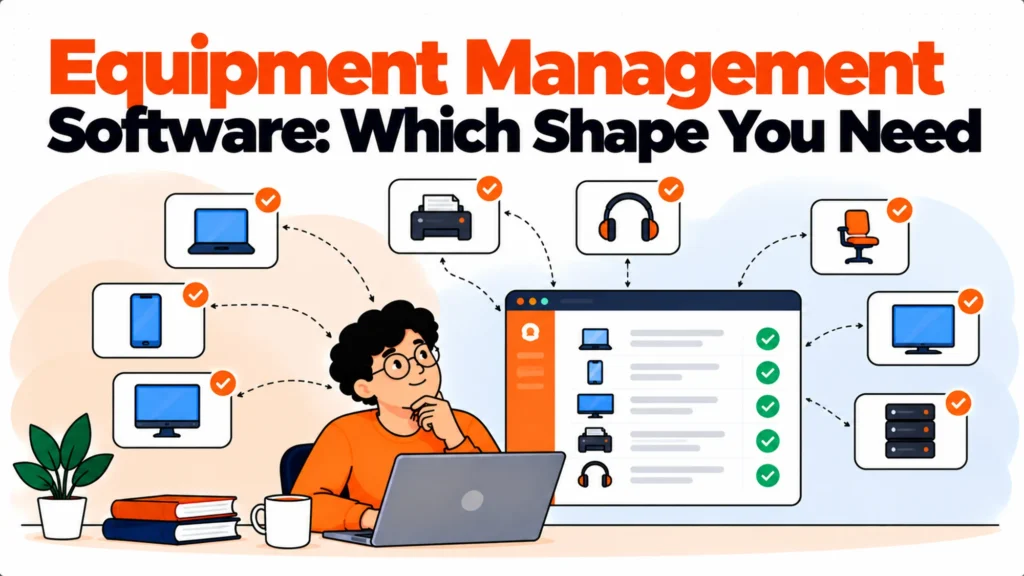
Equipment management software is four different products sold under one phrase. A register, a discovery tool, a lifecycle platform and a maintenance system. They solve different problems, and buying the wrong shape produces a tool that works exactly as designed and changes nothing.
TL;DR
- The four shapes are a register, discovery, lifecycle and maintenance. Most teams need one and shop for all four.
- A register is right when you know what you bought and lose track of where it went.
- Discovery is right when you genuinely do not know what exists, which usually means an office network.
- Lifecycle is right when equipment arrives and leaves without anybody recording it.
- Maintenance is right for machinery with service intervals, and is a different market entirely.
- Two options here publish full price ladders. Everything else requires a demo first.
The four shapes of equipment management software
A register. A list with fields, updated by people. Cheap, simple, and exactly as accurate as the discipline behind it. Right when the facts are known and the problem is recording them.
Discovery. Scanning finds devices and reports what they are. Right when nobody knows what exists. Fails on anything it cannot reach, which on a remote fleet is most of it.
Lifecycle. The record is created by the events themselves: ordering, shipping, assigning, retrieving, wiping. Right when kit moves constantly. Blind to anything bought outside it.
Maintenance. Service schedules, inspections, work orders, parts. A genuinely separate market aimed at machinery rather than computers. If you need calibration intervals, nothing in the other three categories will help.
The phrase covers all four, which is why search results for it look incoherent. Deciding your shape first makes the comparison short.
Working out which shape you need
What to do: answer four questions about your own estate and the answers will point at one shape rather than several.
| Question | If yes |
|---|---|
| Do you know roughly what you own but not where it is? | Register, or lifecycle if it moves a lot |
| Could there be devices on your network nobody has recorded? | Discovery |
| Does equipment regularly arrive and leave without being logged? | Lifecycle |
| Does anything you track have a service or calibration interval? | Maintenance, a separate market |
Two yes answers is common and usually sequential rather than simultaneous. Fix the one causing current pain, run it for a quarter, then reassess. Buying two systems at once produces two half-configured systems and a reconciliation problem nobody owns.
What each option publishes
Read from each vendor’s own page on 16 October 2026, with script and style blocks stripped first.
| Option | Published pricing | Shape |
|---|---|---|
| AssetTiger | $15 a month unlimited items, $20 a month to 500 assets, then $40, $75, $140 and $275 | Register |
| Snipe-IT | Free self-hosted; hosting from $399.99 a year or $39.99 a month | Register |
| Lansweeper | No figure published; free tier available | Discovery |
| Device42 | No figure published | Discovery and dependency mapping |
| Asset Panda | No figure published | Configurable register |
| RemoAsset | No figure published, quote-based with a demo required | Lifecycle |
Two of six publish, which sets your evaluation timeline more than any feature difference. Four sales cycles will decide your schedule rather than your own diary, so start those conversations earlier than feels necessary.
Three traps when gathering prices
All three produce a wrong comparison rather than a missing one, which is the more dangerous failure.
One page appears to show several prices and shows none. Every apparent figure is a minified code identifier. Strip script blocks before reading and the count drops to zero. If you are collecting figures into a spreadsheet, this is the error that lands and never gets questioned.
Another writes its largest options as abbreviations, so a quick read returns single digits rather than thousands. The table above writes them in full.
A third carries a funding announcement in the hundreds of millions on a page a scraper treats as pricing. A figure without its label is not a price.
Six options worth knowing
AssetTiger. Best for a simple register on a tight budget, and the only option here with a fully readable ladder from $15 a month. Where it struggles: no discovery, no lifecycle events, so accuracy rests entirely on your process.
Snipe-IT. Best where somebody will run their own software, since the self-hosted edition is free and open source. Where it struggles: that person becomes a dependency, and the server outlives their tenure.
Lansweeper. Best for office estates where discovery finds genuinely unknown things. Where it struggles: it needs to reach devices, so distributed fleets report in patchily and the register rots quietly.
Device42. Best where you need relationships between infrastructure components rather than a list. Where it struggles: considerably heavier than most teams under 500 people will populate, and no published price.
Asset Panda. Best for mixed asset types needing custom fields. Where it struggles: configuration is a project, and the flexibility is overhead if everything you track is a computer.
RemoAsset. Best for the lifecycle shape, where laptops arrive in people’s homes across several countries and leave again without anybody recording it. Disclosure that should shape how you read this: RemoAsset is owned by the same people who publish this site. Its records are a by-product of ordering, shipping and retrieval rather than something somebody maintains afterwards, which is why accuracy survives staff turnover. Where it struggles, stated plainly: pricing is quote-based and requires a demo, so it cannot be compared against the published ladders without a call; and it is a newer platform with a smaller footprint than the legacy global resellers. It performs no network discovery and handles no maintenance schedules, so two of the four shapes above are outside it.
Verify the figures against the source before committing: AssetTiger and Snipe-IT both publish openly, and pricing here moves within weeks.
Final thoughts
Choosing equipment management software is mostly a classification exercise. Four questions about your own estate will tell you which of the four shapes you need, and the comparison that follows is short.
What does not work is shortlisting on features, because at this level the feature lists overlap heavily while the shapes do not. A discovery tool pointed at a remote fleet and a register nobody updates fail for completely different reasons, and both failures get blamed on the software.
What counts as equipment management software?
The phrase covers four genuinely different products: a register you update by hand, a discovery tool that scans and reports, a lifecycle platform whose records come from ordering and retrieval events, and a maintenance system built around service intervals. They address different failures, which is why search results for the term look incoherent and why classifying your own problem first makes the comparison manageable.
How do we know which shape we need?
Answer four questions. Do you know what you own but not where it is, could there be devices nobody recorded, does equipment arrive and leave unlogged, and does anything have a service interval. The answers point at a register, discovery, lifecycle or maintenance respectively. Two yes answers is common and usually sequential, so fix the current pain first rather than buying two systems at once.
Which options publish their pricing?
Two of the six, and their ladders sit in the comparison table above with each vendor’s own figures attached. The other four require a demo before you see anything. That shapes your timeline more than any capability difference, because four separate sales cycles will set your schedule, so open those conversations earlier than feels necessary.
Why do registers go stale so quickly?
Because they depend on somebody remembering after the event, and the moment when the truth is known is rarely the moment somebody has time to record it. Discovery tools avoid that by scanning, which works only on reachable devices. Lifecycle platforms avoid it differently, by creating the record as a by-product of an action that had to happen anyway, such as an order or a return.
Can one system handle laptops and machinery?
Rarely well. Maintenance software is organised around service intervals, work orders and parts, while IT asset tools are organised around people and assignments. A configurable register can be bent to cover both and the result usually serves one properly. If you genuinely need calibration tracking alongside laptop assignments, expect to configure heavily or run two systems deliberately.
What should a trial actually test?
Whether a record stays correct without anybody being reminded. Add an item, assign it, mark it returned, and check each step is reflected unprompted. Then leave a record untouched for a fortnight and see whether the system still presents it as current, because a tool that shows stale data as fresh is more damaging than one that flags the gap.