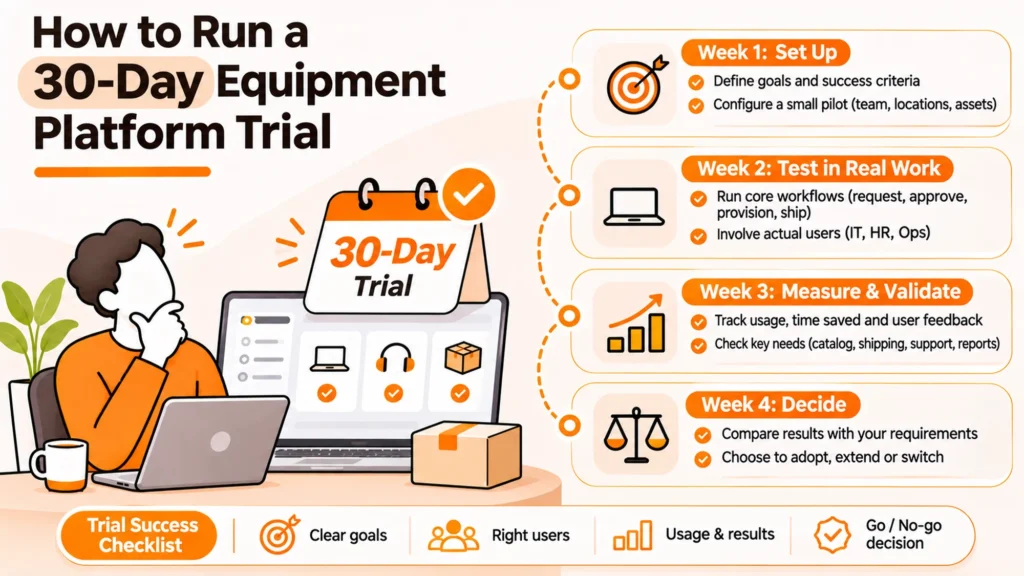
You can’t trial this like software. There’s no sandbox for physically shipping a laptop to somebody in Lisbon, and a single month isn’t long enough to watch a full device lifecycle play out. What you can do is run three specific scenarios that reveal everything a demo deliberately doesn’t.
TL;DR
- A trial here means real orders in real countries, not a test account.
- Pick your hardest market, not your easiest, or you learn nothing.
- Test retrieval as well as delivery. Most trials only test the easy half.
- Deliberately break something and watch how the vendor responds.
- Thirty days is enough for delivery and a failure, not for a full lifecycle.
- Agree in advance what would make you say no, or the trial will always pass.
What a demo won’t show you
Demos show the interface. The interface is almost never the problem.
What actually determines whether a platform works for you is what happens on the bad days: when a shipment is stuck, when an address is wrong, when a leaver won’t answer, when a machine arrives damaged. None of that appears in a demo environment, and all of it is the reason you’re looking for a platform in the first place.
So design the trial around failure rather than around the happy path. The happy path works for everybody or they wouldn’t have a business.
The three scenarios worth running
One: your hardest market. Not your home country. Pick the place where you’ve had the most trouble, where lead times are longest or customs is slowest, and order one real machine for one real person. If it works there, the easy markets follow. If you test in your home market you’ve learned nothing you didn’t know.
Two: a retrieval. Find a device that genuinely needs collecting, ideally from somebody who’s already left, and run it through the platform. This is the half that gets skipped and it’s the half where the money and the failure rate live. A trial covering only outbound has tested the easy direction.
Three: a deliberate problem. Change a delivery address mid-shipment, or raise a query about a machine that hasn’t arrived on time, and time how long the response takes and whether the person answering can actually act. This tells you more about the next three years than any feature list will.
What to do:
- Order into your most difficult market, with a real person at the other end.
- Run at least one genuine retrieval, not a simulated one.
- Raise a real problem and time the response.
- Write down what would make you say no, before you start.
Decide your no in advance
Trials without stated failure criteria pass. Every time, regardless of what happened.
By the end of a month you’ll have invested effort, built a relationship with somebody helpful, and told colleagues you’re evaluating a solution. All of that pushes you toward yes. None of it is evidence. Writing down beforehand what an unacceptable outcome looks like is the only defence, and it takes ten minutes.
Make the criteria specific. Delivery taking more than a stated number of days to your hard market, a retrieval that needs more than two attempts, a query that takes more than one working day to get a substantive answer. Numbers you can check rather than impressions you’ll rationalise.
What thirty days can’t tell you
Be honest about the limits, because a trial that overclaims is worse than no trial.
A month shows you delivery, one retrieval if you force it, and how somebody responds under mild pressure. It can’t show you how the relationship behaves at scale, what happens when your account manager changes, whether the register stays accurate over two years, or how they handle a genuinely serious failure like a lost shipment of a dozen machines.
Those are reference-call questions rather than trial questions. Ask for two customers of roughly your size and shape, and ask them specifically about a bad day rather than about satisfaction.
A team that tested the wrong market
A 115-person company trialled a platform by ordering 3 machines into their London office, where they already had a working supplier and had never had a problem.
All three arrived inside two days. Everybody was duly impressed. Seven months later the first order into Poland took three weeks and needed two escalations, which was precisely the scenario the trial had been designed to de-risk and had never touched. Nothing about the trial was wrong except the market they chose for it.
Test where it hurts. Testing where things already work tells you your existing supplier was fine.
Where we fit
RemoAsset is our own product, so apply the scepticism accordingly. Procurement and retrieval across 80+ countries with each device tracked from issue through return, from $1,499 a year on the Subscription tier for companies with 50 to 5,000+ employees, including a 60 per cent reduction on retrieval charges.
Three limits before you start. It has no network discovery, so a trial won’t surface devices your register never knew about. It has no software licence management, so none of your application estate is covered here. And only the Subscription tier publishes a figure, with pay-as-you-go quoted.
Workwize, Firstbase, GroWrk, allwhere, Esevel and Deel IT all run comparable evaluations and publish no rate card, so expect a conversation rather than a price list from any of them. Run the same three scenarios against each one and compare the results rather than the demos.
Checklist
Checklist:
- Your hardest market identified and used for the test order.
- One real retrieval run end to end.
- One deliberate problem raised, with the response timed.
- Written failure criteria agreed before day one.
- Two reference calls with customers of similar size, asked about bad days.
- The same three scenarios run against every shortlisted vendor.
Final Thoughts
A trial that only tests the happy path tells you the vendor has a working happy path, which was never in doubt. The useful information lives in what happens when something goes wrong, so you have to arrange for something to go wrong.
Pick the market that’s been causing you trouble, force a retrieval, break something small on purpose, and write your no down in advance. Four deliberate choices, and they turn a month of pleasant demos into evidence you can actually decide on.
Frequently asked questions
Can you actually trial an equipment platform?
Not the way you trial software. Because there’s no sandbox for physically shipping a laptop. What you can do is place real orders for real people and observe what happens, which means a trial here costs you actual hardware spend rather than just time. That’s worth budgeting for, because the alternative is choosing from a demo.
Which market should we test in?
The hardest one you have, never your home country. Testing where you already have a working supplier confirms only that your existing arrangement is fine. Order into the market with the longest lead times or the most customs trouble, because if it works there the easier markets will follow and if it doesn’t you have learned something real.
Should we test retrieval too?
Yes, and most trials skip it. Delivery is the easy direction and retrieval is where the cost and the failure rate actually sit, so a trial covering only outbound has tested the half that rarely goes wrong. Find a device that genuinely needs collecting, ideally from somebody who has already left, and run it properly.
Why deliberately cause a problem?
Because the interface is never the issue. Bad days are. Change a delivery address mid-shipment or raise a query about a late machine, then time how long a substantive answer takes and whether the person answering can act directly or has to pass it on. That single test predicts the next three years better than any feature comparison.
What can a 30-day trial not tell us?
How the relationship behaves at scale, what happens when your account manager changes, whether the register stays accurate over years, or how a serious failure is handled. Those are reference-call questions. Ask for two customers of similar size and shape, and ask them about a bad day rather than about overall satisfaction.
Why write failure criteria in advance?
Because trials without them pass regardless of what happened. By the end of a month you have invested effort and built a relationship, and all of that pushes toward yes without being evidence. Agree specific checkable numbers beforehand, such as a maximum delivery time to your hard market or a maximum response time to a query.