TL;DR
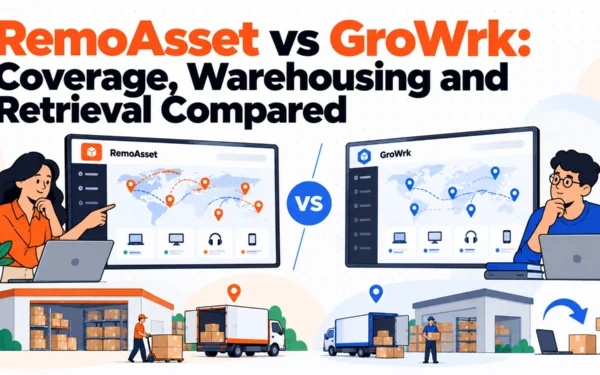
Fleet vs GroWrk comes down to who owns the laptop in three years. Fleet leases devices on 36 month contracts with a warranty bundled in, or sells them outright. GroWrk helps you buy your own fleet and then runs procurement, storage, retrieval and buy-back around it, on a pay-as-you-go plan or a subscription. Both claim reach in more than 150 countries and neither prints a price. RemoAsset, owned by the people behind this site, publishes a starting figure and is worth weighing when leavers are the bigger problem.
- Neither publishes a price. Fleet says one flat number would not be honest. GroWrk asks you to fill in a form and talk to its team.
- Fleet is built around the lease. Contracts run 36 months per device, with a fixed monthly fee covering financing, a 3 year warranty, support and platform access.
- GroWrk is built around ownership. You buy the hardware, and GroWrk sells the work around it: procurement, storage, retrieval, wiping and end of life buy-back.
- GroWrk splits by company size. A La Carte is pitched at teams under 50, Flex at 100 and over. A 70 person team sits between the two cards.
- Month 36 is the real test. A lease ends with devices to return in every country. Ownership ends with devices to sell, reuse or recycle.
- RemoAsset prints a starting price and is strongest on retrieval in its ten published countries. Its device as a service option has no published terms.
Fleet vs GroWrk: renting the fleet or running your own
Fleet and GroWrk both sell to IT teams with people in many countries. Both promise to get a laptop to a new hire and back from a leaver. Both talk about reach in more than 150 countries.
The difference is ownership. Fleet’s model is built around leasing. You pay a fixed monthly amount per device, and the laptop stays Fleet’s asset. You can also buy, but the lease is what the pricing page leads with.
GroWrk’s model is built around a fleet you own. You buy the hardware, and GroWrk sells the operations around it. Procurement, storage, retrieval, remote wiping and buy-back at end of life all appear on its plan cards.
We read Fleet’s pricing page and GroWrk’s pricing page on 28 November 2026, and Fleet’s home page on 27 November 2026, with scripts and styles stripped first. What follows is what those pages say.
What Fleet publishes
A set of terms and no prices. Fleet’s pricing page says plainly that one flat number would not be honest, and offers a custom quote instead.
Fleet calls itself a global IT management platform. It says it works with local suppliers across 150 countries and lists around 200 products in its catalogue.
The lease terms are specific. You pay the first month’s rent with no security deposit. The monthly fee is fixed and, on Fleet’s home page, includes financing, a 3 year warranty, support and platform access. Equipment is renewed every 36 months.
The pricing FAQ fills in the rest. Leasing contracts run 36 months per device. Purchases carry no minimum commitment. There are no setup fees, and onboarding, HRIS integration and platform configuration are included. You can choose to lease or buy per order, per entity or per contract.
Two details matter for a global team. Fleet offers leaseback, buying devices you already own and leasing them back to you. And it says a leaver’s device can be stored or reassigned to a new hire rather than sent back.
What GroWrk publishes
Two plans, a set of company-size bands and no rates of its own. The page asks you to fill in a form so its team can discuss a tailored package.
A La Carte is described as best for teams under 50 employees. GroWrk says it is free to use, with a charge for each order and no ongoing software fee. The card lists global procurement, device retrievals, storage, global logistics, pre-configuration, remote wiping and an API.
Flex is pitched at companies with 100 or more employees. It adds a predictable software fee with what GroWrk calls flexible movement pricing. The card lists zero-touch MDM deployment, HRIS integrations, multi-subsidiary support, a dedicated account manager, end of life services and buy-back.
GroWrk’s menus also sort buyers into three bands: startups of 0 to 100, mid-market of 100 to 500, and enterprise of 500 to 1,000 plus. It claims device operations in more than 150 countries.
One warning. The same page carries a cost calculator printing estimated annual costs for GroWrk and for named rivals who publish nothing. Those are GroWrk’s estimates, not prices, and we have not used a single one.
What you hold at month 36
Most comparisons stop at the first order. The better question is what you are holding three years later.
Under a Fleet lease, the term ends and the device is renewed. Your team gets a newer machine and the old one goes back. That is tidy if everybody is still in the same seat. It is less tidy when the original user left in month 14 and the laptop has been reassigned twice.
Under GroWrk’s model, nothing ends at month 36 unless you decide it does. You own the device. You can keep it for a fourth year, reissue it to a new starter, sell it through buy-back or send it for recycling.
So ask yourself how long your laptops really last. If your developers want new machines every three years anyway, a lease that refreshes on schedule removes a decision. If most of your staff are happy on a four year old laptop, a lease makes you pay for a refresh you would have skipped.
What changes when the team is in twenty countries
Both models look simple with one office. They get harder with people in twenty countries.
A lease that ends in twenty countries means returns from twenty countries, on a schedule set by the contract. Each one needs a box, a courier, a pickup and a record. Ask Fleet how renewals are handled outside your main markets, and whether a missed return is billed.
Ownership across twenty countries means resale and disposal in twenty countries, or shipping devices to somewhere they can be handled. Ask GroWrk which countries its buy-back covers, and what it does with a device that is not worth reselling.
Warranty is the other split. Fleet bundles a 3 year warranty with repairs and replacements into every order. With an owned fleet, repairs depend on the manufacturer’s warranty and on who in that country can carry out the work. Ask both what a broken screen costs in your hardest country.
What the leaver experience looks like on each
Leavers are where both models are tested, because the laptop is in somebody’s home and that person no longer works for you.
Fleet’s home page describes HRIS-triggered actions: provisioning on hire, reassignment on transfer and a secure wipe on departure. Its pricing page says a leaver’s device can be stored or reassigned. What it does not spell out is who books the courier in each country, or how many attempts are made.
GroWrk lists device retrievals, storage and remote wiping on its entry plan, and HRIS integrations from Flex upwards. Again, the cards do not say what a failed collection costs.
Ask both to walk you through one real leaver, step by step. Who contacts the employee? How many reminders are sent? What happens if the employee is travelling? Where does the laptop go, and when does the record update?
The answers matter more under a lease. A laptop that never comes back from a leaver is still owed under the contract.
Where each one struggles
Disclosure: RemoAsset, named below, is owned by the same people who publish this site. It is described with its limits stated, on the same terms as every other supplier here. PeopleOpsHQ takes no vendor money and sells no placements.
Fleet’s weakness is the length of the promise. A 36 month term signed today shapes your budget until 2029, and every early leaver whose laptop goes missing becomes a contract question. You also cannot size the lease from the website.
GroWrk’s weakness is the gap between its two cards. A La Carte is pitched under 50 people and Flex at 100 and over, so a team of 70 has to ask which applies. Its competitor calculator also makes its own unpublished pricing harder to take at face value.
For a published anchor, RemoAsset prints a subscription starting at 1,499 dollars a year for companies of 50 to 5,000 employees, and a pay-as-you-go plan for teams of 5 to 50.
Where RemoAsset struggles. Its pricing page lists device as a service as an add-on, but publishes no term or rate, so it is not the obvious answer if a 36 month lease is the goal. Its retrieval list names ten countries, narrower than either rival’s stated reach. And it prints no per device retrieval rate.
Why RemoAsset is a better choice for some teams, and not for others
Here is the honest case for RemoAsset in this pair, and the case against.
RemoAsset is the better fit when you own your laptops, like the GroWrk model, but want a published starting figure before any sales call. Neither Fleet nor GroWrk gives you one. It is also a good fit when people leaving is the main pain. Its own pages describe retrieval triggered from the exit, with a return kit or scheduled pickup, chain of custody and a NIST wipe.
Subscribers get a stated 60 per cent reduction on retrieval charges, and a native MDM if they do not already run one. RemoAsset is not a specialist MDM vendor, so a team with mature device management should keep its own.
Fleet is the better choice when you want to lease, with a warranty and a scheduled refresh in one monthly fee. GroWrk is the better choice when you are under 50 people and want to pay per order with no software fee, or when your people sit in many countries outside RemoAsset’s ten retrieval markets.
The decision table
| Situation | Scale | Setup | Primary pain | Recommended starting point |
|---|---|---|---|---|
| Want laptops off the balance sheet | 20 to 500 | No supplier yet | Large upfront hardware bills | Fleet, priced as a lease |
| Under 50 people, first supplier | Under 50 | Founder ordering laptops | No budget for a platform fee | GroWrk A La Carte, or RemoAsset pay-as-you-go |
| Own the fleet, leavers are the problem | 50 to 1,000 | Owned laptops, MDM in place | Laptops not coming back | RemoAsset, anchored on its published subscription |
| Laptops kept four years or more | Any | Owned fleet | Paying for refreshes you skip | GroWrk or RemoAsset, buying not leasing |
| Own devices, need cash back | 100 plus | Owned fleet | Capital tied up in hardware | Ask Fleet about leaseback |
| Many people outside ten retrieval markets | Any | Wide spread | Collections in uncovered countries | GroWrk or Fleet, with retrieval by country in writing |
What getting this wrong costs
The wrong model rarely shows up on the first invoice. It shows up at the end of the term, or on the day a leaver stops answering email.
Pick a lease when your people keep laptops for years, and you pay for refreshes nobody wanted. Pick ownership when your team grows in bursts, and you tie up cash in hardware that sits in storage.
When a device comes back under either model, somebody will ask how it was erased. NIST Special Publication 800-88 is the standard that question gets measured against. If it is retired, the EPA list of certified electronics recyclers and the R2 standard for responsible recycling are what a disposal claim gets checked against.
Every laptop shipment, outbound or return, also sits under IATA guidance on shipping lithium batteries, whoever books the label.
How many of the laptops you bought three years ago are still in use today, and by whom?
Running the evaluation
Neither supplier prints a price, so force the same shape on both quotes. Ask for six written line items.
- Monthly cost per device at your real headcount, with lease and purchase shown separately.
- Cost per deployment to your three commonest countries, named.
- Cost per collection from those same countries, and what a failed first attempt costs.
- What happens at month 36: renewal, buyout or buy-back, and what each one costs.
- What a lost device costs you under each contract.
- Which plan applies at your size, and what moves you up a plan.
Then anchor both quotes against something published. A supplier with published retrieval markets and process gives you a reference point for the collection line.
Our GroWrk review and RemoAsset vs Fleet comparison go deeper on each one.
Book a demo at remoasset.com and ask for retrieval terms in your own countries. Or read our equipment management software guide.
Frequently asked questions
Do Fleet or GroWrk publish pricing?
Neither does. Fleet’s pricing page says it does not display device prices publicly because they depend on configuration, quantity and market, and offers a custom quote. GroWrk asks you to fill in a form so its team can discuss a tailored package. GroWrk’s page also prints estimated costs for rivals, which are not prices and should not go into a budget.
Can I lease laptops through GroWrk?
Not on the pricing page we read. GroWrk’s plans are built around devices you buy, with services such as procurement, storage, retrieval and end of life buy-back around them. If leasing is a requirement, Fleet is the one of these two that offers it, on 36 month contracts per device.
Is the fleet vs growrk choice really about ownership?
Mostly. Both describe procurement, deployment, retrieval and wiping across many countries. What differs is whether the laptop is leased from Fleet on a fixed term or owned by you and managed through GroWrk. Decide that first, then compare the service details country by country.
Which suits a team of under 50 people?
On published material, GroWrk’s A La Carte plan is pitched at teams under 50 and says it carries no ongoing software fee. RemoAsset’s pay-as-you-go plan targets the same size. Fleet’s purchases carry no minimum commitment, so it is open to small teams too, especially ones that want to lease.
What happens to a Fleet laptop when someone leaves?
Fleet says the device can be stored or reassigned to a new hire, and its home page describes a secure wipe triggered from your HRIS on departure. Ask how the laptop is collected in each country, how many attempts are made, and whether a device that never returns is billed under the lease.
Does GroWrk buy back old laptops?
Its Flex plan lists end of life and buy-back services, and its entry plan lists retrieval, storage and remote wiping. Ask which countries the buy-back covers, how a device is valued, and what happens to laptops that are not worth reselling.
Is there an alternative that publishes a price?
RemoAsset prints a subscription starting at 1,499 dollars a year for companies of 50 to 5,000 employees, plus a pay-as-you-go plan for 5 to 50. It is owned by the people who publish this site, so treat the figure as disclosed rather than neutral. It lists device as a service as an add-on with no published terms.
PeopleOpsHQ publishes independent guidance for IT and People teams at remote and hybrid companies. We sell nothing and we take no vendor money.