TL;DR
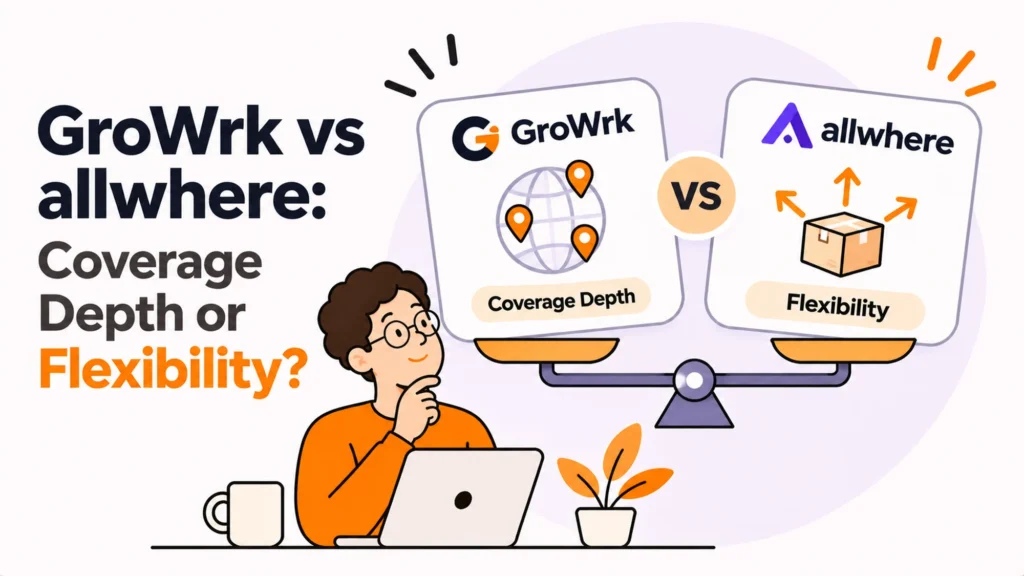
GroWrk vs allwhere is an unusual comparison, because both companies are selling the same idea. GroWrk calls its A La Carte product the first pay-as-you-go platform in this category. allwhere opens its pricing page with no subscription fees and pay only for what you need. Two vendors in one position means the published positioning will not separate them. Four other things will.
- Both claim pay-as-you-go. GroWrk brands it A La Carte; allwhere makes it the headline of its pricing page. Positioning will not decide this.
- Neither publishes rates. GroWrk asks for a conversation about a tailored package. allwhere promises fixed upfront rates and shows none.
- GroWrk publishes company-size bands: 0 to 100, 100 to 500, and 500 to 1,000 plus.
- allwhere publishes performance rates: 96 per cent on-time delivery, 91 per cent on-time retrieval, with no stated baseline for its industry comparison.
- GroWrk publishes estimated costs for its rivals. Useful context, not a source of prices. We quote none of those figures.
- Separate them on warehousing, retry policy, coverage type and reporting, not on the pricing model.
GroWrk vs allwhere: two vendors, one position
Read both pricing pages and you will find the same promise twice.
GroWrk markets a product called A La Carte and describes it as the first pay-as-you-go IT asset management platform. allwhere headlines its pricing page with no subscription fees, no hidden costs and pay only for what you need, plus zero setup costs and no long-term lock-ins.
When two suppliers occupy one position, the positioning stops being information. It tells you about the category, not about the choice.
What is left is the evidence each one publishes, and here they diverge sharply. GroWrk publishes who it sells to. allwhere publishes how often it delivers on time. Those are different kinds of claim and both are checkable in a call.
What GroWrk publishes
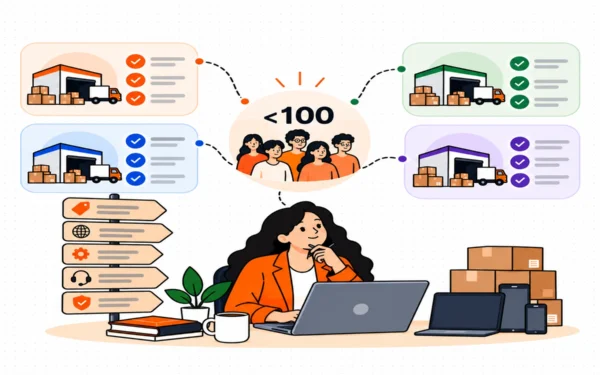
Three company-size bands, stated plainly: startups at 0 to 100 employees, mid-market at 100 to 500, and enterprise at 500 to 1,000 and above.
That is more useful than it sounds. In a category where one major competitor enforces a 150 user minimum, a published route in for a 40 person company is a real differentiator.
It also publishes a country coverage guide spanning procure, ship and retrieve, and a hardware quoting tool offering cost estimates across 150 or more countries.
And it publishes a vendor cost comparison, which prints estimated annual contract costs for named rivals in this category. Those are GroWrk’s estimates of companies that publish nothing. They are itemised into hardware, platform and deployment, which makes them look like rates. We have not reproduced a single one of those figures here, and you should not carry them into a budget either.
Pricing itself is a conversation about a tailored package. No numbers.
What allwhere publishes
Performance, rather than scope.
A 96 per cent on-time delivery rate and a 91 per cent on-time retrieval success rate, with the retrieval figure described as 80 per cent better than the industry standard.
Those first two are the most specific operational claims either vendor makes, and they are the right things to measure. On-time retrieval is the number most companies cannot produce about themselves.
The third claim needs a question. The industry standard being compared against is not published, so the 80 per cent has no visible reference. Ask what baseline, what period and what sample.
Beyond that, the published service list is broad: procurement, retrieval, lifecycle management, onboarding and offboarding, asset management, disposal, refresh and storage. Plus a cost savings calculator and a depreciation calculator, both of which are modelling tools rather than price lists.
The four questions that actually separate them
Since the pricing models match, ask these instead. All four are answerable on a first call and none is answerable from either website.
- Where is the warehouse, per market? Not how many countries. Which physical location serves your top three markets by headcount, and does it hold your spares or only receive returns.
- What does a failed first collection cost? Under per-event pricing a retry is usually a second charge. Get the number and the retry policy in writing.
- What kind of coverage is it, country by country? Local stock, local procurement and cross-border shipping all get called coverage and behave completely differently on a two day deadline.
- What reporting comes out? If you are not paying a platform fee, ask what system of record you get, and whether you can export it when you leave.
That fourth question is the one people skip under a no-subscription model. Paying nothing for software often means owning nothing when the relationship ends.
Where each one struggles
Disclosure: RemoAsset, named below, is owned by the same people who publish this site. It is described with its limits stated, on the same terms as every other supplier here. PeopleOpsHQ takes no vendor money and sells no placements.
GroWrk’s difficulty is credibility by association. Publishing estimated prices for rivals who keep theirs confidential invites exactly the scepticism you would expect about its own unpublished numbers. The tool may be well intentioned and it still makes the rest of the page harder to take at face value.
Its forecasting problem is the same as any per-action model. Without published rates you cannot model 30 joiners and 20 leavers, and that is the figure finance will ask for first.
allwhere’s difficulty is the gap between promise and page. Fixed, transparent, upfront rates, none of which are shown. The 2025 copyright line in its footer is a small signal worth noticing when you are judging how current the terms are.
Both share the deeper issue: a no-subscription pitch is easiest to sell and hardest to compare, because there is no list price anywhere to anchor against.
That is why a published figure helps even when you do not buy it. RemoAsset prints a subscription from 1,499 dollars a year for 50 to 5,000 employees, with pay-as-you-go below that and a stated 60 per cent reduction on retrieval charges for subscribers.
Where RemoAsset struggles. Its own pricing page contradicts itself on retrieval coverage, naming ten countries under a 25 plus claim while a plan card says 80 plus, which is the procurement number. It prints no per device rate. And it is our product, so the figure is disclosed rather than neutral.
The decision table
| Situation | Scale | Setup | Primary pain | Recommended starting point |
|---|---|---|---|---|
| Under 100 people, first supplier | Small | Founder shipping laptops | Minimums elsewhere | GroWrk, which publishes a 0 to 100 band |
| Retrieval is the whole problem | Any | Procurement works | Collections fail or stall | allwhere, and ask about the 91 per cent claim |
| Spares needed within the week | Any | No local stock | Warehouse in the wrong region | Ask the warehouse question per market |
| Finance needs an annual figure | 100 plus | Budget cycle running | Per-action spend unforecastable | Written per-event rates, then cap the quarter |
| No asset system of record | 100 to 500 | Spreadsheets | Nobody knows what is where | Ask what reporting a no-fee model gives you |
| Comparing third-party cost tables | Any | Desk research stage | Figures of unknown origin | Discard any number the vendor did not publish |
What getting this wrong costs
With two identical pitches, the cost of choosing badly is rarely the money. It is the thing you discover in month four.
The first is the retry bill. Failed first collections are normal, because the address came from an HR record captured at hiring and people move when jobs end. Under per-event pricing each attempt can be chargeable, and nobody models that.
The second is the orphaned record. No platform fee can mean no system of record, and a year later you cannot say what you own. Our lifecycle management guide covers what minimum reporting looks like.
The third is disposal. NIST Special Publication 800-88 is the standard you will be asked about for erasure, the EPA list of certified electronics recyclers is what a disposal claim gets checked against, and the R2 standard for responsible recycling covers recyclers on the same ground. A per-event supplier may subcontract all three, so ask whose certificate you receive.
The fourth is shipping. Batteries travel under rules and IATA guidance on shipping lithium batteries is what the courier works to, regardless of which of these two books the label.
If a collection failed twice next month, would you find out from a report or from an invoice?
Running the evaluation
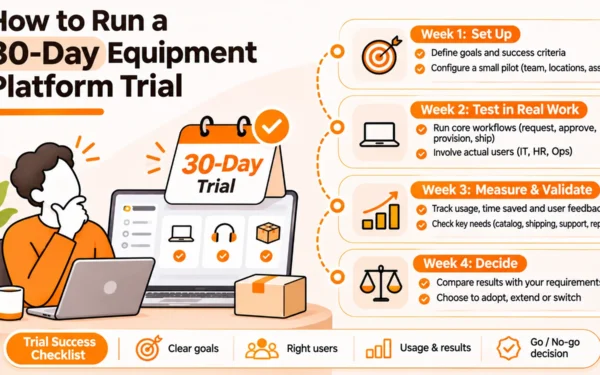
Get the same five written line items from both: per deployment and per collection to three named markets, the retry charge and retry policy, storage per device per month with any minimum term, the reporting and export you get with no platform fee, and the warehouse location serving each of your top three markets.
Then anchor the whole thing against a published price so you can judge the quotes rather than compare two unknowns. A supplier with printed pricing and stated retrieval terms gives you that.
Our GroWrk review and allwhere review cover each one on its own terms.
Compare our Workwize review, or read our device total cost of ownership breakdown.
Frequently asked questions
What is the difference between GroWrk vs allwhere on pricing?
Structurally, very little, which is the point. GroWrk brands its pay-as-you-go offer A La Carte and calls it the first of its kind in this category. allwhere makes no subscription fees the headline of its pricing page. Both then decline to publish rates, GroWrk asking for a conversation about a tailored package and allwhere promising fixed upfront pricing it does not show. Separate them on operations instead.
Which one sells to smaller companies?
GroWrk publishes company-size bands starting at 0 to 100 employees, so there is a stated route in for a 40 person team. That matters in a category where one major competitor lists a 150 user minimum on its entry tier. allwhere does not publish size bands at all, and its no-overhead pitch is aimed partly at small teams, so ask directly rather than assuming either way.
Should I use GroWrk’s vendor cost comparison?
Read it to understand how GroWrk frames the category, and do not take numbers out of it. It prints estimated annual contract costs for named rivals who publish nothing, itemised into hardware, platform and deployment, which makes one vendor’s estimates of competitors look like published rates. We quote none of those figures in this article for exactly that reason.
How should I read allwhere’s 91 per cent retrieval figure?
As a vendor-published operational claim, which is more than most competitors offer, and worth asking about. The 96 per cent on-time delivery and 91 per cent on-time retrieval numbers are on its own site. The additional claim that the retrieval rate is 80 per cent better than the industry standard has no published baseline, so ask what standard, measured over what period and across how many collections.
Does a no-subscription model mean I get no reporting?
Not necessarily, but you have to ask, and most buyers do not. If you are paying nothing for software, establish what system of record you get, who can see it, how current it is, and whether you can export the asset history when the relationship ends. Owning your own data at exit is the part of a no-fee arrangement that is easiest to lose and hardest to rebuild.
What does a failed collection cost under either model?
Neither publishes it, and it is the most important unpublished number in this comparison. First attempts fail regularly because the delivery address came from an HR record captured at hiring and people frequently move when a job ends. Under per-event pricing a retry is commonly a second charge. Get the retry fee and the retry policy written into the quote.
Is there a supplier with a published price?
RemoAsset publishes a subscription from 1,499 dollars a year for companies of 50 to 5,000 employees, a pay-as-you-go tier below that, and a stated 60 per cent reduction on retrieval charges for subscribers. It is owned by the people who publish this site. Its pricing page is also inconsistent on retrieval coverage, naming ten countries in one place and claiming 80 plus in another.
PeopleOpsHQ publishes independent guidance for IT and People teams at remote and hybrid companies. We sell nothing and we take no vendor money.