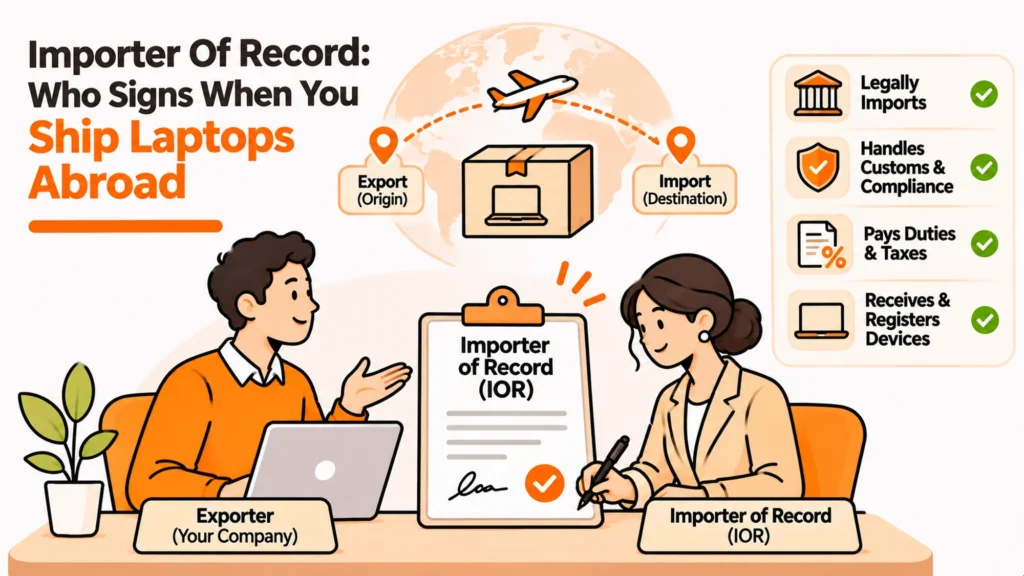
The importer of record is the party that takes responsibility for a shipment entering a country, including the declaration and any duties or taxes owed. When you ship a laptop to an employee abroad, somebody has to be that party. If you have not decided who, the carrier will decide for you, and the usual answer is the employee.
TL;DR
- Every import has one. The question is whether you chose it deliberately.
- Defaulting to the employee is common, and it puts a tax bill on their doorstep.
- Many countries expect a local presence or a local tax registration.
- Requirements differ by country. Confirm each market rather than generalising.
- This is the single most common reason a device stops at a border.
The moment this becomes real
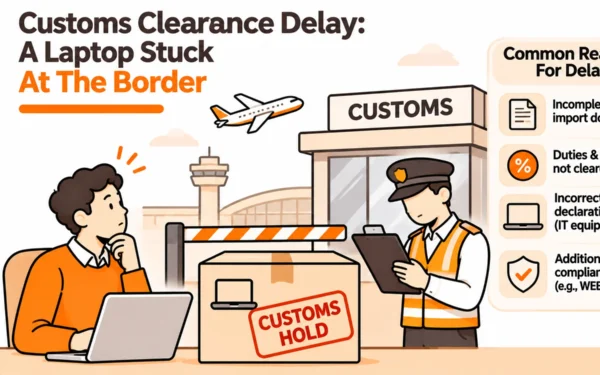
Say you hire a developer in Brazil. IT configures a laptop in your London office and books a courier to the person’s home address. The commercial invoice says the value, the sender is your company, and the receiver is the new hire.
Ten days later the device is in a customs warehouse. The employee receives a message asking for their tax identification number and a payment before release. They have not started yet. They are being asked to personally import company property, declare it, and pay for the privilege.
Somebody in IT suggests marking it as a gift, which is a bad idea for several reasons. The real issue is not the paperwork at the border. It is that nobody decided who was importing this laptop, so the system picked the only named person it had.
When this is lighter than you think
Four stages where the importer of record question barely arises.
- Domestic shipments. No border, no import, no question. Most companies ship domestically for years without meeting this at all.
- Within a single customs union. Movement between member states is usually not treated as an import. Check whether your route qualifies rather than assuming.
- You buy locally in each market. If the device never crosses a border, the problem disappears. This is often the cheapest fix available.
- Low value accessories. Many countries have a threshold below which the process is simplified. Laptops are usually above it.
It becomes real the first time you ship a configured machine to somebody in a country where you have no entity, which for most remote teams is early.
The five questions teams actually ask
Can the employee be the importer of record? Technically it happens constantly, because the carrier names the consignee by default. Whether it is appropriate is a different matter. You are asking a new hire to take on a declaration and a payment for property they do not own, before their first day.
Can our company be it without a local entity? Sometimes, and sometimes not. A number of countries expect the importer to hold a local tax registration or to be established there. The requirements differ by market and they change, so confirm the specific country rather than applying a general rule.
What does a customs broker do here? A broker prepares and files the declaration on somebody’s behalf. They are not usually the importer themselves. Hiring a broker does not answer the question of who carries the responsibility, it answers who does the paperwork.
Is there a service that takes the role? Yes, and in some markets that is the practical answer. Third parties act as importer in countries where you have no presence. Terms, coverage and liability vary a great deal, so read what you are actually buying.
What happens if nobody decides? The shipment stops, the employee gets contacted, and somebody improvises. That improvisation is where devices get abandoned, returned to sender, or released after a payment nobody tracked.
Three ways teams handle it, and where each breaks
Let the employee receive it. The default, because it requires no decision. It works on plenty of routes and fails badly on others. It breaks on fairness as much as logistics: the person is personally handling an import of company property, and if a charge arrives they are the one paying it.
Ship to your own entity, then forward locally. Clean where you have an entity. You import as a company, then send domestically. It breaks wherever you have no entity, which is exactly the markets where this is hardest, and it adds a leg to every shipment.
Use a party that acts as importer in that market. The answer most distributed teams arrive at. Somebody with local standing imports, clears and delivers. It breaks on cost per shipment and on diligence: you are relying on a third party’s standing, so the contract and the coverage matter more than the price.
Five questions to find your own exposure
Working out your importer of record position takes one afternoon and a list of your shipping destinations.
Which countries do you ship devices into? Write the list. Most teams have never seen it in one place.
In how many of those do you have a legal entity? The difference between the two lists is your exposure.
Who was named as consignee on your last ten international shipments? If it was the employee every time, that is your current policy whether you chose it or not.
Has anybody ever paid a charge personally? Ask. It happens more than finance knows, because people expense it or absorb it.
What is your reimbursement path if they do? If there is none, write one today. It costs nothing and it is the obvious gap.
What is actually available
Five honest options, including ours.
Carrier default with the employee as consignee. Best for low value accessories and simple routes. Free and immediate. Struggles on laptops, where values are above most thresholds, and it transfers a company obligation to an individual.
A customs broker per market. Best where you have an entity and need help with the paperwork. Good at declarations. Struggles because a broker files on behalf of an importer and does not remove the need for one.
A specialist service that acts as importer. Best for one off shipments into difficult markets. Solves the specific problem. Struggles on price per shipment and on needing a separate arrangement each time.
Buy in country instead of shipping. Best answer surprisingly often, because it removes the import entirely. Struggles where your specification is not sold locally, or where you need a configured machine rather than a retail one.
RemoAsset. Best when this is a recurring problem across many markets rather than a one off. Chosen because procurement and delivery across 80+ countries handles the import route as part of getting the device to the person, so the question stops arriving per shipment. Where it struggles: it will not make you an importer in a market where you want to be one for your own reasons, and it does not replace advice on your own tax position. It publishes an entry subscription price but no per device rates, so comparing it against a per shipment broker quote needs a conversation rather than a web page.
Where to start, by situation
| Situation | Scale | Setup | Primary pain | Recommended starting point |
|---|---|---|---|---|
| Domestic only | Any | Any | None | No action needed |
| Shipping within one customs union | Any | One entity | Occasional confusion | Confirm the route is not treated as an import |
| Few shipments, one difficult market | Under 10 a year | No local entity | Devices stop at the border | A specialist importer service for that market |
| Regular shipping, many markets | Any | No local entities | A new problem every country | A global service such as RemoAsset |
| Entity in the destination | Any | Local tax registration | Paperwork burden | Import as the company and use a broker |
What the gap actually costs
The direct cost is duty, tax and storage, and it is usually modest per device. Warehouses charge by the day, so a shipment stuck for two weeks costs more than people expect, but it is still a manageable number.
The real cost is the start date. A developer who cannot work for twelve days because their laptop is in a bonded warehouse is twelve days of salary against no output, plus the onboarding momentum you do not get back. That dwarfs the customs charge every time.
Then there is the part nobody writes down. Asking a new hire to pay a customs charge for their own work laptop, in week one, is a memorable introduction to the company. Some of them tell people about it. So the question is not what clearance costs. It is what a bad first fortnight costs you in a market where you are trying to build a reputation as an employer.
When per shipment fixes stop scaling
One difficult country is a problem you can solve by hand. You find a broker, you ask around, somebody figures out the local requirement, and the laptop arrives. It takes a week of somebody’s attention and it works.
The difficulty is that the answer does not transfer. The arrangement you built for Brazil tells you nothing about India, and the one for India tells you nothing about Nigeria. Each market has its own expectations about who may import, what registration is needed and how goods are classified. Teams hiring across many countries end up rebuilding the same solution repeatedly.
That is the point where the question changes from how do we import into this country to who handles importing generally. A laptop lifecycle management service absorbs the route rather than solving it once. Whether that is worth it depends on how many markets you ship into and how often a device has stopped at a border this year. If the answer is one market and never, keep improvising.
Related reading
- Shipping laptops internationally
- Import duty on laptops
- Equipping a first hire in a new market
- Laptop procurement across ten countries
- Rules differ by country. The US International Trade Administration explains Harmonized System codes, and the European Commission publishes EU customs guidance. Confirm each market before shipping.
Frequently Asked Questions
What does importer of record actually mean?
It is the party answerable to the destination country for a shipment entering it, including making the declaration and settling duties or taxes owed. Every import has one. When nobody has been nominated, carriers generally treat the named consignee as the importer, which for employee shipments means the employee.
Can an employee be the importer of record for their own work laptop?
It happens routinely because it is the carrier default, but it is worth thinking about. You are asking an individual to declare and potentially pay for company property they do not own, sometimes before they have started. At minimum, have a reimbursement path so nobody is personally out of pocket.
Do we need a local entity to import into a country?
In some markets yes, in others no, and several expect a local tax registration even without a full entity. The requirements vary by country and change over time, so confirm the specific destination with a broker or adviser rather than applying one rule everywhere.
Is a customs broker the same as an importer of record?
No. A broker prepares and files the declaration on behalf of an importer. They are not usually the importer themselves and do not take on that responsibility. Hiring a broker answers who does the paperwork, not who carries the obligation.
Why do laptop shipments get stuck more than other parcels?
Value and classification. Laptops sit above the simplified thresholds that cover low value goods in many countries, which means a full declaration, and electronics sometimes attract additional checks. A parcel of t shirts and a parcel containing a laptop are not treated the same way.
Should we mark a company laptop as a gift or a sample?
No. Misdeclaring the nature or value of goods creates problems that are much worse than a delayed delivery, and it exposes whoever signed the declaration. If the value or category is causing difficulty, fix it by choosing a different import route, not by changing the paperwork.
Is buying locally a better answer than shipping?
Frequently, yes. If the specification is available in the destination market, local purchase removes the import question entirely along with the delay and the duty. It struggles when you need a specific configuration or a machine that has been prepared before it reaches the person.