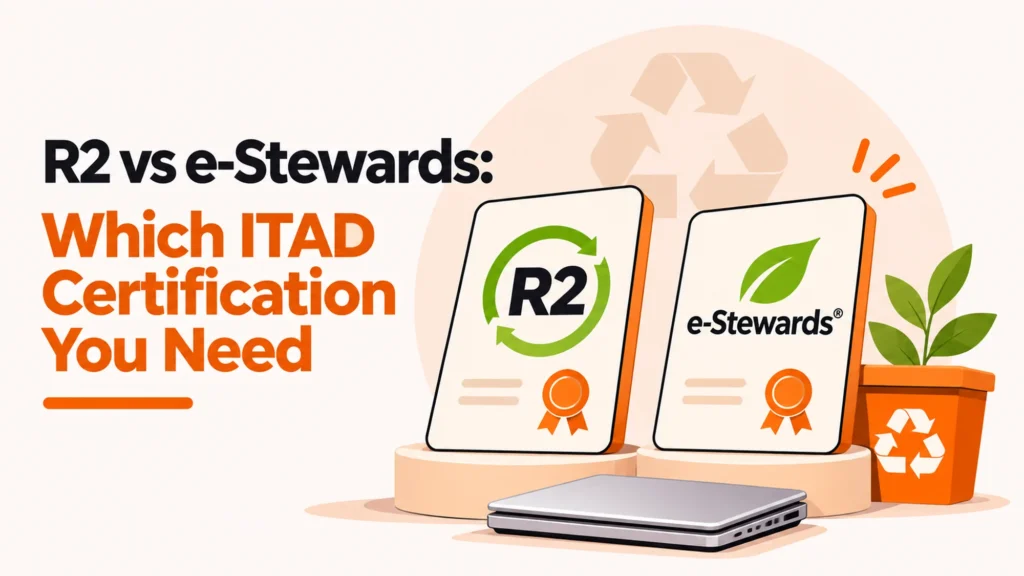
An ITAD certification comparison matters less than most procurement processes assume. R2 and e-Stewards both certify responsible handling, e-Stewards is generally the stricter, and neither tells you the thing that decides whether your disposal programme works.
TL;DR
- Require one of the two unless a contract names a specific standard.
- Environmental certification and data assurance are separate questions.
- Certification covers audited facilities, not whether they can reach your people.
- Check the certificate against the registry, and check which site it covers.
- The standards move. R2 is on v3 and e-Stewards is developing an ITAD-specific one.
- A certificate with no serial numbers cannot be reconciled with your register.
When certification is not your question
Four stages, and only the last two make it the deciding factor.
A handful of devices a year. You need verified sanitisation and a record. A certified bulk recycler is more process than the problem deserves.
A growing pile, no route yet. The useful first step is clearing the backlog, not selecting a standard. Pick a competent vendor and start.
Regular volume disposal. Now certification is a reasonable filter, because you are placing repeated trust in somebody else’s facility.
Contractual or jurisdictional requirement. A customer or a local programme names a standard. The question answers itself and your job is verification.
Why an ITAD certification comparison is the wrong first question
Procurement reaches for certification because it is the one thing in this market that looks objective. Vendors all describe themselves similarly, prices are quoted per unit with different inclusions, and a certification is a fact rather than a claim.
The trouble is that it answers a narrow question. Both standards are about what happens at a facility: how material is processed, where it is allowed to go, how downstream vendors are controlled. The R2v3 standard published by SERI and the e-Stewards standard both do that job properly, and a vendor holding either is unlikely to be doing something reckless at their plant.
Your failure mode is usually earlier. Devices never reach the facility at all, because they are still in former employees’ homes, or they arrive with no serial-level record so nothing can be reconciled afterwards. Neither certificate speaks to either problem.
There is a second reason to hold the comparison lightly. The standards are moving. R2 is on its third revision, and reporting in September 2026 indicated e-Stewards plans a standard specifically for IT asset disposition rather than recycling broadly. Any comparison written more than a year ago is describing an older position than the one you are buying into.
What each standard actually covers
- Downstream control. Both require vendors to know and manage where material goes next. This is the single most valuable thing either certification gives you.
- Export restrictions. The clearest difference, and the reason e-Stewards is usually called stricter: it is more restrictive about moving material to developing countries.
- Data security. Addressed by both, at differing depth. Many buyers add a separate data destruction credential rather than relying on the environmental standard alone.
- Facility scope. Certification attaches to sites, not companies. A vendor with one certified facility is partially certified.
- What neither covers. Collection from your employees, turnaround, and whether the certificate you receive names serial numbers.
Four things each standard gives you, and one it does not. The last item is where most disposal programmes actually fail.
Five questions to ask a vendor
Which facilities are certified? Ask for the site list and check it against the certifying body’s register rather than a PDF.
Will the certificate carry serial numbers? This single question separates vendors more usefully than the certification does.
What is your data assurance, separately? Name the sanitisation method and the verification step rather than accepting a general statement.
Can you collect from residential addresses? Many certified recyclers are built for pallets, not for one laptop in a flat.
What happens to a device that fails verification? There should be a defined fallback, recorded differently.
Routes to compliant disposal, and the trade-offs
A large certified recycler. Best for volume, for the environmental obligation and for audit comfort. It struggles on individual devices and on serial-level evidence, because the operating model is weight rather than units.
A specialist ITAD with data focus. Best for per-device certificates and resale value recovery. It struggles on geographic reach, since most operate in a limited set of markets.
Your hardware vendor’s trade-in. Best for simplicity when refreshing a fleet from one manufacturer. It struggles on evidence detail and on anything outside their own product range.
Local recyclers per country. Best for coverage in markets a central vendor cannot reach. It struggles on consistency, because each one certifies differently and reports differently.
A lifecycle service that collects and routes. Disclosure: RemoAsset is owned by the same people who publish this site. It handles retrieval, storage and certified wiping across 80 or more countries, which addresses the collection problem that sits upstream of any certified facility. Where it struggles: it is not a certified bulk recycler, so a large volume teardown belongs with one of the vendors above. The narrow part it covers is getting devices out of homes and into a process with a record.
The decision table
| Situation | Scale | Setup | Primary pain | Recommended starting point |
|---|---|---|---|---|
| A few devices a year | Under 50 | No IT owner | Over-specifying | Verified wipe plus a record |
| Backlog in storage | Any | Any | Nothing processed | Clear it before choosing a standard |
| Regular bulk disposal | 100 plus | IT owner | Facility trust | Require R2v3 or e-Stewards |
| Customer names a standard | Any | Any | Contractual | Verify the certificate and sites |
| Devices across countries | 100 plus | IT team | Recycler cannot reach them | Solve collection first |
| Audit wants per device proof | Any | Security owner | Certificate has no serials | Change the evidence format |
What choosing on the logo costs
The first cost is a false sense of completion. A certified vendor in the contract feels like the disposal problem is solved, so nobody measures the thing that actually determines the outcome, which is what share of retired devices reach that vendor at all.
The second is evidence you cannot use. Large recyclers often report by weight or by consignment because that is how the material is handled. If your auditor asks about a specific serial, that report is the wrong shape and no amount of certification changes it.
The third is paying for the wrong service. Bulk recycling prices and processes assume pallets. Sending twelve laptops a year through that channel costs more per unit and recovers less value than a specialist who would have resold half of them.
There is a fifth cost that only shows up at renewal. A certification requirement written into a contract narrows your supplier pool permanently, including in markets where no certified operator will collect a single laptop from a residential address. You then either breach your own standard quietly or leave devices uncollected, and both outcomes trace back to a clause written for a different kind of shipment.
The fourth is partial certification read as full. A vendor certified at one site and operating from four is accurately describing themselves, and a buyer who read the logo rather than the scope has drawn a conclusion the vendor never stated.
So the question is not which standard is stricter. It is what proportion of your retired devices reached any certified facility last year, and whether you can name the figure.
The gap certification does not cover
Every certified vendor processes what arrives. The standards are detailed about what happens inside the fence and silent about everything before it.
That silence is where most programmes lose devices. A laptop with a former employee in another country is not being disposed of irresponsibly. It is not being disposed of at all, and no certification distinguishes those two outcomes from the vendor’s side.
Three signals say this is your position. Fewer devices were disposed of last year than were retired. Returns from outside your main market stalled or never arrived. And your unprocessed pile is growing faster than your disposal records.
It is worth measuring before the next vendor selection, because the answer changes what you are shopping for. Looking at how collection, storage and disposal connect in one record shows whether your next decision is a certification or a route.
Related reading
- The ITAD vendor checklist
- How ITAD pricing works
- The certificate of destruction
- ITAD vendors across countries
- WEEE compliance for company laptops
Frequently Asked Questions
What is the difference between R2 and e-Stewards?
Both certify responsible handling of retired electronics. R2v3 is the more widely held standard and is the version in force. e-Stewards is generally described as the stricter of the two, particularly on exporting material to developing countries. For most corporate buyers the difference is narrower than vendor marketing suggests.
Which one should we require?
Require one of them rather than a specific one, unless a jurisdiction or customer contract names e-Stewards. Then spend your attention on the part certification does not cover, which is whether the vendor produces evidence you can reconcile against your own asset register.
Does certification cover data destruction?
Both standards address data security, but the depth differs and many buyers add a separate data destruction credential on top. Treat the environmental certification and the data assurance as two questions, because a vendor can be strong on one and ordinary on the other.
Is certification enough to choose a vendor?
No, and treating it as the decision is the common mistake. Certification tells you a vendor meets a standard at their audited facilities. It does not tell you whether they can collect from your people, how long they take, or whether their certificate names serial numbers you can match.
Do we need a certified vendor at all?
For volume disposal it is the sensible route and often a contractual requirement. For a handful of devices a year the practical question is different: you mainly need verified sanitisation and a record, and a smaller specialist may serve that better than a large certified recycler.
Are the standards changing?
They move, so check the current position rather than an older summary. R2 moved to its v3 revision, and in September 2026 it was reported that e-Stewards intends to develop a standard aimed specifically at IT asset disposition rather than recycling generally. Confirm any certificate directly with the certifying body.
How do we verify a vendor’s certificate?
Check it against the certifying body’s own register rather than accepting a logo or a PDF, and confirm which facility is covered. Certification applies to specific sites, so a vendor with one certified facility and three uncertified ones is a different proposition from a fully certified operator.