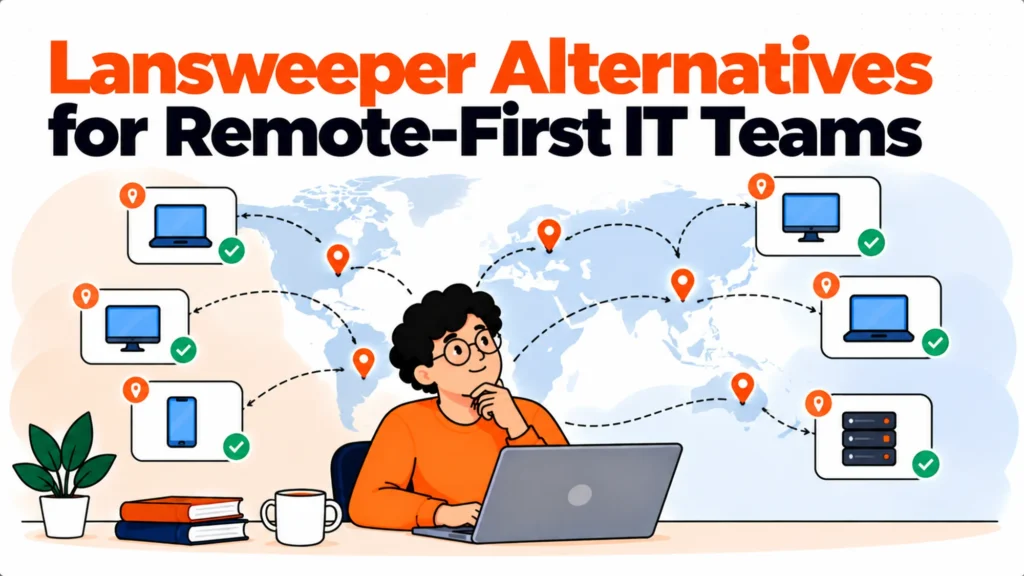
Most searches for Lansweeper alternatives come from one discovery: it finds what is on your network, and a remote-first fleet is almost never on your network. That is not a flaw in the product. It is a mismatch between what it was built for and where your laptops actually are.
TL;DR
- Lansweeper is a network discovery and inventory tool. It is very good at that and it assumes a network.
- If your devices live on home broadband, scanning finds a fraction of the fleet and the register silently rots.
- The honest replacements split three ways: a manual register you maintain, an agent-based tool, or a lifecycle platform that knows about devices because it shipped them.
- Only two options here publish a price at all. AssetTiger starts at $15 a month.
- Snipe-IT is free if you host it yourself, which is the cheapest credible route.
- Lansweeper, Device42 and Asset Panda all quote, so expect a demo before you see a number.
- Before switching, check whether your problem is discovery or data entry. They need different products.
What Lansweeper is actually good at
Worth stating plainly, because an honest assessment of Lansweeper alternatives has to start from what you would be giving up.
Depth of technical detail. It reads installed software, driver versions, BIOS and warranty state without anybody typing it in. No manual register comes close.
Discovery of things nobody told you about. On an office network it finds the switch in a cupboard, the printer somebody plugged in and the server that is still running. That is genuinely valuable and it is the capability most people mean when they say asset discovery.
It has a free tier. So the entry cost is low and the evaluation is self-serve, which is rarer in this market than it should be.
So the question is not whether it works. It is whether its core assumption holds for you.
The assumption that breaks on a remote fleet
Network discovery works by reaching devices. A laptop on somebody’s home broadband in another country is not reachable, is often asleep, and connects through a VPN only when its owner remembers.
What that produces is worse than a gap. It produces a register that looks populated and is quietly wrong: machines that last reported four months ago, leavers still listed, and new starters who never appeared because nobody connected them to anything.
What to do: pull your current scan results and count how many devices last reported inside the past seven days. Divide by your real headcount. Below about 70 per cent you do not have an inventory, you have a sample, and no amount of tuning the scanner changes that.
The three shapes Lansweeper alternatives come in
A register you maintain deliberately. Somebody records each device at the point it is bought, assigned or returned. Boring, cheap, and surprisingly accurate because the data enters at the moment somebody knows the truth. Fails when nobody owns the discipline.
An agent on every device. Software on the machine reports in regardless of network, which solves reachability properly. Fails on anything you cannot install software on, and on contractor or personal devices where you have no right to.
A lifecycle platform that knows because it shipped the device. The record is created by the act of procurement rather than by discovery, so it is correct on day one by construction. Fails for everything bought before you started, and for anything bought outside it.
Those three fail in different places, which is why the right answer depends on how your fleet arrived rather than on a feature comparison.
What each option publishes
Every figure below was read from the vendor’s own page on 16 October 2026, with script and style blocks stripped first. That last detail matters and the next section explains why.
| Option | Published pricing | Shape |
|---|---|---|
| Lansweeper | No figure published; free tier available | Network discovery |
| AssetTiger | $15 a month for unlimited inventory items, $20 a month up to 500 assets, then $40, $75, $140 and $275 a month | Manual register |
| Snipe-IT | Free and open source self-hosted; hosting from $399.99 a year or $39.99 a month | Manual register |
| Device42 | No figure published | Discovery and CMDB |
| Asset Panda | No figure published | Configurable register |
| RemoAsset | No figure published, quote-based with a demo required | Lifecycle and logistics |
Two of six publish, which tells you something about how this market sells. If you need to scope a budget before engaging a sales team, your realistic list of Lansweeper alternatives is shorter than it looks.
A warning about reading these pricing pages
Three traps caught us on the way through, and all three would have produced a confidently wrong comparison.
Device42’s page appears to carry six prices and carries none. Every one is a minified JavaScript identifier rather than money. Strip the scripts and the count is zero. If you are gathering figures programmatically, this is the shape of error that reaches a spreadsheet and never gets questioned.
Snipe-IT writes its dedicated server options as abbreviations. Read properly they are $5,000 and $7,500 a year. Written the way the page writes them, a naive read returns single digits.
Mosyle’s only currency figure is a funding announcement in the hundreds of millions, which is not a price and does not belong in any comparison. A figure without its label is not a price.
Six Lansweeper alternatives worth knowing
AssetTiger. Best for teams who want a cheap, readable register and are willing to keep it current by hand. Chosen because it is the only option here with a full published ladder, starting at $15 a month. Where it struggles: no discovery at all, so the register is exactly as good as your discipline.
Snipe-IT. Best for teams with somebody who enjoys running their own software, because the self-hosted edition is free and open source. Hosting starts at $399.99 a year if you would rather not. Where it struggles: also no discovery, and self-hosting is a real commitment that outlives the person who set it up.
Device42. Best for larger estates that genuinely need a configuration database with dependency mapping, not just a list. Where it struggles: it is a heavier product than most teams under 500 people need, and it publishes no price.
Asset Panda. Best where you need to track things that are not computers, since its field model is unusually configurable. Where it struggles: that flexibility is configuration work somebody has to do, and pricing is quote-only.
RemoAsset. Best where the fleet is distributed and the register keeps drifting because devices arrive and leave without anybody recording it. Disclosure that should shape how you read this: RemoAsset is owned by the same people who publish this site. Its record is created by the act of procurement and retrieval rather than by scanning, which is why it holds up on a fleet that never touches a corporate network. Where it struggles, stated plainly: pricing is quote-based and requires a demo, so you cannot benchmark it against the two options above without a call; and it is a newer platform with a smaller footprint than the legacy global resellers, which matters if you need somebody already established in an unusual market. It is also not a discovery tool, so it will not find the server in the cupboard.
Staying on Lansweeper for the office and adding something for the remote fleet. Best for hybrid estates, and more common than vendors suggest. Chosen because the office discovery genuinely works and throwing it away to solve a remote problem is an overcorrection.
Check the published figures against the source before committing, because pricing here moves within weeks: AssetTiger and Snipe-IT both publish openly.
Final thoughts
The useful question behind most searches for Lansweeper alternatives is not which tool is better. It is whether your problem is discovery or data entry, and the check-in percentage above answers it in ten minutes.
If your devices are reachable and your issue is depth of detail, stay where you are. If most of your fleet has not reported in a month, no scanner will fix that, and the register needs to be fed by the moments when somebody actually knows the truth: when a device is bought, assigned, returned or wiped.
Why do remote teams outgrow Lansweeper?
Because network discovery depends on reaching the device, and a laptop on home broadband in another country is rarely reachable. The result is a register that looks populated but is quietly stale: leavers still listed, new starters missing, and machines that last reported months ago. Count how many devices checked in within the last seven days against headcount, and the scale of the gap becomes obvious.
What is the cheapest alternative?
Snipe-IT, if you are willing to host it yourself, because the self-hosted edition is free and open source. The two options with published ladders are compared with their own figures in the pricing table above, which is the only place those numbers mean anything. Both of them are registers rather than discovery tools, so neither finds anything on its own and both are exactly as accurate as the discipline behind them.
Which options publish their prices?
Two of the six in this comparison. AssetTiger publishes a full ladder and Snipe-IT publishes both its free self-hosted edition and its hosting tiers. Lansweeper, Device42, Asset Panda and RemoAsset all require a conversation, which means budgeting before a demo is only possible for two of your candidates. That is worth knowing before you plan an evaluation timeline.
Do we need discovery or just a register?
Discovery earns its place when you genuinely do not know what exists, which is usually an office estate with switches, printers and forgotten servers. A register is right when you know what you bought and the problem is keeping track of where it went. Remote-first companies almost always have the second problem, and buying discovery for it produces a tool that finds very little.
Can we keep Lansweeper and add something else?
Yes, and for a hybrid estate that is often the right answer rather than a compromise. The office discovery genuinely works, so throwing it away to solve a remote-fleet problem is an overcorrection. Run it where it is effective and feed the distributed devices from procurement and retrieval events instead, keeping one of the two as the system of record so nobody has to reconcile them.
What should we check during a trial?
Whether the thing stays accurate without somebody remembering to update it, because that is what actually fails. Add a device, assign it, mark it returned, and see whether the register reflects each step unprompted. Also test what happens to a machine that goes quiet for a month, since a tool that silently keeps showing stale records as current is worse than one that flags them.