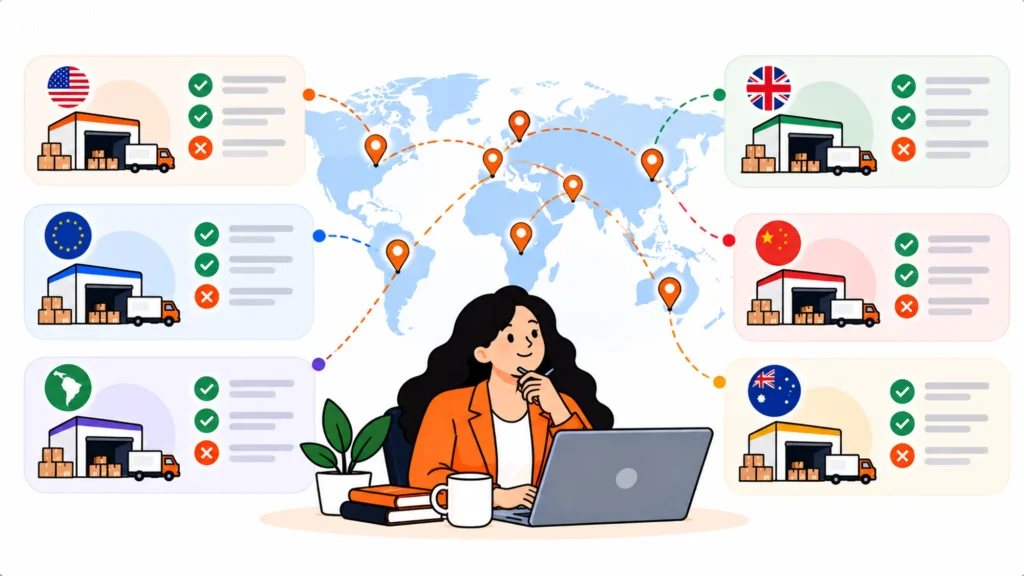
Coverage numbers are the least informative figure any equipment platform publishes. A vendor can cover a hundred and fifty countries and hold stock in six. Those are completely different products sold with the same sentence, and the difference is measured in how long somebody waits for a replacement laptop.
TL;DR
- Coverage counts countries a courier can reach. Stock location counts countries where a machine is sitting ready. Only the second one predicts replacement time.
- Ask for the warehouse list, not the country list. It is always far shorter and nobody volunteers it.
- Test against your own top five markets by headcount, not against the total country count.
- A country served through a partner is not worse automatically. It is slower and usually costs more, and you should know which ones they are.
- Import duty and who acts as importer of record varies by country and changes the invoice more than most people expect.
- No vendor in this category publishes a price. All six were read from their own pages on 14 October 2026.
What a coverage number actually means
There are three different things a vendor might mean by covering a country, and the marketing figure uses the loosest.
We can ship there. This is usually what the headline number counts. It means a courier serves the destination and the vendor will arrange it. Almost every vendor covers almost every country by this definition.
We have a partner there. A local reseller or logistics firm handles the physical work. Workable and common, with a markup and an extra handoff where things get lost.
We hold stock there. A machine is physically present and can go out tomorrow. This is the list that matters and it is typically a single-digit number of countries for every vendor in this category.
How to test it against your own map
| Ask this | Because |
| Which of my top five have local stock | Replacement time follows stock, not coverage |
| Which are served through a partner | Extra handoff, extra markup, extra delay |
| What is the replacement target per country | A global service level is a marketing number |
| Who is importer of record there | Decides whether duty lands on your employee |
| Can you collect from there too | Retrieval coverage is narrower than delivery |
| What happened last time you missed | Tests experience rather than intention |
The fifth row catches people out. Retrieval coverage is almost always narrower than delivery coverage, because collecting from a private address and getting a device back across a border is harder than sending one out. A vendor can genuinely ship to a country and have no practical way of getting the machine back.
The duty question that changes the invoice
A device crossing a border attracts duty and import tax, and somebody has to be the importer of record. There are three arrangements and they are not equivalent.
Delivered duty paid means the vendor handles the paperwork, pays the charges and bills you one figure. This is the version you want and it is usually the most expensive line on a quote.
Delivered duty unpaid means the courier presents a bill at the door, which is to say your new starter is asked for money on their first morning. If one quote is noticeably cheaper than the others, check this first.
You as importer of record leaves the obligation with you, which is fine if somebody understands what that means and a genuine exposure if nobody does.
Often the cheapest route is not shipping at all. Buying locally in a country where you have several people avoids the whole question, which is exactly why local stock beats a long coverage list.
Where the vendors differ
Workwize owns warehouse space, which is the clearest version of real stock presence in this category. The advantage applies in the countries where the warehouses are and not elsewhere. Its domain is now goworkwize.com.
GroWrk leads with country breadth and scopes each arrangement individually, which suits an unusual spread and makes comparison slower.
Firstbase and allwhere both run partner networks, the first inside a subscription model and the second inside a managed service. Deel IT benefits where its employment footprint already exists.
Disclosure: RemoAsset is owned by the same people who publish PeopleOpsHQ. It covers procurement, deployment, tracking and retrieval for distributed teams. Its limits, stated plainly: it publishes no price and requires a demo, it is weaker for hardware it did not supply, and it is not a device management system. Compared alongside the rest in our laptop procurement platform comparison.
Running the test
Checklist:
- List your countries by headcount, including the ones with a single person. Those are where quotes diverge.
- Send that list to each vendor and ask them to mark each country as local stock, partner, or ship only.
- Ask for a replacement working-day target per country, with a remedy if missed, in writing.
- Ask separately about collection, because retrieval coverage is narrower than delivery coverage.
- Ask who is importer of record per country and whether duty is inside the quoted figure.
- Re-ask the stock question annually, because footprints change and nobody tells you when they do.
That last point matters more than it sounds. Vendors open and close warehouses as their own customer base shifts, and the first you hear of a change is usually a replacement that takes a week instead of a day.
One more worth adding if your spread is genuinely awkward. Ask what they would do about a country they do not cover well. Honest answers exist and they are useful: hold a spare machine locally, use a regional reseller for that market, or accept a longer target and plan around it. A vendor who insists every country is equally served has either not read your list or is hoping you will not test it.
Final thoughts
A long coverage list tells you a vendor has a logistics partner, which every vendor in this category has. It does not tell you how fast somebody in Lisbon gets a replacement when their laptop dies on a Tuesday.
Ask for the warehouse list, test it against your own top five markets rather than against the total, and ask about collection separately from delivery. Three questions, one call, and the shortlist usually resolves itself.
Frequently asked questions
What does country coverage actually mean for equipment platforms?
Usually just that a courier serves the destination and the vendor will arrange shipping, which is true of almost every vendor for almost every country. The three real tiers are ship-only, served through a local partner, and stock physically held in country, and only the third one predicts how quickly somebody gets a replacement machine.
What should I ask instead of how many countries they cover?
Ask for the warehouse list rather than the country list, then send your own markets ranked by headcount and have each vendor mark every one as local stock, partner or ship only. That exercise takes a vendor ten minutes and tells you more than any coverage figure, and nobody volunteers it unprompted.
Is retrieval coverage the same as delivery coverage?
No, and it is almost always narrower, because collecting from a private address and moving a device back across a border is harder than sending one out. A vendor can genuinely ship to a country and have no practical route for getting the machine back, so ask about collection as a separate question rather than assuming it mirrors delivery.
Who pays import duty on a shipped laptop?
It depends which of three arrangements applies: the vendor handles and includes it, the courier bills your employee at the door on their first morning, or the obligation sits with you as importer of record. Ask per country and get the answer in the contract rather than the quote, because a notably cheap quote often answers this differently from the others.
Is a partner-served country a problem?
Not automatically, and it is slower and usually costs more because of the extra handoff and markup. What matters is knowing which of your countries are partner-served before you sign rather than discovering it when a replacement takes a week, so ask for the classification explicitly and expect honest vendors to volunteer their weaker markets.
How often should I re-check a vendor’s stock footprint?
Annually, because vendors open and close warehouses as their own customer base shifts and nobody proactively tells customers when a market changes. The first sign is usually a replacement that takes a week when it used to take a day, by which point somebody has already waited, so a fifteen-minute question at renewal is cheap insurance.