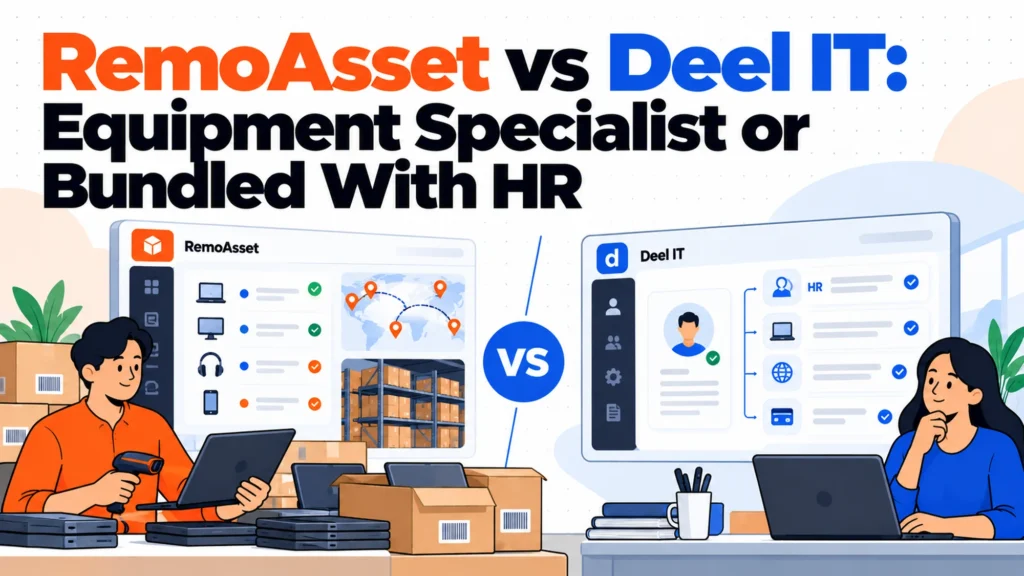
The short version. This is not really a feature comparison. Deel IT is equipment attached to an employment and payroll platform; RemoAsset, which is our own product and should be read with that in mind, does equipment and nothing else. If you already run payroll on Deel, the bundle is genuinely convenient and the integration is real. The question worth answering before you take it is what happens if you ever change payroll provider, because at that point your equipment arrangement is attached to a decision that has nothing to do with equipment.
The disclosure
RemoAsset is built by the company that publishes this site. Check the claims below rather than trusting them. Deel details come from its own site, read on 21 October 2026.
What the bundle genuinely gives you
Three things, and they are not marketing.
One vendor and one invoice. For a finance function already managing dozens of suppliers, consolidating equipment into an existing relationship removes a procurement cycle, a contract review and a payment arrangement.
Employment data that is already there. The platform already knows who joined, who left, where they sit and when their contract ends. An equipment process built on top of that does not need the integration work that a standalone platform requires, because the data never has to move.
A single escalation path. When somebody joins in a market you have not hired into before, employment and equipment are the same conversation with the same account team rather than two parallel ones.
What the bundle costs you, and it is mostly optionality
The equipment function becomes attached to the employment decision. That sounds abstract until you want to change one of them.
Companies change payroll and employer-of-record providers for reasons that have nothing to do with laptops: cost, coverage in a new market, a service problem, an acquisition. When equipment is bundled, that decision now carries a second migration with it, and the devices already in the field under the existing arrangement have to be accounted for somewhere in the move.
The second cost is that equipment is not the platform’s main business. That is not a criticism, it is arithmetic. A company whose primary product is global employment allocates its engineering and operational attention accordingly, and equipment is one capability among many rather than the thing the company exists to do.
Pricing, and a figure to be careful with
Deel publishes no price for the IT product specifically. Its IT page routes to a conversation, verified on 21 October 2026.
One warning that matters more than it should. Deel’s pages carry a prominent figure describing the total payroll volume processed through the platform. That is a scale claim about the company, not a price for anything, and it scrapes as currency. If you are gathering figures for a comparison spreadsheet, exclude it, because it has no relationship to what equipment costs.
RemoAsset publishes a Subscription tier starting at $1,499 a year for companies between 50 and 5,000 employees, with a pay-as-you-go tier below for 5 to 50 carrying no published figure.
The question that actually decides this
How likely are you to change employment provider in the next three years.
If the answer is very unlikely, because Deel covers your markets, the service works and nothing on the horizon changes that, the bundle is a reasonable choice and the convenience is real.
If the answer is possibly, because you are hiring into markets at the edge of their coverage, or because an acquisition or a cost review is plausible, then bundling equipment adds a cost to a decision you may want to make freely later.
That is genuinely it. Most of the feature comparison between these two is noise relative to that one question.
What unbundling actually involves
Worth understanding before you need it rather than during.
Devices currently in the field under the bundled arrangement need to be identified, and the record of them lives in the incumbent’s system. Ask before signing how that data comes out and in what format.
Anything the incumbent physically holds, in a warehouse or in transit, has to go somewhere. Ask what happens to held inventory on exit and who pays to move it.
And retrieval obligations for people who leave during the transition fall into a gap between two vendors unless somebody has agreed who owns them. That gap is where devices get lost.
Where RemoAsset is weaker
It enrols devices but is not an MDM in its own right, so endpoint management is still a separate product.
It wipes devices but is not a certified ITAD, so formal destruction certificates are a separate arrangement.
And on the axis this article is about, a specialist cannot give you the thing the bundle is good at. If one vendor and one invoice is what you are optimising for, a standalone equipment platform is by definition adding a supplier rather than removing one, and we would rather state that than argue around it.
How to decide
Answer the three-year question honestly. If your employment arrangement is stable and well covered, take the bundle and stop reading comparison articles.
If it is not stable, ask both about exit. Data export format, what happens to held inventory, who handles retrieval during a transition.
Price the convenience. One invoice and no integration work is worth real money. Decide roughly how much, so the comparison is between a number and a number rather than between a number and a feeling.
Does Deel publish pricing for its IT product?
Not for the equipment product specifically. The IT page routes to a conversation rather than showing figures, verified on its own site on 21 October 2026. One caution for anybody gathering numbers: Deel’s pages carry a large figure describing total payroll volume processed through the platform, which is a company scale claim rather than a price and which scrapes as currency. Exclude it from any cost comparison, because it has no relationship to what equipment costs.
Is bundling equipment with payroll a mistake?
Not inherently, and for a lot of companies it is the right call. The bundle gives you one vendor, one invoice, employment data that is already present so no integration is needed, and a single escalation path when you hire somewhere new. The cost is optionality: the equipment arrangement becomes attached to an employment decision you might want to make freely later. Whether that trade is good depends almost entirely on how stable your employment provider arrangement is.
What should I ask about exit before signing a bundled arrangement?
Three things. How the record of devices currently in the field is exported and in what format, since that data lives in the incumbent’s system. What happens to any inventory the vendor physically holds for you, including who pays to move it. And who handles retrieval for people leaving during a transition, because that responsibility falls into a gap between two vendors unless somebody has explicitly agreed it. That gap is where devices get lost during a migration.
Does a specialist platform actually do equipment better?
It allocates more attention to it, which is arithmetic rather than a claim about quality. A company whose primary product is global employment distributes its engineering and operational focus across many capabilities, and equipment is one of them. A specialist has nowhere else to put that attention. Whether the difference matters to you depends on how complex your equipment situation is, because for a straightforward one the bundled version may be entirely sufficient.
What does RemoAsset cost and where is it limited?
The Subscription tier starts at $1,499 a year for companies between 50 and 5,000 employees, with a pay-as-you-go tier below it for 5 to 50 that carries no published figure. Its stated limits are that it enrols devices without being an MDM in its own right, wipes devices without being a certified ITAD, and that coverage and lead times vary by market. It is our own product, so verify the figure on the pricing page rather than relying on this page for it.
Can we use Deel for employment and a specialist for equipment?
Yes, and it is a common arrangement. You lose the single invoice and you take on some integration work to get joiner and leaver data flowing into the equipment system, which is exactly what the bundle saves you. What you gain is the ability to change either vendor without the other being affected. For companies whose employment arrangement is settled, the bundle usually wins on convenience; for companies expecting change, keeping them separate is cheaper over a three-year horizon.