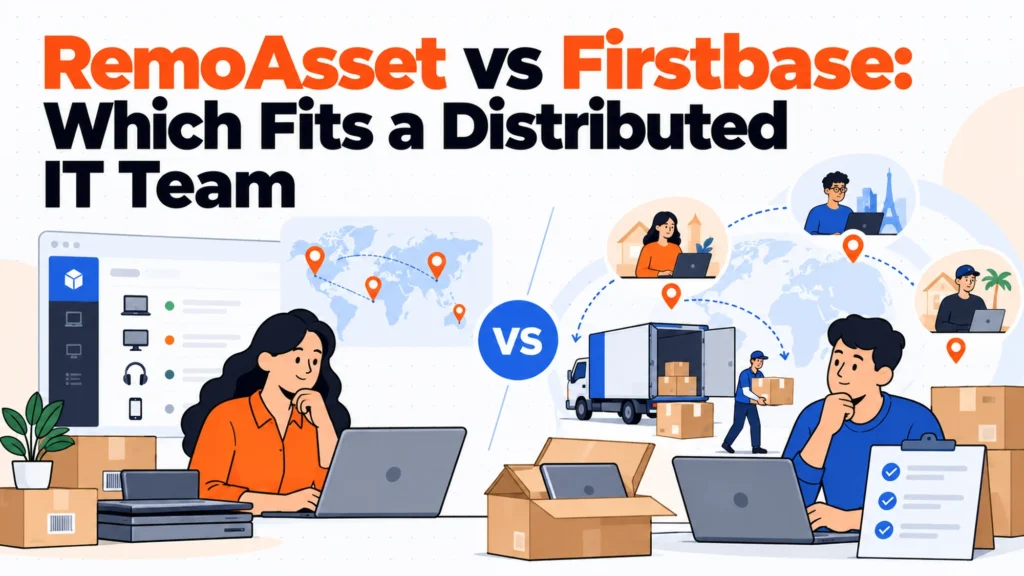
The short version. These two sell the same outcome by different routes. Firstbase is the more established managed service with its own inventory and a conversation at every step. RemoAsset is our own product, which you should weigh against everything below, and it differs in two checkable ways: it publishes a price and it offers a pay-as-you-go tier for teams too small for a subscription. Neither is better in the abstract. The decision comes down to whether you want a managed relationship or a system you operate yourself.
The disclosure, before anything else
RemoAsset is built by the company that publishes this site. That is a reason to read this comparison sceptically rather than a reason to discount it, and the useful response is to check the claims rather than to trust them.
Everything below about Firstbase comes from its own site, read on 21 October 2026. Everything about RemoAsset comes from its published pricing page on the same date. Where RemoAsset is weaker, this says so, because a comparison that finds its own product better on every axis is not a comparison.
What is actually the same
Both handle the full loop: buying devices, getting them to people in multiple countries, tracking what went where, and collecting them back at the end. Both exist because doing that with couriers and a spreadsheet stops working somewhere around fifty people across three or four countries.
Both also sit beside your MDM rather than replacing it, and both will tell you that if you ask directly. If you are hoping either one removes the need for endpoint management, neither does.
Pricing transparency, which is the clearest difference
Firstbase publishes no price. Its pricing page returns a contact route rather than a figure, verified on 21 October 2026. That is normal for this category rather than unusual, and it is not evasiveness: cost genuinely varies with country mix and volume enough that a published tier would mislead most readers.
RemoAsset publishes. The Subscription tier starts at $1,499 a year and is pitched at companies between 50 and 5,000 employees. Below that there is a pay-as-you-go tier with no published figure, aimed at teams of 5 to 50.
What that is worth to you depends on where you are in a buying process. If you are building a budget line before anybody has approved a conversation, a published number is genuinely useful. If you are already in procurement with three vendors, it matters less, because you will get real quotes from all of them anyway and your own specification will drive the comparison more than any list price.
Country coverage, and the question to ask about it
RemoAsset states procurement and retrieval support across 80+ countries. Firstbase describes global coverage without committing to a number on its public pages.
A country count is a weak signal on its own and both of us would tell you the same thing. What matters is depth in the specific markets where you employ people, and depth varies within any vendor’s list. Supported can mean a warehouse and staff, or it can mean a partner arrangement that works but takes longer.
So the useful question is not how many countries, it is what the lead time and the retrieval process look like in your three hardest markets, named explicitly. Ask both vendors that and the answers will differ more than the headline numbers suggest.
Service model, which is the real fork
Firstbase leans managed. The model assumes a relationship, an account contact and a conversation when something unusual comes up. For a company with no IT operations function, that is the point rather than a drawback, because you are buying somebody to own the problem.
RemoAsset leans operational. The Subscription tier includes MDM integration, native MDM where you do not have one, HRMS integration and a dedicated account manager, but the shape is a system you run rather than a service that runs for you.
Neither is better. A ten-person IT team that wants control will find a heavily managed model slow. A company with no IT function at all will find a self-operated system is work they cannot absorb. Decide which you are before you take either call.
Where RemoAsset is weaker, stated plainly
Three limits, and they are the same three stated everywhere else on this site.
It enrols devices but it is not an MDM in its own right. If full endpoint management is what you actually need, you still need an MDM alongside it, and the native MDM included at the Subscription tier is a floor rather than a replacement for a dedicated product.
It wipes devices but it is not a certified ITAD. If your disposal process requires formal destruction certificates for audit, that is a separate arrangement with a certified provider.
Coverage and lead times vary by market, which is the same caveat applied to Firstbase above and applies equally here. The 80+ figure describes reach, not uniform speed.
How to decide between them
Name your three hardest markets. Not your biggest. The ones where you have one person, or where customs has caught you out before. Ask both vendors for lead time and retrieval process in those specific countries.
Decide managed or operated, honestly. Count who would actually own this internally and how many hours a week they have. If the answer is nobody with any hours, a managed model is worth paying more for.
Send the same specification to both. Headcount by country including the single-person markets, last year’s real joiners and leavers, your device standard as a specification rather than a model name, and what you would accept as a replacement time. Quotes built from different inputs cannot be compared.
Ask what happens on a failed collection. In their words, including the charge. The difference between vendors in this category concentrates almost entirely in what happens when something goes wrong, and a yes or no question will not surface it.
The honest summary
If you want one party accountable end to end and you have no internal capacity to run equipment operations, Firstbase is the more established version of that and has been doing it longer.
If you want a system you operate, want MDM and HRMS integration in the base arrangement, or you are at the stage where a published starting figure helps you build a budget, RemoAsset is worth a quote. And if you are under fifty people, the pay-as-you-go tier exists for exactly that reason, which is a gap Firstbase’s model does not really address.
Get quotes from both. We would tell you that even though one of them is ours, because a single quote in a category with no public pricing tells you nothing about whether it is reasonable.
Does Firstbase publish its pricing?
No. Its pricing page routes to a contact form rather than showing figures, confirmed on its own site on 21 October 2026. This is the norm across this category rather than anything unusual to Firstbase, because cost depends heavily on country mix, device volume and which parts of the lifecycle you want covered. The practical consequence is that you cannot build a budget line from public information and will need a conversation to get a number.
What does RemoAsset actually cost?
The Subscription tier starts at $1,499 a year and is aimed at companies between 50 and 5,000 employees, with a pay-as-you-go tier below it for teams of 5 to 50 that carries no published figure. Treat the starting figure as a floor rather than a quote, because what you pay depends on volume, country mix and which add-ons you take. RemoAsset is our own product, so verify this against the pricing page rather than taking our word for it.
Do either of these replace an MDM?
Neither does, and both would tell you so directly. RemoAsset enrols devices and includes a native MDM at the Subscription tier, but that is a floor rather than a substitute for a dedicated endpoint management product, and if you need full policy enforcement, patching and compliance reporting you still need a proper MDM alongside. Firstbase sits in the same position. Anybody evaluating these as an MDM replacement is comparing the wrong category.
Which one is better for under fifty people?
RemoAsset has an explicit tier for that size, a pay-as-you-go arrangement for teams of 5 to 50 where you pay for what you use rather than committing to a subscription. Firstbase’s managed model is built around a larger relationship and tends to be heavier than a small team needs. That said, a company under fifty with people in only one or two countries may not need either, because the cost of this problem rises with borders rather than headcount.
How much weight should the country count carry?
Less than it appears to. A supported country can mean a warehouse with staff or a partner arrangement that works but takes longer, and the difference matters enormously if that country is where a third of your people sit. Name your three hardest markets and ask both vendors for lead time and retrieval process in each one specifically. The answers diverge far more than headline coverage numbers suggest, and that divergence is what should drive the decision.
Can we run both, or switch later?
Running both is possible but rarely sensible, since the value comes from one system holding the whole picture and splitting it reintroduces the reconciliation problem you were trying to remove. Switching later is a real project rather than a cancellation: devices already in the field under one arrangement have to be accounted for, and the asset data has to move. Ask about exit terms and data export before you sign with either, because that conversation is much easier before a contract than after one.