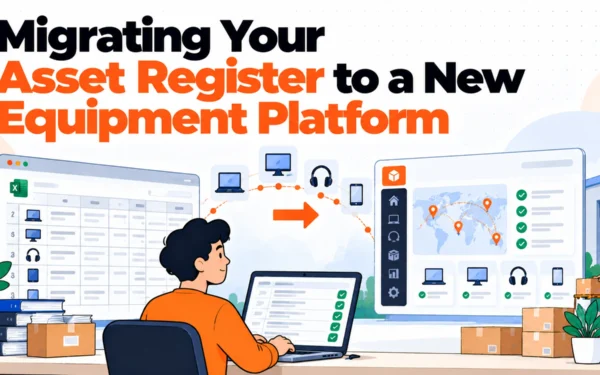
Switching equipment platforms is unusual because the thing you are migrating does not move. The laptops stay exactly where they are, with the same people, in the same countries. What migrates is the record, the warranties, the in-flight shipments and the stock sitting in somebody’s warehouse, and each one breaks differently.
TL;DR
- The devices do not move. The register, the open shipments and any stored stock do, and those are the risky parts.
- Export your asset register before you give notice, not after. Goodwill is easier to ask for before you have told them.
- Stock sitting in the old vendor’s warehouse is the single most expensive loose end. Decide its fate in writing.
- Run both platforms in parallel for one full cycle rather than cutting over on a date.
- Warranties usually follow the device rather than the vendor, and the paperwork frequently does not.
- Nobody in this category publishes a price, so a cheaper replacement quote may simply have excluded more.
What actually has to move
| Thing | Risk if mishandled |
| Asset register | You lose the history, not just the list |
| Devices in transit | Nobody owns a shipment mid-flight |
| Stock in their warehouse | Shipping or disposal costs on exit |
| Open collections | A leaver’s laptop falls between vendors |
| Warranty records | Claim paperwork sits with the old vendor |
| Integrations | Your HR system still points at the old one |
The second and fourth rows are where real devices get lost. A machine shipped last Tuesday and a collection booked for next Friday both sit in a gap if the cutover is a date rather than an overlap.
Export the register first
Before anybody is told anything, get a full export. Not a screenshot of a dashboard. A file containing every device with its serial, current holder, location, assignment date, purchase date, cost and condition history.
The history is the part people forget. A current-state list is easy to reconstruct. Knowing that a particular machine has been reassigned three times and repaired once is not, and it is exactly what tells you whether to replace or redeploy it.
Do this monthly regardless of whether you are switching. A register that exists only inside a vendor’s product is a register you rent, and the moment you give notice your ability to ask for favours drops sharply.
The stock question
If the outgoing vendor holds machines for you, whether spares, returns awaiting redeployment or stock bought ahead, that inventory is the most expensive loose end in the whole exit.
There are three options and all of them cost something. Ship it to the new vendor, which means paying freight on machines that are not generating any value. Ship it to an office, which works if you have one and creates a cupboard problem if you do not. Or sell or dispose of it, which recovers some value and may be the right call for older stock.
Decide before you give notice, and get the storage end date in writing. Vendors are reasonable about this when asked in advance and considerably less flexible when the contract has already ended and your machines are occupying space.
Overlap rather than cut over
A date-based cutover assumes nothing is in flight on that date, which is never true. Overlap costs you a month of double subscription and prevents the failure mode where a device belongs to nobody.
What to do:
- Export the full register with history before giving notice, and keep a copy outside both platforms.
- Stop placing new orders with the outgoing vendor two weeks before the switch, so nothing new goes in flight.
- Let every in-flight shipment and booked collection complete under the old vendor rather than transferring it.
- Route all new activity to the incoming vendor from an agreed date, with both contracts live.
- Reconcile the two registers at the end of the overlap and investigate every discrepancy before closing the old account.
- Update your HR and onboarding integrations before the old account closes, not after.
The reconciliation step is the one that finds the devices nobody noticed were missing. Expect discrepancies, and treat each one as a real machine somewhere rather than a data problem.
Two other things belong in the overlap window. Tell your people once, in plain terms, that device requests go to a new place from an agreed date. Employees who email the old address get silence rather than a bounce, and silence from IT is how somebody ends up buying a laptop on a personal card.
And check what the old vendor does with your data on exit. Ask for the deletion commitment in writing, including how long they retain the register and whether anything persists in backups. The register contains every employee’s home address, which makes this a privacy question rather than a housekeeping one.
Choosing the replacement
Switching is expensive enough that most teams live with a poor fit for a full term rather than fix it, which means the replacement decision deserves more scrutiny than the original one did.
Workwize owns warehouses, which helps if storage and redeployment were part of why you are leaving. Its domain is now goworkwize.com. Firstbase bundles the lifecycle into a subscription. GroWrk and allwhere both scope per customer, which suits an awkward country mix. Deel IT fits where employment and devices come from one provider.
Disclosure: RemoAsset is owned by the same people who publish PeopleOpsHQ. Relevant to switching specifically: it is weaker for hardware it did not supply, so an incoming fleet is exactly the case to test before committing. It also publishes no price and requires a demo, and it is not a device management system. The options sit side by side in our laptop procurement platform comparison.
Final thoughts
Nothing physical moves in this migration, which is why teams underestimate it. What moves is the record of where several hundred thousand pounds of hardware is, and that record is easy to degrade and hard to rebuild.
Export before you give notice, settle the warehouse stock in writing, overlap for a full cycle, and reconcile both registers before closing the old account. Done that way it is a month of mild administrative irritation. Done as a cutover on a date, it is how companies discover six months later that eleven machines are unaccounted for.
Frequently asked questions
What actually migrates when you switch equipment platforms?
Not the devices, which stay with the same people in the same countries. What migrates is the asset register and its history, any devices in transit, stock sitting in the old vendor’s warehouse, open collections for leavers, warranty paperwork and your integrations, and the in-flight items are where real machines go missing.
When should I export my asset register?
Before anybody is told you are leaving, and monthly as routine regardless. Export the full history rather than a current-state list, because knowing a machine has been reassigned three times and repaired once is what tells you whether to replace or redeploy it, and that history is the hardest part to reconstruct afterwards.
What happens to stock held in the old vendor’s warehouse?
It is the most expensive loose end in the exit and it has three possible destinations: shipped to the new vendor at freight cost, shipped to an office if you have one, or sold and disposed of. Decide before giving notice and get a storage end date in writing, because vendors are far more flexible about this in advance than once the contract has ended.
Should I cut over on a date or run both in parallel?
Run both for one full cycle. A date-based cutover assumes nothing is in flight on that date, which is never true, so a shipment sent last week or a collection booked for next week ends up belonging to nobody. The overlap costs a month of double subscription and prevents the only failure mode that loses actual devices.
What do I do about discrepancies between the two registers?
Treat each one as a real machine in a real place rather than a data problem, and investigate before closing the old account. The reconciliation at the end of the overlap is what surfaces devices nobody had noticed were missing, and once the old vendor’s access is gone you lose the only record that could explain where a given serial was last seen.
How do I pick a replacement platform?
With more scrutiny than the original decision, because switching costs are high enough that most teams live with a poor fit for a full term. Test the incoming vendor specifically on importing your existing fleet, since that is where platforms diverge most and your whole estate will arrive as hardware they did not supply.