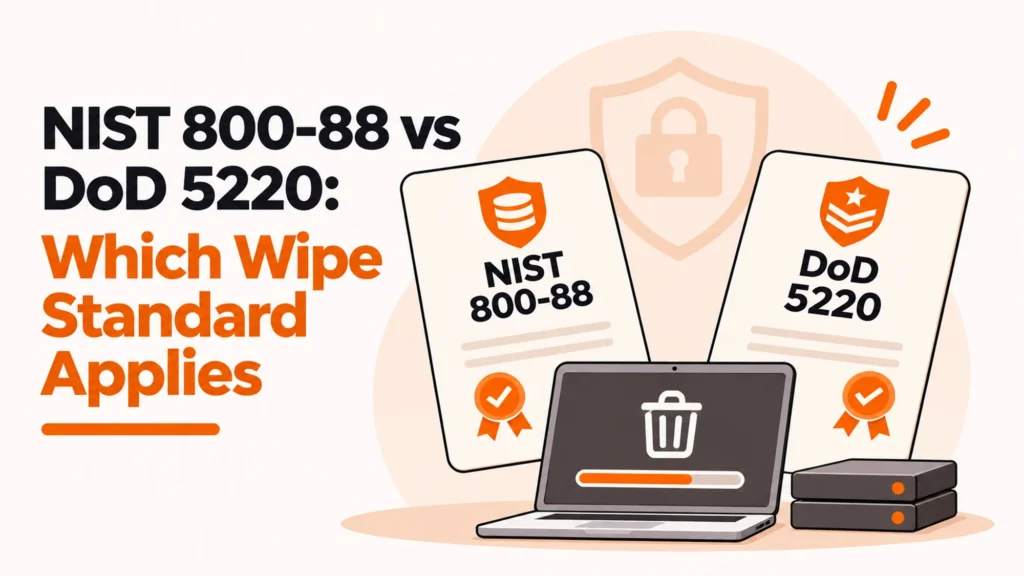
A wipe standard comparison usually ends with a buyer asking for a method name. The method matters less than the media type it is applied to and the verification that follows, and current guidance is built around exactly that distinction.
TL;DR
- Three levels exist: clear, purge, destroy. Pick on sensitivity and destination.
- Multiple overwrite passes are largely obsolete for modern drives.
- Solid state drives need a different approach from spinning disks.
- Crypto erase is accepted under conditions, and the conditions matter.
- Ask for the method and the verification, not an acronym.
- A certificate without serial numbers evidences nothing you own.
When this does not matter much
Four stages, and the first two can keep it simple.
Devices stay and get reissued internally. A standard operating system reinstall between colleagues is proportionate. The device never leaves your control.
A few disposals a year, low sensitivity. A built in secure erase plus a note is reasonable, and overbuying here is common.
Regulated data on endpoints. Now the method, the media type and the evidence all have to be deliberate, because somebody will test them.
Devices sold, donated or sent to a third party. The drive is leaving your control entirely, which is exactly the case the standards were written for.
Why a wipe standard comparison is harder than it looks
Buyers want a single answer: which standard is best. The field does not work that way, and the reason is that the right method depends on what the drive is rather than on how careful you want to appear.
The current reference most vendors cite is NIST SP 800-88, and it is structured as a decision rather than a recipe. It sets out clear, purge and destroy, and asks you to choose based on data sensitivity and on whether the media is leaving your control. Two organisations can both follow it correctly and do different things.
The older reference people still quote came from a United States Department of Defense manual and specified multiple overwrite passes. That approach made sense for the magnetic media of its era. On modern drives it is unnecessary, and on flash media it is not even reliable, because the controller decides which physical cells a write touches.
So a vendor whose headline claim is a three pass overwrite is not necessarily doing something wrong. They are describing a method chosen for hardware most companies no longer buy, and quoting it signals that their documentation has not been revisited recently. Guidance from bodies such as the National Cyber Security Centre reaches the same conclusion from a different direction.
The three levels, and what they mean
- Clear. Standard overwrite or reset using normal interfaces. Appropriate when the device stays inside your organisation and gets reissued.
- Purge. Methods that defeat laboratory recovery, including built in secure erase commands and cryptographic erase. The right level for most devices leaving your control.
- Destroy. Physical destruction of the media. Reserved for failed drives, unverifiable cases and the highest sensitivity classes.
- Media type first. The same level is achieved differently on a spinning disk and on a solid state drive, which is the detail most procurement documents omit.
- Verification throughout. Every level requires confirmation that the method worked, and that confirmation is the artefact you keep.
Choose the level from the destination, choose the method from the media, and keep the verification. That sequence covers almost every case you will meet.
Five questions to ask a vendor
Which method do you apply to a solid state drive? If the answer is the same as for a hard disk, keep asking.
How do you verify it worked? A method without verification is a procedure, not a result.
What happens when verification fails? There should be a defined fallback to destruction, recorded separately.
Will the certificate carry serial numbers? This decides whether the evidence is reconcilable.
Which standard edition are you working to? A current answer suggests current documentation; an old acronym suggests the opposite.
Methods, and the trade-offs
Operating system reinstall. Best for internal reissue and effectively free. It struggles as a sanitisation claim, because it is a clear level action and should never be presented as more than that.
Built in secure erase. Best for modern drives, fast and designed by the manufacturer for the purpose. It struggles when the command is not supported or silently fails, which is why verification is not optional.
Cryptographic erase. Best for encrypted drives and the quickest route at volume. It struggles when encryption was enabled late or cannot be proven, since the guarantee depends entirely on the original encryption.
Physical destruction. Best for failed drives and absolute certainty. It struggles on cost and on value, destroying hardware with years of life, and it still needs a record to be worth anything.
A lifecycle service performing and recording it. Disclosure: RemoAsset is owned by the same people who publish this site. It handles retrieval, storage and certified wiping across 80 or more countries, so the method and its record arrive together rather than from two suppliers. Where it struggles: it is not a forensic laboratory and not a bulk media destruction specialist for failed enterprise storage. The narrow part it covers is whether each device is wiped and evidenced individually.
The decision table
| Situation | Scale | Setup | Primary pain | Recommended starting point |
|---|---|---|---|---|
| Reissue internally | Any | No IT owner | Over-specifying | Clear level, note it |
| Occasional disposal | Under 50 | Part time owner | Unsure what is enough | Secure erase plus verification |
| Devices sold or donated | Any | Any | Leaving your control | Purge level, evidence per unit |
| Mostly solid state fleet | Any | IT owner | Overwrite assumptions | Secure erase or crypto erase |
| Regulated data | 100 plus | Security owner | Evidence under test | Method, verification, serials |
| Failed or unreadable drive | Any | Any | Cannot verify | Destroy, record separately |
What quoting the wrong standard costs
The first cost is paying for work that does nothing. Specifying multiple overwrite passes on a modern fleet buys processing time and no additional protection, and on flash media it may not even address the cells you were worried about.
The second is the opposite error, which is more serious. Treating an operating system reinstall as sanitisation for a device being sold on applies a clear level action to a purge level situation. The gap is invisible until somebody recovers something.
The third is evidence you cannot reconcile. A certificate stating that forty drives were sanitised to a named standard proves a batch was processed. It cannot answer a question about the specific laptop an auditor picked, and that is the only question that gets asked.
The fourth is value destroyed by a default. When nobody has decided the method, destruction becomes the safe-feeling choice, and perfectly good drives are shredded because that felt more responsible than verifying an erase.
A fifth cost is subtler and only appears in mixed fleets. Teams that settled on one method years ago keep applying it as the hardware underneath changes, so a procedure written when everything was a spinning disk is still being run on a fleet that is now almost entirely solid state. Nothing about the paperwork looks wrong, and the method stopped matching the media some time ago without anybody noticing.
So the question is not which standard your vendor claims. It is what they actually do to a solid state drive, and how they know it worked.
Verification is the whole deliverable
Everything above is about choosing a method. In practice the method is the easy half, because any competent vendor can run the right command on the right media.
What separates them is whether the result is confirmed and recorded per device. A verification step catches the drive that reported success and did not comply, which happens, and the record is the only thing that survives into an audit a year later.
Three signals say your evidence is weaker than your method. Your certificates name quantities rather than serials. You cannot pick one device from last year and show what was done to it. And nobody can tell you what happens when a verification fails.
It is worth settling before the next disposal round, because the method is cheap to change and the missing records cannot be recreated. Seeing how wipe records attach to individual assets shows what a reconcilable evidence trail looks like.
Related reading
- The certificate of data destruction
- Data wiping services compared
- How to wipe a hard drive
- Hard drive destruction
- The ITAD vendor checklist
Frequently Asked Questions
What does NIST 800 88 actually require?
It describes three levels of sanitisation, clear, purge and destroy, and asks you to pick one based on the sensitivity of the data and whether the media will leave your control. Crucially it requires verification, so the method alone is not the deliverable. The record that it worked is.
Is the old three pass overwrite still needed?
For modern drives it is largely obsolete, and current guidance does not call for multiple overwrite passes on them. It persists in procurement documents because it was once the common reference. A vendor still quoting it as their headline method is describing an approach built for older magnetic media.
Does a solid state drive need different handling?
Yes, and this is the most important practical difference. Overwriting assumes you can address every block, which flash controllers do not guarantee. Sanitisation for these drives usually relies on a built in secure erase command or on encryption with key destruction, both of which need verifying rather than trusting.
What is crypto erase and is it enough?
It means destroying the encryption key so the stored data becomes unreadable, which is fast and well suited to encrypted drives. It is accepted in current guidance under the right conditions, and the conditions matter: the drive must have been encrypted properly from the start and the key destruction must be verifiable.
Which standard should we ask a vendor for?
Ask which method they apply, to which media type, and how they verify it, rather than asking whether they meet a named standard. A vendor who answers with a method and a verification step is a different proposition from one who answers with an acronym and a logo.
When is physical destruction the right answer?
When the drive has failed and cannot be addressed, when verification is impossible, or when your own risk assessment requires it for that data class. Destroying a healthy drive that would have passed verification destroys residual value, so it should be a decision rather than a default setting.
What should the certificate show?
The serial number, the method applied, the date, the verification result and who performed it. A certificate naming a quantity rather than serials cannot be reconciled against your asset register, which means it evidences that something happened without evidencing that it happened to your device.