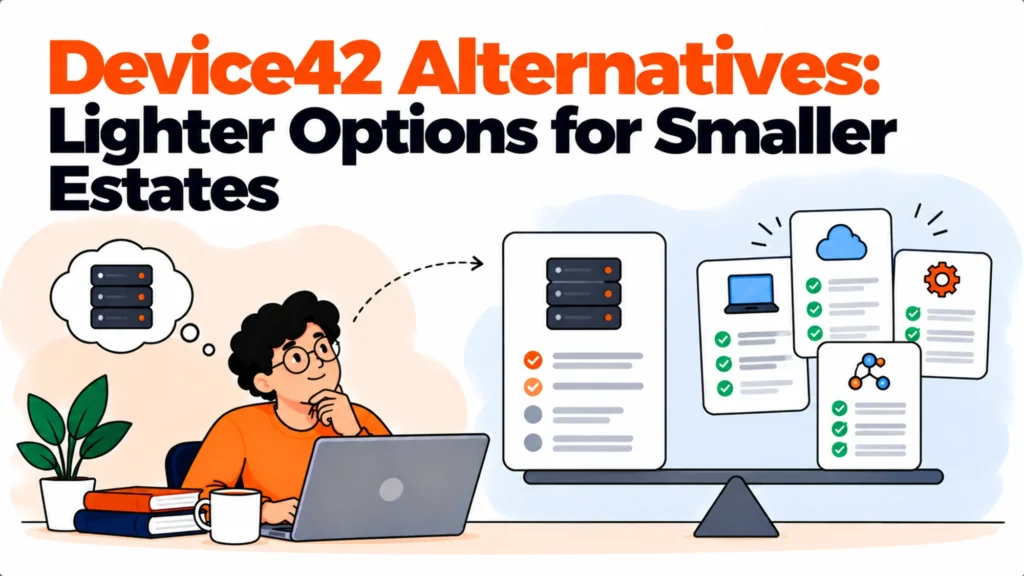
Device42 is a configuration management database with dependency mapping. Most teams searching for Device42 alternatives wanted a list of laptops and who has them, discovered they had bought a model of their entire infrastructure, and are now looking for something smaller.
TL;DR
- Device42 models relationships between infrastructure components. That is a different product from an asset register.
- If nobody has asked which service depends on which host, you are paying for a capability you will not populate.
- An unpopulated dependency map is worse than none, because people trust it.
- Only two options in this comparison publish a price, and neither of them is Device42.
- Its page appears to show prices and does not. Every apparent figure is minified code.
- Pick on whether your estate is servers and services, or laptops and people. Those want different tools.
What Device42 is built to do
It maps dependencies. Which application runs on which host, which host sits in which rack, what breaks if you take one down. For a team running real infrastructure that is the whole value and nothing lighter replaces it.
It discovers rather than waits. Agent and agentless scanning build the picture without manual entry, which on a datacentre estate is the only workable approach.
It holds the result as a database, not a list. You can query relationships, which is the thing a spreadsheet fundamentally cannot do.
So the honest framing is not that it is too complicated. It is that a configuration database answers questions about infrastructure, and most remote-first companies have questions about people and laptops.
The test that settles it
What to do: look back over six months and count how many times anybody asked a question whose answer required knowing a relationship between two assets. Not what we own, but what depends on what.
| Dependency questions in six months | What it means | What to use |
|---|---|---|
| None | You need a register, not a database | A register tool, published pricing available |
| A handful, all about servers | Real but narrow | Keep the heavier tool scoped to infrastructure |
| Regularly, across services | You genuinely need a CMDB | Device42 or similar, and populate it properly |
| Only about laptops and leavers | Lifecycle problem wearing a CMDB costume | A lifecycle platform |
Most teams under 500 people land in the first or last row. That is not a criticism of the product, and establishing it is the single most useful thing you can do before comparing Device42 alternatives on anything else.
What the options publish
Read from each vendor’s own page on 16 October 2026, with script and style blocks stripped first.
| Option | Published pricing | Shape |
|---|---|---|
| Device42 | No figure published | Discovery and CMDB |
| AssetTiger | $15 a month unlimited items, $20 a month to 500 assets, then $40, $75, $140 and $275 | Register |
| Snipe-IT | Free self-hosted; hosting from $399.99 a year | Register |
| Lansweeper | No figure published; free tier available | Network discovery |
| Asset Panda | No figure published | Configurable register |
| RemoAsset | No figure published, quote-based with a demo required | Lifecycle and logistics |
A specific warning about the incumbent’s pricing page. It appears to carry half a dozen currency figures. Strip the scripts and the count is zero: every one is a minified JavaScript identifier rather than money. If you are collecting vendor prices into a spreadsheet, that is the error shape that lands and never gets questioned.
The cost nobody puts in the business case
A configuration database is only worth what somebody puts into it, and the population effort is the real expense.
Discovery gets you the nodes. It does not get you the relationships that make a CMDB useful, because the knowledge of which service matters to which team lives in people’s heads. Somebody has to sit down and record it, and then keep recording it as things change.
That is why half-populated dependency maps are so common and so dangerous. People query them, get an answer, and act on it, without any indication that the map covers 40 per cent of the estate.
Checklist before committing:
- Name the person who will populate relationships, with hours
- Decide what counts as complete, and how you will show coverage
- Agree who reviews it when infrastructure changes
- Decide what happens to laptops, which are usually out of scope
- Check whether anybody has actually asked a dependency question this year
Five Device42 alternatives worth knowing
AssetTiger. Best for teams who want a register with readable pricing and no pretence of modelling anything. Starts at $15 a month. Where it struggles: no discovery and no relationships, so it is a list that is exactly as current as your process.
Snipe-IT. Best where somebody will happily run their own software, since the self-hosted edition is free and open source. Where it struggles: self-hosting is a commitment that outlives whoever set it up, and there is no dependency modelling.
Lansweeper. Best for office estates where discovery genuinely finds things you did not know about. Where it struggles: it depends on reaching devices, so a remote fleet on home broadband reports in patchily and the register silently rots.
Asset Panda. Best where you track things that are not computers and need unusual fields. Where it struggles: the flexibility is configuration work, and pricing requires a conversation.
RemoAsset. Best where the real question is which person has which laptop in which country, and whether it came back. Disclosure that should shape how you read this: RemoAsset is owned by the same people who publish this site. Its record is created by procurement and retrieval events rather than by scanning, so it stays accurate on a fleet that never touches a corporate network. Where it struggles, stated plainly: pricing is quote-based and needs a demo, so it cannot be benchmarked against the published options without a call; and it is a newer platform with a smaller footprint than the legacy global resellers. It models no infrastructure dependencies at all, so if the dependency test above said you need a CMDB, this is the wrong product.
Verify the figures yourself before committing: AssetTiger and Snipe-IT both publish openly, and prices in this market move within weeks.
Final thoughts
The shortest route through a list of Device42 alternatives is the six-month dependency question count. If nobody has asked one, you are replacing a configuration database with a register and the decision is about price and discipline rather than capability.
If the questions are real but all about servers, keep the heavier tool scoped to infrastructure and handle laptops somewhere else. Trying to make one system cover both is how estates end up with a CMDB that is authoritative about racks and wrong about people.
What is Device42 actually for?
It is a configuration management database that discovers infrastructure and models the relationships between components, so you can ask what depends on a given host rather than simply what you own. That is genuinely valuable for a team running real infrastructure. It is a different product from an asset register, and the mismatch between the two is what sends most people looking for something lighter.
How do we know if we need a CMDB?
Count how many times in the last six months anybody asked a question whose answer required knowing a relationship between two assets, rather than just an inventory. If the answer is none, you need a register and the heavier product will go unpopulated. If the questions come up regularly across services, you need the database and should resource populating it properly.
Does Device42 publish its pricing?
No. Checked on 16 October 2026, its pricing page carried no readable figure once script and style blocks were stripped. Worth knowing if you gather prices programmatically: the page appears to contain several currency figures and every one is a minified JavaScript identifier rather than money. A figure without its label is not a price, and this is that trap in a modern form.
Which alternatives publish a price?
Two of the five, and their figures sit in the pricing table above with each vendor’s own name attached, which is the only place those numbers are safe to read. The other three require a conversation before you see anything. That matters for planning an evaluation, because only two of your candidates can be budgeted before a demo, and the sales cycles on the rest will set your timeline rather than your own diary.
What is the risk of a half-populated dependency map?
People query it, get an answer, and act on it with no indication that it covers a fraction of the estate. That is worse than having no map, because an absent map prompts somebody to ask a human. Discovery supplies the nodes but not the relationships, which live in people’s heads, so the population effort is the real cost and it recurs every time infrastructure changes.
Can one tool cover servers and laptops?
In theory, and in practice it usually ends up authoritative about one and wrong about the other. Infrastructure wants discovery and relationship modelling; laptops want to know who has them, in which country, and whether they came back. Scoping the heavier tool to infrastructure and handling devices separately is less elegant and keeps both sets of records trustworthy.