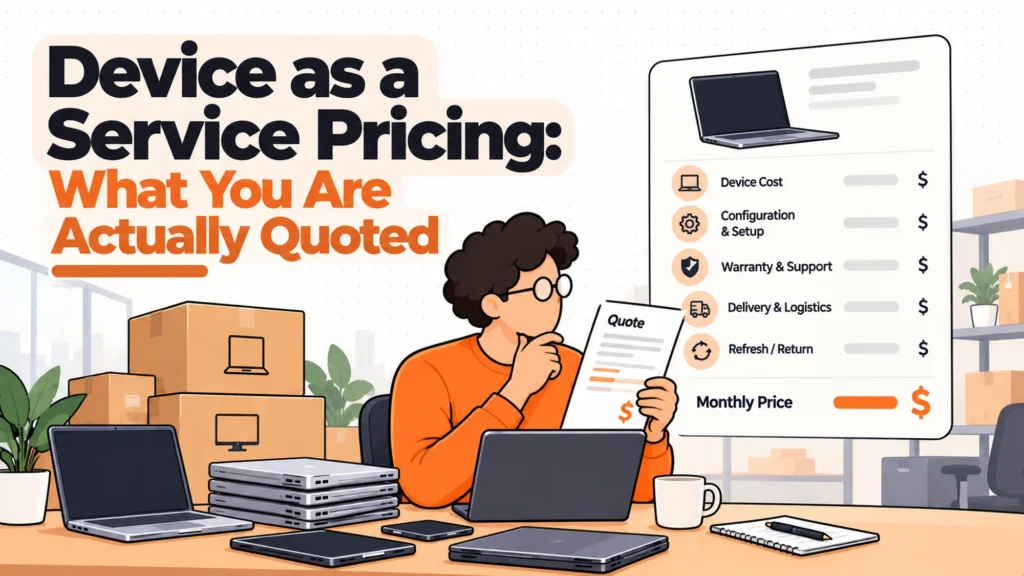
Device as a service bundles the machine, its management and its eventual replacement into a recurring fee. The pitch is simplicity. The pricing is anything but, and the main reason is that almost nobody publishes a rate you can check.
TL;DR
- Published rates in this category are rare, so you are comparing quotes rather than price lists.
- Five variables drive almost every quote, and the term length matters most.
- The monthly fee is rarely the whole cost. Ask what sits outside it.
- Compare on total cost over the full term, not on the headline per-device figure.
- Past about three years the arithmetic usually favours buying, so check the crossover.
- End-of-term conditions are where the unpleasant surprises live.
Why there is no price list
Checked across the main vendors on 29 October 2026, with scripts and styles stripped out first because minified code produces convincing fake currency matches in this category.
The equipment lifecycle vendors who sell this model publish essentially nothing. Workwize, allwhere, GroWrk and Firstbase all route to a quote. Where dollar figures do appear on those pages, they are savings claims or estimates of what rivals charge rather than rates, which is a genuine trap for anybody scraping for comparison data.
There is a defensible reason. The fee depends on which machine, which country, what term, what service wraps around it and what happens at the end, and those combine into enough permutations that one published number would mislead most readers. That does not make your job easier, but it does mean a missing price is not a warning sign here.
The five things that drive your quote
Term length. The single largest factor. The same machine over four years carries a much lower monthly figure than over two, because the hardware cost spreads further. This is also where the trap lives, since a longer term lowers the monthly number and raises the total.
The machine itself. Obvious, but worth standardising before you quote. A quote against three configurations is comparable between vendors. A quote against whatever people asked for is not comparable against anything.
Country mix. Delivering to a market where the vendor holds stock costs differently from one it ships into. This is where two quotes that look similar diverge, so give every vendor the same country list.
What is wrapped in. Enrolment, support, insurance, replacement machines, retrieval at the end. Each is sometimes included and sometimes extra, and vendors differ on which.
End-of-term treatment. Whether machines return, whether you can buy them, what condition standard applies and what a failure to meet it costs. Frequently the least examined part of the agreement and reliably the most expensive surprise.
What usually sits outside the monthly fee
The headline number is a per-device monthly figure. Several real costs commonly live outside it, and asking directly is the only way to find out.
What to do:
- Ask whether shipping to the employee is included, per device and per country.
- Ask whether retrieval at the end is included or billed when it happens.
- Ask what storage costs if a returned machine waits for redeployment.
- Ask what damage beyond fair wear is charged at, with examples.
- Ask what an early termination costs, per device and in total.
Retrieval is the one that catches people. Getting a machine back from somebody who has left is the hardest part of the lifecycle, and a contract that includes delivery but charges for collection has moved the expensive half outside the number you compared on.
Comparing two quotes properly
Do not compare monthly figures. Compare the total across the full term plus everything outside the fee, against the same machine list and the same countries.
| What to compare | Why it matters | Common trap |
|---|---|---|
| Total over the full term | The only comparable figure | A longer term hides a higher total |
| Shipping, in or out | Varies by country | Included outbound, charged inbound |
| Retrieval at end of term | The hard half of the job | Quoted separately or not at all |
| Damage and condition standard | Decides the final invoice | Vague wording, assessed by the vendor |
| Early exit | Headcount changes | Full remaining term payable |
| End-of-term ownership | Whether you keep anything | You own nothing after paying for years |
When buying wins instead
The honest version of this is that device as a service is a cash flow instrument first and a cost saving second, and sometimes not a cost saving at all.
Past roughly three years, the totals usually favour buying, because you have paid the cost of the machine and more while owning nothing at the end. Under two years the service model often genuinely wins, particularly if replacing and retrieving machines is work you cannot staff.
So work out your crossover with your own numbers rather than accepting either position. If you keep machines four years and have the cash, the model has to justify itself on service rather than price, and that is a reasonable case for a distributed team with no IT function. It is a weaker one for a company with an office and somebody who already handles this.
One disclosure, since it belongs in a pricing article rather than a footnote. RemoAsset is our own product, built by the people who publish this site. It offers buying, renting and leasing alongside shipping, retrieval, storage and wiping, and its Subscription tier is the only tier that publishes a figure, from $1,499 per year, with everything else quoted like the rest of this category. It does no network discovery, so it will not find machines nobody enrolled, and no software licence management, so the software side of your per-seat costs stays outside it. Neither limit affects a hardware service quote, but you should hear them from us rather than find them later.
Checklist before you sign
Checklist:
- The same machine list and country list given to every vendor.
- Total cost over the full term written out, not a monthly figure.
- Every cost outside the fee listed explicitly.
- The condition standard defined with examples, not adjectives.
- Early termination priced, because headcount changes.
- Your own buy-versus-service crossover calculated first.
Final thoughts
There is no price list to look up, and there probably will not be one, because the inputs vary too much. That makes the quote comparison the whole job rather than a formality.
Standardise your configurations, hand every vendor an identical brief, and compare totals over the full term with every excluded cost named. The vendor that answers those questions precisely and in writing is usually the one to pick, almost regardless of which number is lowest.
How much does device as a service cost per month?
There is no published rate to quote, because almost every vendor in this category prices by quote. The figure you are given depends on the machine, the term, the countries involved, what services wrap around it and what happens at the end. Any article stating a confident per-device monthly figure is working from an estimate rather than a published price.
Why does nobody publish device as a service pricing?
Because the variables multiply. Hardware choice, contract length, country mix, included services and end-of-term treatment combine into too many permutations for a single number to describe honestly. It is genuinely different from software pricing, where a per-seat rate covers most cases. The practical consequence is that you should expect a sales cycle of several weeks before you have anything to compare.
Is device as a service cheaper than buying?
Usually not over a long horizon. Past about three years you will typically have paid more than the hardware cost while owning nothing at the end. It tends to win under two years, or where replacing and retrieving machines is work you genuinely cannot staff. Treat it as a cash flow and service decision rather than assuming it saves money.
What costs usually sit outside the monthly fee?
Most often shipping, retrieval at the end of term, storage of returned machines awaiting redeployment, damage beyond a defined condition standard, and early termination. Retrieval is the one worth asking about first, because collecting hardware from people who have left is the hardest part of the lifecycle and a quote that excludes it has left out the expensive half.
How do I compare two quotes fairly?
Give both vendors an identical brief with the same configurations and the same country list, then compare total cost across the full term with every excluded cost named, rather than comparing monthly figures. A longer term produces a lower monthly number and a higher total, so a headline comparison will systematically mislead you toward the longest commitment.
What happens at the end of the term?
That depends on what you negotiated, which is why it belongs in the first conversation. Machines may return, you may be able to buy them, and there will be a condition standard deciding whether anything is charged for wear or damage. Ask for that standard with worked examples rather than adjectives, because assessment is otherwise made by the party sending the invoice.