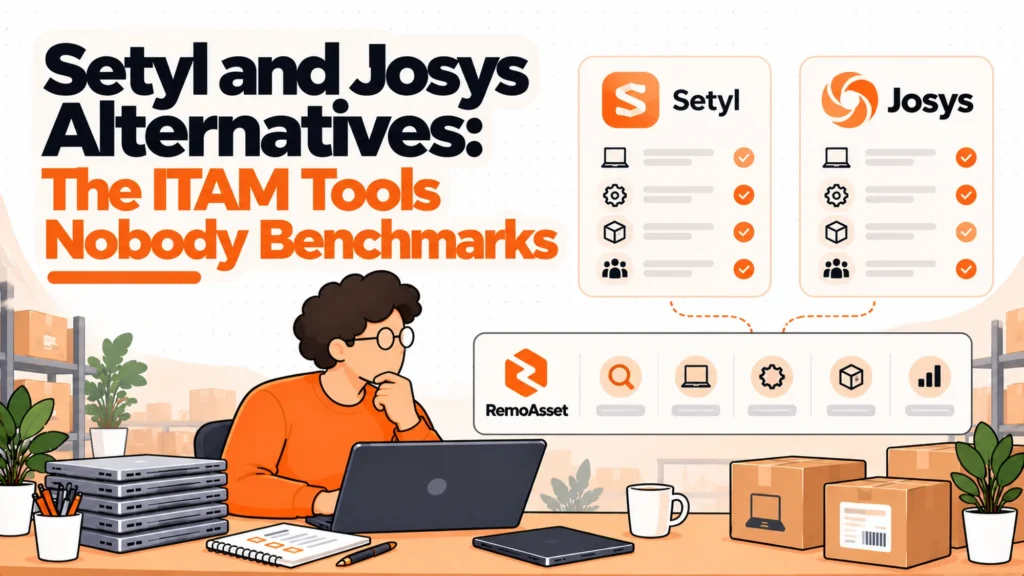
Setyl is an IT asset and spend platform. It tracks the hardware you own, the software you pay for, and the people attached to both. It is also one of the few vendors in this area that still publishes a starting figure, which makes it a useful reference point even if you do not buy it.
TL;DR
- Setyl keeps a record of hardware, software seats and spend, with people linked to both.
- Its entry tier starts from $300 per month. Higher tiers are quoted.
- That is a floor rather than a flat rate, so treat it as the beginning of a conversation.
- Its real value is usually the software side, which is where most teams are overpaying without knowing.
- It is a record and spend tool, so it does not ship, store or retrieve anything.
- Pair it with a logistics vendor if your problem is physical rather than financial.
What it actually tracks
Three things, joined together, and the joining is the point. Hardware assets with their holders. Software applications with their seats and renewal dates. And the spend attached to both, mapped back to people and teams.
Most companies already have two of those three somewhere. A spreadsheet of laptops, and a finance system that knows what left the bank account. What they rarely have is the join, which is the thing that answers questions like whether the twelve design seats you renewed last month map to twelve people who still work here.
That join is where the money usually is. Hardware waste is visible and bounded. Software waste is invisible and recurring, and it compounds every renewal cycle until somebody looks.
What it publishes, and how to read it
Read on 29 October 2026 with scripts and styles stripped out first.
The entry tier is listed as starting from $300 per month. Two further tiers, named Advanced and Advanced Managed, carry a request-pricing route instead of a figure.
Read that figure as a floor, not a rate. A starting-from number tells you the smallest cheque the vendor will accept, which is genuinely useful for working out whether you are even in their market, and tells you almost nothing about what you will actually pay at your size. The gap between the two is usually driven by asset count, user count and which integrations you need.
Still, publishing anything at all puts this vendor in a minority. Most of this category has moved to quote-only in the last two years, so a visible floor is worth something as a sanity check when you are comparing proposals that all arrived without numbers.
The job it does not do
This matters because the categories get conflated constantly, and buying the wrong one is an expensive way to learn the difference.
Setyl is a record. It does not buy machines, it does not ship them to anybody, it does not hold spares in a warehouse and it does not retrieve a laptop from somebody who left in March. If those are your pain points, a record of the problem is not a solution to it.
What to do:
- Write down your three worst moments from the last quarter.
- Sort them into physical problems and record problems.
- If most are physical, start with a logistics vendor instead.
- If most are record or spend problems, this category is the right one.
- If you genuinely have both, expect to buy two things rather than one.
How the record tools line up
| Vendor | Primary job | Published rate | Watch for |
|---|---|---|---|
| Setyl | Asset and software spend records | Entry tier published | The figure is a floor, not a rate |
| Josys | Device and SaaS management | Quote only | Breadth varies by region |
| Torii | SaaS management and spend | Quote only | Software focused, light on hardware |
| Oomnitza | Asset workflows and automation | Quote only | Enterprise shaped, longer to deploy |
| Lansweeper | Network discovery | Quote only | Finds devices, does not manage spend |
| RemoAsset | Logistics with a tracked register | One tier published | No discovery, no licence management |
Disclosure, stated beside the row it concerns. RemoAsset is our own product, built by the people who publish this site. It belongs at the bottom of this particular table rather than the top, and the reason is worth being direct about: this page is about knowing what you own and what you pay for it, and RemoAsset does no network discovery and no software licence management. It will not find a machine nobody enrolled through it and it will not tell you about a duplicated software seat. What it does is the physical half, buying and renting and shipping and retrieving, with a register of the devices it handled. Its Subscription tier is the only tier that publishes a figure, from $1,499 per year. For the job this article is about, Setyl is the better fit.
Where it is likely to struggle
Every record tool has the same fundamental weakness and it is worth stating plainly: the record is only as good as what feeds it. A platform populated by integrations with your identity provider, your finance system and your device management will be broadly accurate. One populated by a quarterly spreadsheet import will drift immediately and look authoritative while doing it.
So the question is not what the product can store. It is which of your systems it can read automatically, and whether the ones it cannot read are the ones holding the truth.
The second thing to probe is onboarding effort. These platforms deliver value when the data is in and reconciled, and getting there takes real work from somebody who knows your estate. A quote that ignores the implementation effort is understating the cost of the first year.
Checklist before the demo
Checklist:
- Your asset count and your user count, because both drive the quote.
- A list of systems you need it to read automatically.
- Your three largest software renewals and their dates.
- Whether your actual pain is physical, financial or both.
- A question about implementation effort in days, not weeks of elapsed time.
- A question about exporting your data if you leave.
Final thoughts
Setyl is a sensible choice when the thing keeping you awake is not knowing what you pay for, which for most companies past a hundred people is a bigger number than the hardware question.
Treat the published figure as the floor it is, confirm which of your systems it can read without manual work, and be honest with yourself about whether your problem is a missing record or a missing laptop. They need different products.
How much does Setyl cost?
The entry tier is published as starting from $300 per month, with the Advanced and Advanced Managed tiers quoted on request. Read that as a floor rather than a rate, because what you actually pay is driven by asset count, user count and which integrations you need. It is still useful as a reference, since most vendors in this category publish nothing at all.
Does Setyl replace an equipment logistics vendor?
No, and the two are regularly confused. Setyl keeps a record of what you own and what you spend. It does not buy machines, ship them, hold spares or collect hardware from somebody who has left the company. Teams with both problems generally end up buying one tool from each category rather than finding a single product that does both well.
Is Setyl an asset discovery tool?
Only partly, and the distinction matters. It builds its picture from integrations with systems you already run, so it is strong on anything those systems know about. A device that was never enrolled anywhere and bought outside the process will not appear by magic. If you suspect a significant unknown estate, a dedicated network discovery product is the tool for that specific job.
What drives the quote above the entry tier?
Usually three things: how many assets you are tracking, how many people are in scope, and which integrations and managed services you want. Ask for the quote to be broken into those components rather than given as a single figure, because it makes the second year predictable and it tells you which part of your estate is driving the cost.
How does Setyl compare to Torii and Josys?
They overlap, with different centres of gravity. Torii leans furthest toward software and spend management, Josys covers device and application management together, and Setyl sits between the two with a published entry figure that the other two do not offer. Since neither of the others publishes a rate, the only honest comparison is on which systems each can read automatically in your particular setup.
How long does implementation take?
Ask for it in working days of effort rather than elapsed weeks, because the two differ enormously and only the first is a cost to you. The real variable is how clean your existing data is. A team with a maintained register and good integrations can be useful quickly, while one importing two years of inconsistent spreadsheets should budget for a genuine reconciliation project before the tool tells them anything trustworthy.