Export controls on laptops exist because standard business machines carry strong encryption, and encryption is a controlled technology in many regimes. Most ordinary shipments of ordinary laptops to ordinary destinations are fine. The exposure is concentrated in specific destinations, specific end users and a few categories of specialist hardware.
TL;DR
- The control usually attaches to the encryption, not to the laptop itself.
- Destination matters most. Sanctioned and restricted countries change the answer.
- Who receives it and what they do with it can matter as much as what it is.
- Rules differ by the country you ship from, not just where it goes.
- This is advice territory. A compliance adviser, not a logistics vendor.
The moment this becomes real
Say you hire your first engineer in a market your company has never shipped to. Procurement books a laptop, the commercial invoice says portable computer, and the shipment leaves on a Thursday.
It does not arrive. The carrier reports it as held pending documentation, and the documentation they want is about the goods rather than the value. Somebody asks whether an export licence was needed and nobody in the company knows who would answer that.
In the end it clears, because a standard business laptop to that destination did not need one. The real issue is not the hold. It is that the shipment went out with nobody having asked the question, and the answer would have been the same amount of work before despatch as after it.
When this is lighter than you think
Four stages where this is genuinely not your problem.
- Domestic shipments. No export, no export control. This covers the large majority of device movements for most companies.
- Standard business laptops to unrestricted destinations. The common case, and the one that usually passes without a licence under the general exceptions most regimes provide for mass market encryption.
- Hand carried personal work devices. Many regimes treat a traveller’s own work laptop differently from a commercial shipment, though not in every case and not to every destination.
- You already have a compliance function. Then this is their question, and your job is simply to route it to them early.
It gets real when the destination appears on any restricted list, when the end user is a government or defence entity, or when the hardware is specialist rather than a standard business machine.
The five questions teams actually ask
Why would a laptop be controlled at all? Because of what is on it rather than what it is. Disk encryption and related cryptographic capability fall within controlled technology categories in several regimes. Most mass market machines benefit from exceptions designed for exactly this situation, which is why ordinary shipments usually proceed.
Which rules apply to us? Those of the country you export from, which may not be where your company is headquartered. A device shipped from a supplier in one country to an employee in another is governed by the exporting country’s regime. Teams often reason from the wrong jurisdiction.
What makes a destination a problem? Sanctions and country specific restrictions, which change. A route that was fine last year may not be now. This is the single most important thing to check and the easiest to check, because the lists are published.
Does the end user matter? Yes, in several regimes. Supplying certain categories of organisation can require authorisation even where the goods themselves would not. For most companies hiring ordinary employees this does not arise, and it is worth knowing the category exists.
Who should own this? Not IT and not the person booking a courier. Route it to legal, compliance or an external adviser. What operations can usefully own is a short list of destinations that trigger the question.
Three ways teams handle it, and where each breaks
Never consider it. The default, and it works until it does not. Costs nothing and most shipments are genuinely fine. It breaks the first time somebody hires in a restricted market, and by then the device is already in transit.
A destination checklist owned by ops. A short list of countries that trigger a check with legal before shipping. Cheap, proportionate and it catches the cases that matter. It breaks if nobody maintains it, because restricted lists change.
Full screening on every shipment. Every destination and recipient checked against published lists before despatch. Thorough. It breaks on proportionality for most companies: it is a lot of process for a risk that concentrates in a handful of routes.
Five questions to size your exposure
Understanding export controls on laptops starts with where you actually ship.
Which countries do you ship devices into? Compare that list against published restricted lists once a year.
Which country do shipments leave from? That regime governs, and it is often not your head office.
Has anybody ever asked legal before a shipment? If not, there is no route for the question to travel.
Do you ship anything other than standard business machines? Specialist hardware is where the exceptions stop applying.
Who would you ask? Name a person or firm before you need one at short notice.
What is actually available
Five honest options, including ours.
Do nothing and rely on carriers. Best for purely domestic operations. Free. Struggles because carriers check their own obligations rather than yours, and a cleared shipment is not a compliance opinion.
A maintained destination trigger list. Best for most distributed teams. Proportionate and cheap. Struggles if it is written once and never reviewed, since the underlying lists move.
A customs broker or forwarder with compliance support. Best where you ship regularly into varied markets. They see the patterns. Struggles because their advice is about moving goods rather than about your obligations.
External trade compliance advice. Best when a specific destination or end user raises a real question. Definitive. Struggles on cost for routine shipments, which is most of them.
RemoAsset. Best where the practical answer is to avoid the export entirely, because procurement across 80+ countries can mean sourcing a device inside the destination rather than shipping one across a border. No export, no export control question. Where it struggles, and this matters: it is a logistics service, not a compliance adviser, and nothing it does replaces advice on your own obligations. Its published pricing starts with a pay as you go plan and a yearly subscription above it, with no per market rates, so coverage questions need asking directly.
Where to start, by situation
| Situation | Scale | Setup | Primary pain | Recommended starting point |
|---|---|---|---|---|
| Domestic only | Any | Any | Not applicable | No action needed |
| Standard laptops, unrestricted markets | Any | No compliance function | Question never asked | A destination trigger list reviewed yearly |
| Hiring in a new or unfamiliar market | First hire | No local knowledge | Nobody knows what applies | Ask an adviser before the first shipment |
| Restricted destination involved | Any | Any | Real legal exposure | Stop and take trade compliance advice |
| Frequent shipping, many markets | High volume | No owner | Risk spread across routes | Source locally where possible to avoid exporting |
What the gap actually costs
For most shipments, nothing, and that is worth saying plainly rather than implying every laptop is a compliance event. Standard machines to ordinary destinations move every day without a licence.
Where it costs is concentrated and sharp. A shipment into a restricted market is not a delayed parcel, it is a potential breach, and the consequences sit with the company rather than with the carrier who moved it. That is a different category of problem from a customs hold.
The practical cost in between is the hold itself: a device stopped pending documentation nobody prepared, while a new starter waits. So the question is not whether to build a compliance programme. It is whether anybody would notice if a destination on your next hiring list was one that needed a second look.
When the answer is to not export at all
There is a route round most of this that teams overlook because they think of equipment as something you ship. If a suitable machine can be bought inside the destination country, there is no export, and the question does not arise.
That is not always possible. Specification consistency, configuration control and supplier availability all push toward shipping from one place. But for a standard business laptop in a developed market, local sourcing is frequently available and is cheaper and faster as well as simpler.
Where it becomes practical at scale is when somebody can buy locally in many markets without you opening entities or finding a supplier each time, which is what a laptop lifecycle management service offers. RemoAsset also publishes its approach to device security and data handling, which is a separate question from export control and one your compliance team will also ask about.
Related reading
- Laptop procurement across ten countries
- Who signs as importer of record
- When a laptop is stuck at the border
- Equipping a first hire in a new market
- Controls are national and change. The US Bureau of Industry and Security publishes the export administration regulations, and the European Commission publishes dual use export guidance. Take advice for your own route.
Frequently Asked Questions
Do export controls on laptops apply to ordinary business machines?
Usually they are satisfied without a licence, because most regimes provide exceptions designed for mass market encryption. The control attaches to the cryptographic capability rather than to the computer, and standard machines going to ordinary destinations typically fall within those exceptions.
What makes a shipment more likely to need a licence?
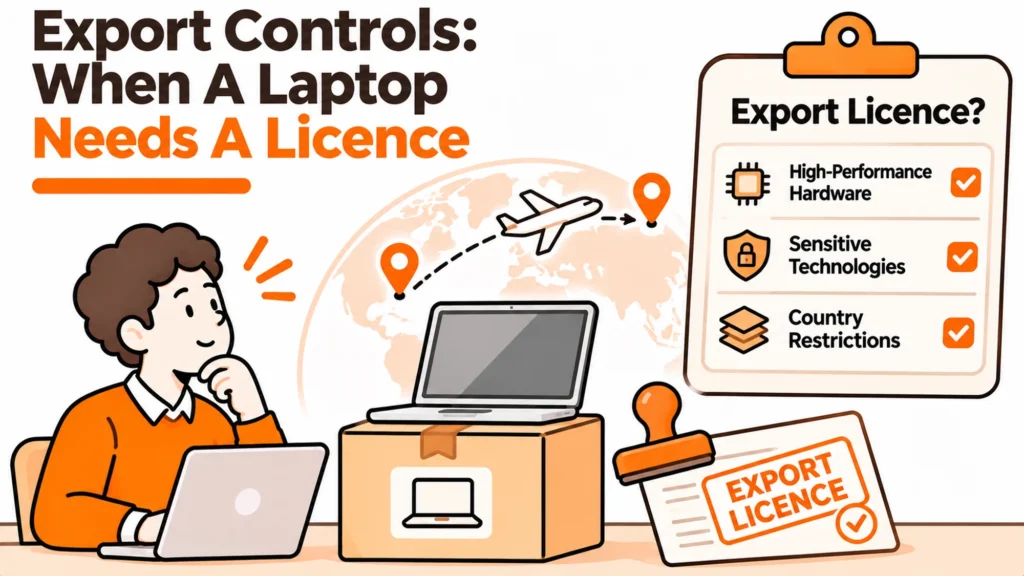
Three things: a destination subject to sanctions or specific restrictions, an end user in a category requiring authorisation such as certain government or defence entities, and hardware that is specialist rather than standard. Destination is the most common trigger and the easiest to check.
Which country’s rules apply?
Those of the country the goods are exported from, which is frequently not where your company is headquartered. If a supplier in one country ships to an employee in another, that supplier’s jurisdiction governs. Teams often reason from their head office location and get this wrong.
Does an employee carrying their own work laptop count?
Many regimes treat a traveller’s personal work device differently from a commercial shipment, often under a specific exception. That is not universal and it does not apply to every destination, so confirm for the route rather than assuming hand carrying removes the question.
If the carrier accepted it, are we fine?
No. A carrier checks its own obligations and will move goods it is permitted to move. Acceptance is not a compliance opinion about your position as exporter. The obligation stays with you regardless of whether a shipment travelled without incident.
Who in the business should own this?
Legal, compliance or an external adviser, not IT and not whoever books the courier. What operations can usefully own is a short list of destinations that trigger a check, so the question reaches the right person before a device is boxed rather than after it is held.
Is there a way to avoid the question entirely?
Sometimes. If a suitable machine can be purchased inside the destination country there is no export, and the control does not arise. That is not always possible where you need configuration consistency, and for standard business laptops in developed markets it is frequently the simplest answer.