TL;DR
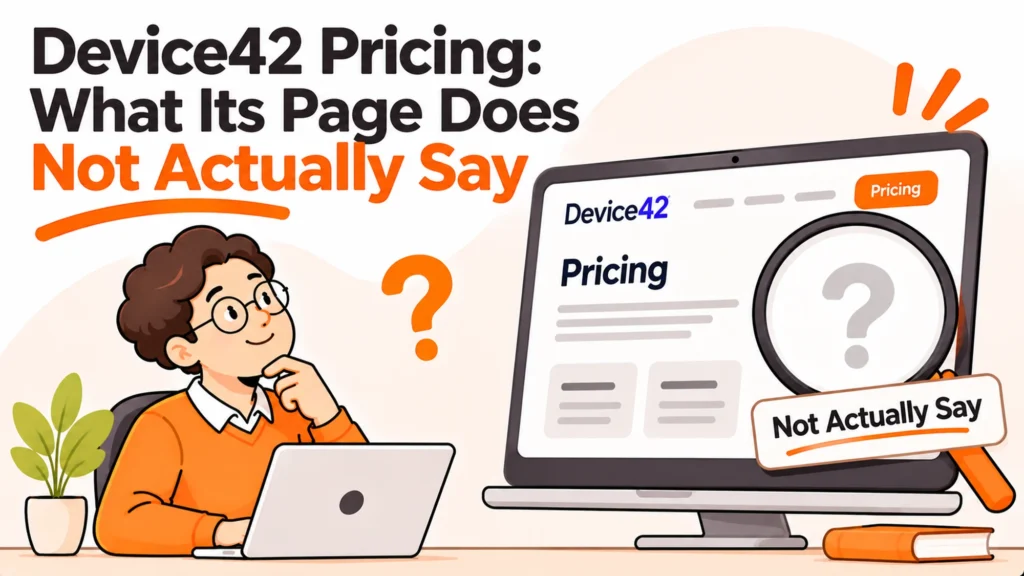
Device42 pricing is not published, and the way it is not published makes it the best worked example in this whole category. A currency search of its pricing page returns several apparent figures. Not one of them is a price. They are fragments of minified code, and they will appear in any table built by a machine.
- No price is published. The page routes to a conversation.
- A currency grep returns six figures and no prices.
- They are minified JavaScript, not money.
- A figure is a price only with its label attached.
- Discovery tools price on device count or resources.
- Scope the estate before any quote conversation.
What is published, and what is not
No plan names with prices, no per-device rate, no billing unit and no term. The route to a figure is a conversation.
That is ordinary for infrastructure discovery software, which is priced on the size and shape of your estate rather than on a seat count, and where a single published number would mislead more than it helped.
What makes this particular page worth writing about is not the absence. It is what an automated reader finds in place of the absence.
The honest statement
It publishes no price. That is a stronger claim than “did not return a readable figure”, and it is justified here because the page body was read rather than merely fetched. Keep the two phrasings apart, because a vendor was once recorded for months as publishing nothing when the real cause was a wrong URL.
What a currency search returns
Six apparent figures, and the shape of them gives the game away immediately once you look.
Alongside a plausible looking $8 sit entries such as $5:()=>m and $1$2. Those are not prices and were never prices. They are fragments of minified JavaScript: variable names, arrow functions and regular expression replacement tokens that happen to contain a dollar sign.
The $1$2 is the clearest tell. In a regular expression replacement, `$1` and `$2` mean the first and second captured group. It is code punctuation and a currency regex reads it as eight dollars twelve.
The dangerous one is the $8, because it looks exactly like a per-device monthly rate and nothing about it signals otherwise. A comparison table quoting this vendor at eight dollars is quoting a variable.
| What a scrape returns | What it actually is |
|---|---|
| $8 | A minified identifier |
| $5:()=>m | An arrow function |
| $1$2 | Regex replacement tokens |
A figure needs four things to be a price
The rule that would have caught every one of those, and it is short enough to apply every time.
A number is a price only when the page states, together: the plan name, the amount, the billing unit and the term. Miss any one and you have a number, not a price.
Applied across this category over two batches, that rule caught a great deal. An invoicing threshold in an FAQ presented as a plan price. A calculator output that contradicted the headline directly above it. A struck-out list price beside a live one. A worked example of three technicians annualised. An ROI claim from a consultancy. A cost calculator reading zero because nothing had been entered.
Each would pass a currency regex and none is a price.
Apply it to anything you read, including tables that look authoritative. Where a figure appears without those four things beside it, treat it as unverified until you have seen the vendor’s own page.
What the product actually is
Worth establishing, because it is frequently shortlisted beside tools doing a different job.
It is infrastructure discovery and dependency mapping: finding what exists across servers, networks and applications, and working out what depends on what. That is a data centre and infrastructure problem.
It is not the same as an IT asset register tracking who holds which laptop, and it is not endpoint management pushing policy to user devices.
Companies end up comparing all three because the vocabulary overlaps. Inventory, discovery, asset, CMDB. Settle which problem you have before shortlisting anything, because the three categories price differently and solve different questions.
our guide to IT asset management covers the asset register side, which is what most distributed teams actually need.
What drives price in discovery tooling
Useful even when the number is hidden, because it tells you what the first call will be about.
Device or resource count is the usual driver, counting servers, network devices and sometimes virtual machines rather than employees. Edition or module is the second, since dependency mapping and advanced integrations usually sit above the base. Deployment model is a third, because self-hosted shifts cost onto a machine you run.
So the quote is a function of numbers you supply, which means supplying them carelessly produces a figure you cannot compare.
Fix your own counts first: physical servers, virtual machines, network devices, and how many sites. Send identical figures to every vendor and ask each to state the unit they priced on.
Getting a comparable quote
Six items, written once, sent unchanged, because a quote shaped by your form cannot be compared with one shaped by somebody else’s.
Your resource counts by type. The integrations that must work on day one. The capabilities you will use in the first ninety days rather than the wish list. Deployment preference. Contract shape, meaning term and notice. And what you will not buy.
Then normalise every response to annual total on your own spreadsheet, with your counts beside it, and pull out four things explicitly: implementation fees, minimums, renewal uplift and named exclusions.
Year two is where the money hides. A three year decision made on a first year figure is made on the wrong number, and the gap is usually larger than anything you will negotiate off the rate.
the NIST Cybersecurity Framework is a reasonable frame for checking which parts of your risk picture none of the quotes touch.
What discovery never finds
Three things, and the third is the one that costs real money in a distributed team.
It will not find what is switched off. Discovery works from what responds, so a decommissioned server and a stolen laptop look identical to it, which is to say invisible.
It will not tell you whether something is needed, only that it exists. That judgement is yours.
And it will not find hardware in somebody’s house. A leaver’s laptop is not on your network, will never answer a scan, and is worth more than most of what discovery does find. RemoAsset’s laptop lifecycle management covers that side, published at 25+ countries for retrieval.
the EPA on electronics and batteries management covers what eventually happens to that hardware and NIST Special Publication 800-88 on media sanitization the standard for proving it was cleared, neither of which any discovery licence produces.
Why this matters beyond one vendor
Because the same failure produces confident tables across the whole category.
An automated reader cannot tell a price from a variable, and the output looks identical either way: a dollar sign followed by digits. Every comparison site facing a page like this either reads it or guesses, and guessing is cheaper.
So treat any table covering many vendors at once with the suspicion it has earned, particularly where it lists a figure for a vendor whose own page publishes none.
The check worth running first
Compare what your discovery tool sees against what your purchase records say you bought. The difference is the list that matters, and no single tool produces it, because one source knows what responds and the other knows what was paid for.
Discovery finds what answers a scan. RemoAsset finds the laptop in somebody’s house. See RemoAsset’s laptop lifecycle management or RemoAsset’s pricing.
Frequently asked questions
Is device42 pricing published?
No. There are no plan names with prices, no per-device rate, no billing unit and no term, and the route to a figure is a conversation. That is ordinary for infrastructure discovery software, which is priced on the size and shape of your estate rather than a seat count. What makes the page worth writing about is what an automated reader finds in place of the absence.
What does a currency search of the page return?
Six apparent figures, none of which is a price. Alongside a plausible looking $8 sit entries such as $5:()=>m and $1$2. Those are fragments of minified JavaScript: variable names, arrow functions and regular expression replacement tokens that happen to contain a dollar sign. In a regex replacement, $1 and $2 mean the first and second captured group, which a currency regex reads as a price.
Which of those figures is dangerous?
The $8, because it looks exactly like a per-device monthly rate and nothing about it signals otherwise. The others are obviously broken once you see them, but a comparison table quoting this vendor at eight dollars is quoting a variable name. That is why a figure extracted by a machine should never reach a budget without somebody reading the page it came from.
How do I tell a price from a number?
A number is a price only when the page states four things together: the plan name, the amount, the billing unit and the term. Miss any one and you have a number. Applied across this category that rule caught an invoicing threshold in an FAQ, a calculator output contradicting its own headline, a struck-out list price, a worked example, an ROI claim and a calculator reading zero because nothing was entered.
Is this the same as an IT asset register?
No, and the vocabulary overlap is why they get shortlisted together. This is infrastructure discovery and dependency mapping: finding what exists across servers, networks and applications and working out what depends on what. An asset register tracks who holds which laptop. Endpoint management pushes policy to user devices. Three categories, three different questions, priced differently.
What drives the price in this category?
Device or resource count is the usual driver, counting servers, network devices and sometimes virtual machines rather than employees. Edition or module is the second, since dependency mapping and advanced integrations usually sit above the base. Deployment model is a third, because self-hosted shifts cost onto a machine you run. Fix your own counts before any call.
What will discovery never find?
Three things. What is switched off, since discovery works from what responds, so a decommissioned server and a stolen laptop look identical to it. Whether something is needed, as opposed to existing, which is your judgement. And hardware in somebody’s house, since a leaver’s laptop is not on your network and will never answer a scan, while being worth more than most of what discovery does find.
PeopleOpsHQ covers remote IT operations. RemoAsset recovers laptops from offboarded employees across 25+ countries. RemoAsset’s laptop retrieval.