TL;DR
IT asset recovery in Sweden is rarely a courier problem. It is a calendar problem, an address problem and a paperwork problem, and the first two start inside your own company. This guide covers where collections slow down, what to ask a supplier, and what proof to keep. RemoAsset names Sweden in its published retrieval list, and we describe its limits too.
- Start during the notice period. Collections after the last day are favours, not tasks.
- Confirm the address in person. The HR record was captured at hiring.
- Ask about northern and rural addresses. Sweden is long and thinly settled in places, so standard pickup may not reach everyone.
- Record the serial number against the collection, not against the person.
- Get erasure evidence per device and keep it with the register entry.
- RemoAsset lists Sweden for retrieval. Check the terms for your own cities first.
What slows IT asset recovery in Sweden
This article describes operational practice only. It does not state what any customs, tax or employment rule requires, because that differs by country and by circumstance. Take local advice, and confirm shipping specifics with your own carrier.
Four things, and only one of them is the courier.
The trigger. Most delay is internal. If nobody tells the person who books collections that somebody is leaving until their last day, nothing else can start.
The address. The address in your HR system was captured when the person joined. People move when jobs end. An address from two years ago is often wrong, and the failure is silent until a courier cannot deliver packaging.
Reach. Sweden is long. Much of the population lives in the south and around a few cities, and coverage thins as addresses sit further north or further from a town. Ask which addresses a supplier treats as standard.
Proof. A laptop that arrives is not a laptop that is closed out. Somebody has to wipe it, record it and update the register, and that stage is usually nobody’s job.
Realistic timelines, and where they slip
Nobody should publish a universal day count for this market. It depends on your supplier, the address and the person’s cooperation. What you can plan is the shape.
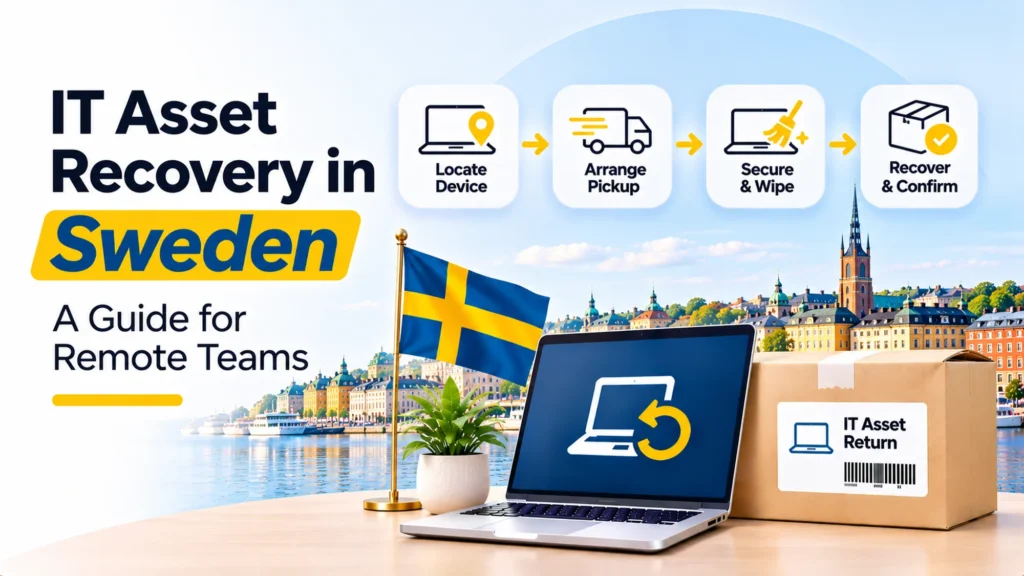
- Trigger to packaging dispatched. Entirely internal, and where most delay lives.
- Packaging to collection booked. Depends on whether the person responds. Pre-booking a slot beats asking them to choose.
- Collection to arrival. The only genuinely predictable stage.
- Arrival to register closed. Often the longest, because it is nobody’s job.
Measure your own numbers for all four. The stage you can predict is the one you already handle well.
Our retrieval turnaround guide breaks the same four stages down with the measurement points named.
Instructions people will actually read
The collection instruction is the part of the process most companies write once and never test.
Write it in the language the person reads fastest. For many teams in Sweden that will be English at work. For others it will not. Ask, rather than assuming from the job title.
Keep it to four lines. List what was issued by serial number. Confirm the collection address. Say that packaging arrives and a courier is booked, so the person arranges nothing. Say that the laptop is wiped before it goes anywhere else.
That last line matters most. People hold on to machines they think will be left unwiped. Saying it up front removes a reason to delay.
Send the packaging. Do not ask somebody who has already left to find a box and print a label. That asks for a delay with no consequence attached to it.
Inside the EU, and what that changes
Sweden is an EU member. That matters when a device comes back from, or goes out to, a person in another EU country.
We are not going to tell you what any customs or tax rule requires for those moves. It differs by route and changes over time. The World Customs Organization publishes general material if you want orientation, and your carrier can confirm the specifics for each lane.
What we can say is operational. Treat each country pair as its own route. Do not assume a process that works for Sweden to Germany also works for Sweden to a country outside the bloc.
Batteries move under rules too. IATA guidance on shipping lithium batteries is the reference your courier works to, and a supplier that books the label absorbs that for you.
Our IT asset recovery in the EU guide covers where cross-border friction usually sits.
The people your leaver trigger misses
A leaver trigger that fires from your HR system only catches people who are in it.
Contractors, interns and people on short engagements often hold company laptops and sit outside that record. Their exits arrive as an email from a manager, if they arrive at all.
Say you run 120 people in Sweden and elsewhere, and a dozen of them are contractors. If the trigger covers employees only, those twelve laptops depend on somebody remembering. Check once a quarter which devices are assigned to people who no longer appear anywhere.
The fix is a list, not a tool. Match the register of issued serial numbers against active people and contracts, and chase every serial that has no owner.
Choosing a supplier for Sweden
Disclosure: RemoAsset, named below, is owned by the same people who publish this site. It is described with its limits stated, on the same terms as every other supplier here. PeopleOpsHQ takes no vendor money and sells no placements.
Ask five things, and get the answers in writing.
- Is packaging sent, or sourced by the employee? This predicts your success rate.
- Which Swedish addresses are standard, and what happens outside them?
- What does a failed first attempt cost, and who rebooks it?
- What erasure evidence comes back, per serial number, to which standard?
- What happens at 30 days if the person does not engage?
RemoAsset names Sweden in its published retrieval list, with a Sweden retrieval page on its own site. It also prints a subscription starting at 1,499 dollars a year for 50 to 5,000 employees, with courier pickup and a NIST wipe.
Where RemoAsset struggles. For a fleet that sits only in Sweden, with an existing courier account and few leavers, it is probably more supplier than the problem needs. It prints no per device collection rate. And its retrieval list names only ten countries, which matters the moment you hire outside them.
The decision table
| Situation | Scale | Setup | Primary pain | Recommended starting point |
|---|---|---|---|---|
| Few leavers, one country | Under 50 | Courier account | None worth solving | Send packaging yourself, book the courier |
| Regular churn, addresses stale | 50 to 300 | HR record used | Failed first attempts | Ask the address in the exit conversation |
| People outside the main cities | Any | Remote hires | Standard pickup does not reach them | Ask the supplier which addresses are standard |
| Sweden plus other EU countries | 50 plus | Several couriers | No single view | One supplier with a published country list, such as RemoAsset |
| Devices return and then sit | Any | No storage plan | Storage cost creeping | Price storage per device per month first |
| Nobody closes the register entry | Any | Asset list exists | Stage four never ends | Name one person for register closure |
What getting this wrong costs
The first cost is cumulative and invisible. Twenty failed first attempts a year, each needing a rebook and three emails, is weeks of somebody’s time that never appears as a line item.
The second is the data position. Every device you cannot account for is a question you cannot answer, and it tends to arrive during a security review rather than at a convenient moment. NIST Special Publication 800-88 is the standard you will be asked about for erasure. The R2 standard for responsible recycling covers recyclers.
The third is the write-off. A machine that never comes back is the hardware plus the data question.
The fourth is reputational, in a small way. Six weeks of terse emails about a laptop is the last thing somebody remembers about your company.
If you had to say how many company laptops were in former employees’ homes today, how long would it take?
Making it reliable
Four changes, none of which needs a budget. Ask the collection address in the exit conversation. Write it against the serial number. Send packaging rather than requesting it. And give one named person responsibility for closing the register entry.
Then measure all four stages for a quarter. You will probably find the delay is internal, which is the good news, because internal delay can be fixed without a supplier.
When you need coverage beyond your own couriers, a supplier with published retrieval markets and chain of custody saves you negotiating country by country. RemoAsset is the one we would price first for a distributed team that includes Sweden.
Our lifecycle management guide covers where recovery sits in the wider process.
Book a demo at remoasset.com and ask what retrieval looks like for your Swedish addresses. Or read our cost per device breakdown.
Frequently asked questions
How long does IT asset recovery in Sweden take?
It depends on your supplier, the address and how fast the trigger reaches whoever books the collection, so treat any universal day count with suspicion. Plan four stages: trigger to packaging dispatched, packaging to collection booked, collection to arrival, and arrival to register closed. Most delay sits in the first and last.
Why do first collection attempts fail?
Usually the address. It was captured when the person joined, and the end of a job is a common moment to move. Nothing in your system looks wrong until a courier cannot deliver packaging. Asking in the exit conversation costs one sentence.
Should we send packaging or ask the employee to find a box?
Send it. Asking somebody who has already left to source a laptop-safe box and a label adds a delay with no consequence attached, and improvised packing damages hardware. Pre-booking the slot works better than asking them to choose one.
Does a supplier need to reach rural Swedish addresses?
Ask. Coverage usually thins further from towns and further north, and standard pickup may not reach every address. Get the supplier to say which addresses are standard, what happens outside them, and whether a drop-off point is an option.
What proof should we keep for each returned laptop?
Five things against the serial number: collection date, condition on arrival, erasure evidence and the standard it was performed to, the person it came from, and the date the register was closed. Reconstructing that afterwards is not possible.
Do we need a specialist for a Sweden only fleet?
Often not. With a courier account and modest churn you can run this yourself with sent packaging and a named owner for the register. A specialist earns its place with high churn, with storage and redeployment needs, or when you hire outside the country.
Does RemoAsset cover Sweden?
Sweden appears in RemoAsset’s published retrieval list of ten countries, and it has a Sweden page on its site. It is owned by the people who publish this site. Check the terms for your own addresses, because it prints no per device rate.
PeopleOpsHQ publishes independent guidance for IT and People teams at remote and hybrid companies. We sell nothing and we take no vendor money.