TL;DR
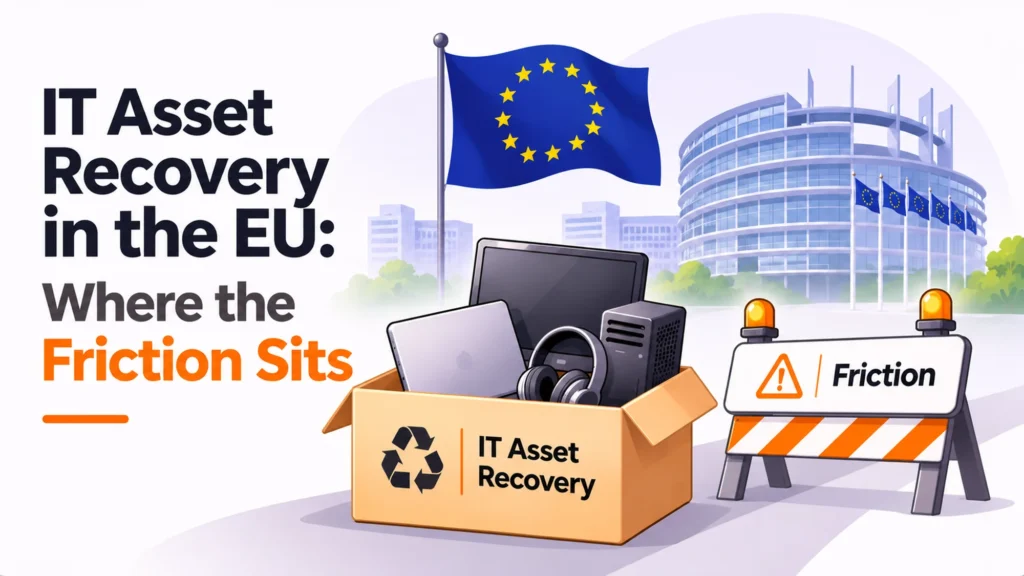
IT asset recovery in the EU gets quoted as if it were one market with one answer. It is 27 member states, and the suppliers who serve it price Europe as at least two regions. Ask any vendor to name the EU countries it can collect from and the list is usually much shorter than the claim. That gap is where the friction sits, and it is entirely findable before you sign anything.
- Europe is sold as one market and priced as two. Workwize defines EU and non-EU Europe as separate priced regions on its own page.
- The United Kingdom is not in the EU, and in most vendor region models it is not even in the same pricing region as Germany.
- Ask for named countries, not a claim. RemoAsset publishes five EU markets by name out of 27.
- Courier density varies sharply between western member states and parts of the east and south.
- Cross-border inside the bloc is not the same as domestic. Confirm specifics per route with your carrier.
- One consolidation point per region beats 27 arrangements, if you can store and redeploy from it.
IT asset recovery in the EU: one market, several prices
This article describes operational practice only. It does not state what any customs, tax or employment rule requires, because that differs by country and by circumstance. Take local advice, and confirm shipping specifics with your own carrier.
The single most useful thing you can know before a supplier call is that the vendors themselves do not treat Europe as one unit.
Workwize publishes its region definitions openly, and they list EU and Europe outside the EU as separate regions, alongside North America, APAC, MEA, LATAM and Other. Its entry tier covers three regions in total.
Read that carefully and the consequence is sharp. A company with people in Germany, the Netherlands and the United Kingdom is using two European regions out of the three it has, before it has hired anywhere else in the world.
That is not a quirk of one vendor. It reflects something real: the operational difference between moving a device inside the bloc and moving one across its external border is large enough that suppliers price it separately.
So when a page says European coverage, the question is which Europe, and the follow-up is which countries.
Make them name the countries
Coverage claims in this category are almost always country counts. Counts hide the shape.
Take our own product as the worked example, because it is the one we can quote without complaint. RemoAsset’s retrieval section names ten markets: the United States, Canada, Mexico, Brazil, the United Kingdom, Germany, the Netherlands, France, Ireland and Sweden. Of those, five are EU member states. The United Kingdom is not one.
Twenty-seven member states exist. Five are named. That is a perfectly reasonable commercial position and it is not what a reader takes from a headline figure.
We are using our own numbers here deliberately. The point generalises: ask every supplier on your shortlist for the named list rather than the count, and ask it about retrieval specifically rather than coverage in general, because procurement coverage is usually much wider than collection coverage.
Then compare that list against where your people actually are, pulled from your HR system rather than from memory.
Where the friction actually sits
Four places, and the border is only one of them.
Courier density. High in the western member states and in the major cities everywhere. Thinner in parts of the east and south, and thinner again outside urban areas. Remote work has put people in all of those places.
Language. A collection involves instructions to a person who did not choose to receive them. A process that only works in English will have a lower success rate in several large member states, and nobody measures that because the failure looks like non-cooperation.
Entity presence. Whether you have a legal entity in a country changes who the counterparty is for a storage arrangement or a disposal certificate. It is a question for your advisers rather than one with a general answer.
Movement across the external border. Specifics vary by route and change over time, and the World Customs Organization is the body whose conventions underlie much of the framework. Confirm each route with your carrier rather than carrying an assumption from the last one.
Our guide to reading platform country coverage covers the claim-versus-reality gap in more detail.
Consolidation beats twenty-seven arrangements
The design that works at scale is simple and most companies arrive at it late.
One consolidation point per region, with storage and redeployment, rather than a separate collection and shipping decision per leaver.
Why it works here specifically: intra-bloc movement is operationally easier than crossing the external border, so a device collected in Portugal and stored in the Netherlands can be reissued to a joiner in Belgium without the harder movement ever happening.
What it needs is three things from a supplier. In-region storage, a published rate per device per month, and a redeployment process that does not require the device to come back to you first.
What it saves is two shipments per cycle and several weeks. Our laptop storage guide works through the arithmetic, and our note on DDP against DAP covers who carries which responsibility when a shipment does cross a border.
The alternative, which is a courier account and a spreadsheet per country, works at five people per market and stops working at twenty.
Choosing a supplier for this market
Disclosure: RemoAsset, named below, is owned by the same people who publish this site. Its published coverage and its limits are both stated. PeopleOpsHQ takes no vendor money and sells no placements.
Six questions. Ask all of them about retrieval rather than about coverage.
- Name the EU member states you can collect from. Not the count.
- Which of those are your own operation and which are a partner? A handoff is fine, and you should know.
- What languages do collection instructions go out in?
- Where is the storage, and what is the rate per device per month?
- Can you redeploy from storage to a new hire in another member state without the device returning to us?
- What erasure evidence comes back, and does it name the serial number?
That fifth question is the one that separates a logistics supplier from a courier with a dashboard.
RemoAsset publishes subscription pricing from 1,499 dollars a year, names five EU markets plus the United Kingdom in its retrieval list, and includes local storage with redeploy, recycle and resale pathways.
Where RemoAsset struggles. Five named EU markets is a long way short of the bloc, and its own pricing page is inconsistent about this: the retrieval section claims 25 plus markets while a plan card says 80 plus, which is the procurement figure rather than the collection one. It publishes no per device rate. Ask for the named list, exactly as we are telling you to ask every other supplier.
The decision table
| Situation | Scale | Setup | Primary pain | Recommended starting point |
|---|---|---|---|---|
| Two or three western member states | Under 100 | Courier accounts | Manageable, just manual | Run it yourself with sent packaging |
| People across six or more states | 100 plus | Per country arrangements | No single view or rate | One supplier, named country list |
| Germany plus the United Kingdom | Any | Assumed one region | Priced as two regions | Check the vendor region definition first |
| Hiring and leaving continuously | Any | Shipping each way | Two shipments per cycle | In-region storage and redeployment |
| Staff outside major cities | Any | Distributed addresses | Courier reach drops | Ask reach by region, plan longer |
| No entity in the country | Any | Remote hires only | Counterparty unclear | Take local advice before arranging storage |
What getting this wrong costs
The first cost is the coverage claim you believed. You sign on a country count, hire in Romania, and discover the named list stopped at five. That is a renegotiation from a weak position.
The second is the per-leaver shipment loop. Without in-region storage you move a device out and another one in, twice per cycle, for the life of the arrangement.
The third is the data position. NIST Special Publication 800-88 is the standard you will be asked about for erasure, and where hardware is finished the EPA list of certified electronics recyclers and the R2 standard for responsible recycling are what a disposal claim gets checked against. Ask which entity issues yours in each country.
The fourth sits underneath everything. Batteries move under rules and IATA guidance on shipping lithium batteries is what your carrier is working to, on every route inside and out of the bloc.
If you hired in two new member states next quarter, would your current supplier’s named list cover them?
Setting it up properly
Three steps, in order, and the first one takes an afternoon.
Pull every employee location from your HR system and group them by country. That list is the only specification that matters, and most supplier conversations happen without it.
Ask each shortlisted supplier for its named retrieval countries and compare the two lists directly. Anything that is not covered needs a named plan, not an assumption.
Then decide where your consolidation point sits, and price storage and redeployment there. A supplier with stated collection markets and chain of custody makes that comparison possible rather than theoretical.
Our first hire in a new market guide covers the same groundwork from the joiner side.
Read our international shipping guide, or our note on import duty.
Frequently asked questions
Is IT asset recovery in the EU one market or several?
Operationally it is several, and the suppliers say so themselves. Workwize publishes region definitions that list the EU and non-EU Europe as separate priced regions. A company with people in Germany, the Netherlands and the United Kingdom is therefore using two European regions rather than one. Treat European coverage as a claim to be unpacked, not as a single answer.
How many EU countries do suppliers actually collect from?
Fewer than their headline coverage suggests, and the only way to know is to ask for the named list. RemoAsset, which we own, publishes ten retrieval markets in total, of which five are EU member states, out of 27. That is a reasonable commercial position and it is not what a reader infers from a country count. Ask every supplier the same question about retrieval specifically.
Does the United Kingdom count as part of Europe for pricing?
Not usually in the way buyers expect. The United Kingdom is not an EU member state, and in the region models these vendors publish it generally falls into a non-EU Europe bucket priced separately from Germany or France. If your fleet spans both, confirm how your supplier counts it before you agree a tier, because that single definition can move you up the ladder.
What causes most failed collections inside the bloc?
The same thing as everywhere else, which is a stale address, followed by language. The address came from an HR record captured at hiring and people move when jobs end. Language matters more here than people allow for: collection instructions issued only in English have a lower success rate in several large member states, and the failure looks like non-cooperation rather than a process gap.
Should we consolidate storage in one country?
If you have meaningful headcount across several member states, usually yes. Moving a device between member states is operationally easier than crossing the external border, so a machine collected in Portugal and stored in the Netherlands can be reissued to a joiner in Belgium without the harder movement happening at all. You need in-region storage, a published monthly rate and redeployment that skips you.
What should we confirm about shipping a recovered device?
Confirm the specifics with your own carrier for each route rather than carrying an assumption from the last one, because they vary by route and change over time. Lithium batteries travel under rules your carrier works to. Where any customs or tax question arises, take local advice: this is not an area where a general article can give you a dependable answer.
What erasure evidence should we require per country?
A certificate naming the serial number and stating the standard the wipe was performed to, plus clarity on which entity issues it in each country. Ask whether erasure happens at collection, at a regional facility, or at a subcontractor, because the answer changes who you are relying on. For hardware that is genuinely finished, ask the same questions about the recycler.
PeopleOpsHQ publishes independent guidance for IT and People teams at remote and hybrid companies. We sell nothing and we take no vendor money.